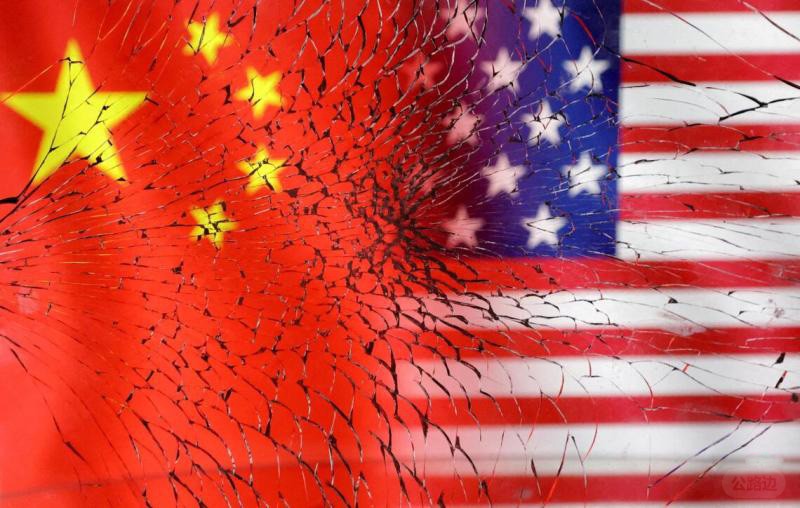
The wording on the Taiwan question in the U.S. National Security Strategy document released on December 5 is tougher than that in the National Security Strategy document issued during Trump's first term, according to Reuters. Under a new U.S. National Security Strategy, President Donald Trump aims to prevent conflicts with mainland China over Taiwan and the South China Sea by strengthening the military capabilities of the United States and its allies. As reported by Reuters, the Trump administration issued an official National Security Strategy document on Friday (December 5), which outlines the administration's approach to one of the world's most sensitive diplomatic issues: the Taiwan question. Beijing has been stepping up pressure on Taiwan and Japan, deploying a large number of naval and coast guard vessels in East Asian waters this week, with the number exceeding 100 at one point, marking the largest display of maritime military force to date. The U.S. National Security Strategy states that "deterring and preventing conflict over Taiwan, ideally through maintaining military advantages, is a priority." This is the first National Security Strategy document since Trump took office in January this year, serving as a vision statement regularly submitted by the U.S. government to Congress. Mainland China regards Taiwan as an inalienable part of China's territory, and Beijing has never abandoned the option of reunifying Taiwan by force. China also holds extensive regional claims, including sovereignty over almost the entire South China Sea, which are disputed with many smaller neighboring countries. The United States does not have formal diplomatic relations with Taiwan, but it is Taiwan's most important international supporter and is legally obligated to provide Taiwan with the resources needed for self-defense. Over the years, the Taiwan question has been a major friction point in China-U.S. relations. The wording on the Taiwan question in the latest U.S. National Security Strategy is tougher than that in the document released during Trump's first term. The 2017 National Security Strategy mentioned Taiwan only three times in a single sentence and adhered to long-standing U.S. diplomatic wording. In contrast, the new document references Taiwan eight times across three paragraphs and concludes that "heightened attention to Taiwan is justified" given its strategic location in busy trade waters and its dominant position in semiconductor manufacturing. The document states, "We will build a military capable of deterring any aggression along the island chain extending from Japan to Southeast Asia." "But U.S. forces cannot and should not bear this burden alone. Our allies must invest more funds—and more importantly, contribute more to collective defense." It adds that this will enhance the ability of "the United States and its allies to deter any attempt to seize Taiwan by force" or any other actions that "would make defending Taiwan impossible." Trump, a Republican, has largely avoided directly stating how he would respond to an escalation of tensions over Taiwan. His predecessor, Democrat Joe Biden, repeatedly stated during his 2021-2025 term that the United States would defend Taiwan if mainland China invaded. Trump is eager to strike deals and has sought to build closer ties with Chinese President Xi Jinping, raising concerns in the region that U.S. support for Taiwan and allies such as Japan and the Philippines may weaken. Trump plans to visit China next April, when the leaders of the two countries will discuss extending the trade war truce agreement. |

Complaint/Suggestion Contact
+email:3387918072@qq.com


Copyright © 2026 Gonglubian Copyright Powered by gonglubian 1.0





 WeChat
 douyin