When you think of names around the world, it’s fascinating how few can rival “Coca-Cola”—and Disney has an absolutely fantastic name too... The beauty of Mickey Mouse is that he doesn’t have an agent. I mean, Mickey Mouse is yours. Mickey won’t sit there renegotiating every week or month, saying things like, “Look how famous I’ve become in China,” or whatever else. If you own that mouse, you own him forever.
— Warren Buffett
Duan Yongping once briefly commented on Disney:
“Buffett says he’s a collector of great companies. I think Disney is precisely the kind of great company worth collecting. I love Disney’s products and admire the spirit of its performers. In my view, Disney is a truly collectible great company—but I’ve never fully understood its business model. I don’t get why Disney appears so powerful yet struggles to make real money.”
I’m still pondering the long-term sustainability of Pop Mart’s individual IPs and whether its platform model—balancing peaks and troughs across multiple IPs—can effectively mitigate risk. Generally, I don’t buy into a company when it’s at its peak; I prefer entering when it’s out of favor (it dropped another 8% yesterday). That’s why I spend time now thoroughly analyzing core issues—so when a “solvable problem” emerges, I’ll be ready to seize the opportunity to buy low.
A fellow investor in our group asked: “Do value investors really need to watch ‘the market’? Do they also need non-consensus views?”
Of course we must watch the market—but what Buffett and Duan criticize is being swayed by market sentiment. The real value of observing the market lies in understanding why a company is out of favor. In 2011, the market believed Apple would collapse without Jobs—but Duan disagreed and heavily bought in. In 2016, the market feared Apple’s revenue decline meant it would be overtaken by Android; its P/E ratio fell to just 13x. But Buffett saw otherwise and went all-in—eventually earning a 10x return, making it the most profitable investment in human history.
Risk comes from not knowing what you’re doing—or from failing to account for downside factors. If you’ve considered those risks and believe they’re either temporary or less severe than the market assumes, that’s when compelling investment opportunities arise. That’s the logic behind buying during sharp declines.
Last night, I watched Zootopia 2. Disney maintained its high standard: it elevated the original film’s herbivore-vs.-carnivore conflict into a more nuanced “mammal vs. reptile” marginalization dilemma, shifting the emotional core from individual ambition to partnership and psychological healing—themes far more resonant with today’s zeitgeist.
I’m not a film critic, so let me cut straight to China box office results:
Day 1: RMB 730 million
6 days: surpassed RMB 2 billion
12 days: reached RMB 3.02 billion
This clearly demonstrates the film’s success—especially impressive given that nine years have passed since the first installment.
Since the opening of Shanghai Disneyland’s Zootopia-themed land in December 2023, the park has seen significant performance boosts. In 2024, Shanghai Disneyland welcomed 14.7 million visitors, with a notably high proportion coming specifically because of the new Zootopia area.
Similarly, Hong Kong Disneyland had been unprofitable since 2015—until the launch of its newly expanded “World of Frozen” land in November 2023 (my daughter’s absolute favorite). In the fiscal year ending September 28, 2024, Hong Kong Disneyland reported a net profit of HK$8.38 billion, a 54% year-over-year revenue increase to HK$8.8 billion, and a record-breaking 7.7 million admissions.
This is Disney’s business model in action: a fully integrated “Content → Platform → Experience → Consumption” ecosystem.
1. Create IPs through films and shows.
2. Amplify reach via streaming (Disney+, Hulu) and traditional TV.
3. Deliver immersive experiences through theme parks, resorts, and cruises.
4. Monetize broadly through consumer products and IP licensing.
In short: maximize the monetization potential of each IP—“one fish, many dishes.”
Disney’s approach to sustaining IP relevance is also clearer than Pop Mart’s: it releases new films on 5–10 year cycles. I now understand Disney’s model quite well—it’s just complex and diversified.
This highlights the fundamental difference between how Disney and Pop Mart create and sustain IPs: Story-Driven vs. Image-Driven.
1. Disney builds story-driven IPs with rich world-building, compelling narratives, and vivid character arcs. These are developed internally by teams like Pixar and Marvel Studios. Production cycles are long—5 to 10 years per film—with budgets often exceeding hundreds of millions of dollars. But the payoff is longevity: Mickey Mouse remains beloved after 90+ years; Zootopia thrives a decade later; Pirates of the Caribbean endures after 20.
2. Pop Mart relies on image-driven IPs, lacking explicit storylines. Appeal stems primarily from visual design and the emotions it evokes. It signs external independent artists and uses a “horse-race” system—launching multiple IPs simultaneously. Development cycles are short: 5–12 months per series, costing ~RMB 1 million. However, IP lifespans are typically only 3–5 years, requiring constant new launches to maintain momentum. Exceptions exist—LABUBU and Molly have both lasted over 10 years.
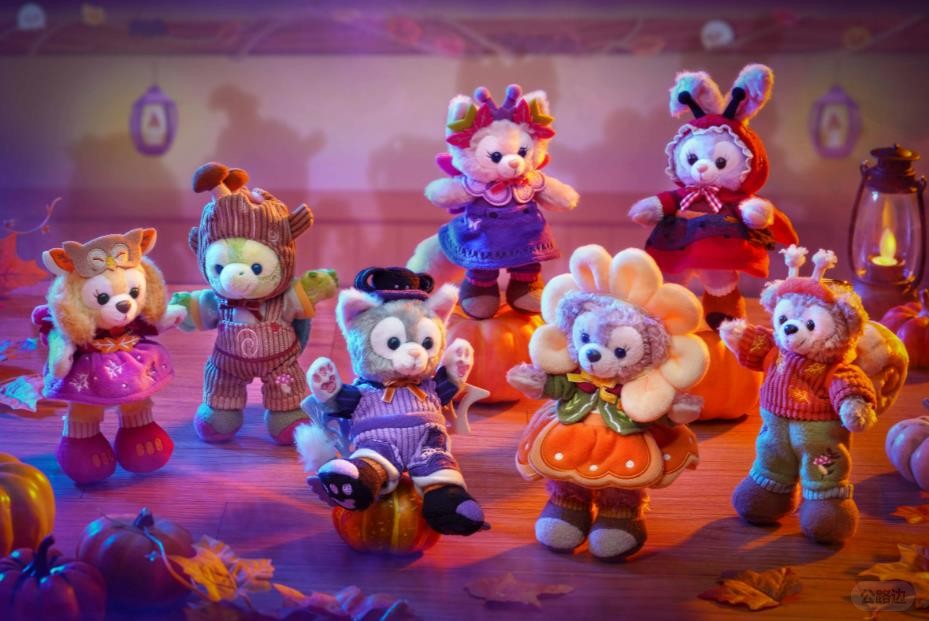
Disney’s IP monetization cycle is long, and creating new IPs is extremely difficult. Frozen debuted in 2013, Zootopia in 2016. LinaBell (2021) was an anomaly—lacking a film narrative, it followed Pop Mart’s playbook instead.
Disney’s path—“make movies → license rights → build parks → sell merchandise”—is capital-intensive, slow, and heavy. Annual depreciation from its parks alone exceeds $5.3 billion.
Unsurprisingly, Disney shareholders have been frustrated over the past decade: the stock has actually declined 6% over 10 years. Add to that persistent financing for acquisitions, high interest expenses, and minimal dividend yields.
Contrary to popular belief, Disney’s most profitable segment isn’t IP licensing (like Pop Mart)—it’s theme parks (or streaming, which Disney has aggressively pushed as its new strategic pillar).
Per Disney’s FY2024 and FY2025 reports:
Entertainment (linear TV, DTC streaming, studios): ~45% of revenue
Experiences (parks, cruises, resorts, merchandise): ~37%
Sports (ESPN): ~19%
Within Experiences:
Park tickets: 30%
Hotel stays: 28%
Food & beverage: 24%
Merchandise & licensing: 18%
Thus, merchandise/IP sales account for only 37% × 18% = 6.66% of Disney’s total revenue—versus 95% for Pop Mart. Though both operate in the IP space, they’re selling fundamentally different things.
When Pop Mart was still obscure, founder Wang Ning dreamed of becoming the “Disney of the East.” Now he realizes the world doesn’t need an “Eastern Costco” or “Eastern Disney”—Costco and Disney have already come to the East themselves. Copying them offers little competitive edge or social value.
Pop Mart is a new species altogether. From a pure business model perspective: if Pop Mart’s individual IPs prove sustainably long-lived, then its efficiency in IP creation and direct monetization through collectibles could be 10x faster than Disney’s movie-and-park model.
Let’s be clear: film is a terrible business. I’ve never seen anyone consistently make big money from long-term film investments. It’s cyclical—hit movies bring profits for a few years; flops wipe them out. Look at the long-term financials of Huayi Brothers or Enlight Media—you’ll see this pattern clearly.
Film requires upfront capital, often financed with debt (hurting cash flow). Only blockbusters yield outsized returns—and success hinges entirely on individual projects, with no compounding effect. It’s essentially venture investing. Even successful franchises rarely exceed 5 sequels; most run out of steam by the third.
That’s precisely why standalone animation studios often sell to Disney or Netflix.
Disney recognized this early and deeply integrated filmmaking with theme parks. Pirates of the Caribbean hasn’t had a new film in years—yet you’ll still pay RMB 500 to ride its attraction at Disneyland. What we truly love are the rides and experiences; the IP is the cherry on top. Parks give consumers a reason to return repeatedly, maximizing IP value—even without new films. Great films get rewatched, but their cultural heat fades; once embedded as national symbols, however, IPs live forever.
This is why Disney’s business is far more stable than Pop Mart’s:
FY2023 Experiences revenue: $32.5B, operating profit: $8.9B
FY2024: $34.1B / $9.2B
FY2025 (est.): $36.1B / $9.9B
→ Operating margin: 27%
Once built, Disney parks become city landmarks—Orlando, Anaheim, Paris, Hong Kong, Tokyo, Shanghai. Their massive capex creates high barriers to entry: no competitor dares open a rival park in the same city. Universal chose Beijing precisely because Disney wasn’t there.
Disney’s growth path is limited to two options: keep making movies and building parks—or compete in streaming like Netflix. But streaming favors pure internet players; it’s not Disney’s natural strength.
Disney is strong—but growth is hard. At a 15x P/E, it’s not expensive.
Pop Mart, meanwhile, boasts higher capital efficiency: lower IP creation costs, faster iteration, and direct global monetization of standardized products—much like Coca-Cola—with gross margins around 70%.
However, all these advantages hinge on two assumptions:
1. The long-term sustainability of individual Pop Mart IPs, or
2. Pop Mart’s ability—as an IP platform—to continuously launch new hits that offset the decline of older ones (“peak-shaving and valley-filling”).
Only if one (or both) holds true can Pop Mart’s model truly outperform.
|
 Fear of God ESSENTIALS Hoodie Review: Mi86 人气#fashion
 The Derby of San Francisco Style 300 Cha112 人气#fashion
 Why the Derby of San Francisco Classic S130 人气#fashion
 Romaoss Launches "Rebirth Plan," in Talk70 人气#tech



 WeChat
 douyin