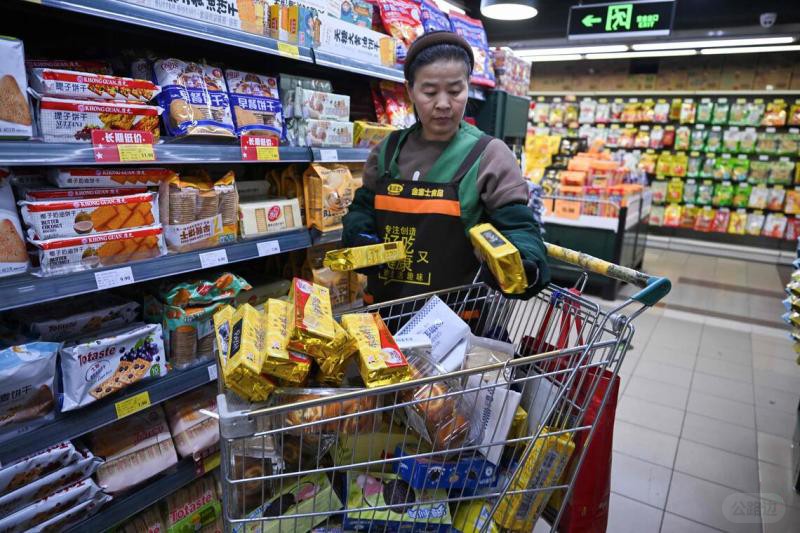
The International Monetary Fund (IMF) projected that China's economy will grow by 5.0% and 4.5% in 2025 and 2026 respectively. The photo shows an employee arranging goods at a supermarket in Beijing on Wednesday (December 10).
The IMF raised its forecast for China’s 2025 economic growth rate to 5%, an upward revision of 0.2 percentage points from its October projection.
According to a report released by the IMF on its official website on Wednesday (December 10), the Fund projected that China's economy will expand by 5.0% in 2025 and 4.5% in 2026.
The IMF stated that compared with its October World Economic Outlook, the above projections have been revised upward by 0.2 and 0.3 percentage points respectively. This is mainly attributable to the macroeconomic stimulus measures adopted by the authorities and the lower-than-expected tariff burden on China’s exports.
However, the IMF also pointed out that while the economy has demonstrated resilience, imbalances remain significant amid weak domestic demand and deflationary pressures. China’s inflation level is relatively low compared with that of its trading partners, which has led to real exchange rate depreciation, thereby fueling robust exports and a widening current account surplus.
The IMF argued that the key policy priority is to advance the transition toward a consumption-driven growth model. To achieve this shift, the authorities need to more urgently adopt stronger expansionary macroeconomic policies, implement reforms to reduce elevated household savings, and scale back unnecessary industrial policy support and inefficient investment. Such a policy package will also mitigate external imbalances.
In addition, to address mounting risks and sustain sound medium-term growth, the IMF recommended that the authorities carry out fiscal and financial framework reforms; clean up the balance sheets of the general government, real estate, and financial sectors; and advance market-oriented reforms, including opening up the services sector and promoting competitive neutrality among enterprises.
|