Despite the Chinese government’s continued intensified efforts to curb "involutionary" competition across industries, factory-gate deflation in November worsened again after three consecutive months of improvement. However, the slight pickup in consumer price growth indicated a moderation of the deflationary pressure.
China’s National Bureau of Statistics (NBS) released November’s data for the Consumer Price Index (CPI) and the Producer Price Index (PPI) on Wednesday, December 10. The CPI rose by 0.7% year-on-year in November, in line with market expectations. The growth rate expanded by 0.5 percentage points from October, marking the highest level since March 2024.
The core CPI, which excludes food and energy prices, climbed 1.2% year-on-year, unchanged from October and staying above the 1% threshold for three consecutive months. Gold jewelry prices maintained their strong momentum, surging by 58.4%—an 8.1 percentage point increase from the previous month.
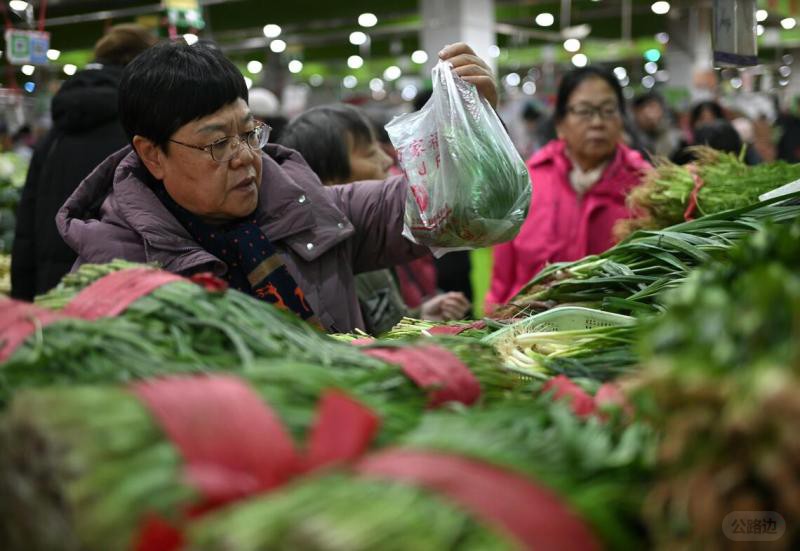
Interpreting the data, Dong Lijuan, Chief Statistician of the Urban Survey Department at the NBS, stated that the expanded year-on-year growth of the CPI in November was mainly driven by the shift of food prices from decline to increase. Specifically, the price of fresh vegetables reversed from a 7.3% drop in October to a 14.5% rise, marking the first upturn after nine consecutive months of decline; the price of fresh fruits turned from a 2% decrease in October to a 0.7% increase; the prices of beef and mutton went up by 6.2% and 3.7% respectively, with both growth rates accelerating.
In an interview, Chen Bo, Senior Research Fellow at the East Asian Institute of the National University of Singapore, pointed out that it may not be a positive sign that CPI growth is primarily driven by food prices. He commented, "It would be more desirable if CPI growth were led by manufacturing prices, as that would indicate optimized production capacity alongside strengthened market demand."
A report by China Chengxin Credit Rating highlighted that the prolonged downturn in the property market, persistent shrinkage of household wealth, and weak consumer confidence mean there is little likelihood of a sharp rise in price levels in the coming period, and the trend of low prices will persist. Additionally, escalating volatility in the external environment and the significant decline in international crude oil prices will also exert downward pressure on the CPI.
Xu Tianchen, Senior Analyst at the Economist Intelligence Unit, projected a modest rebound in China’s prices next year. He said, "Fiscal stimulus policies will remain robust in 2025, with a deficit ratio likely to stay around this year’s level, which should support a moderate pickup in price levels."
On the other hand, the PPI, which measures the factory-gate costs of goods, resumed its long-term downward trend in November after three months of consecutive improvement, falling by 2.2% year-on-year and extending its decline to the 38th consecutive month. A drop in the PPI implies narrowing profit margins for enterprises.
Chen Bo analyzed that the prolonged PPI decline reflects that the overcapacity issue in China’s manufacturing sector remains severe and has not been fundamentally resolved, adding that "the government still faces a long and arduous task in its efforts to tackle overcapacity."
China’s factory-gate deflation has persisted for three years. Despite the authorities’ stepped-up measures to curb industrial overcapacity and calls for key industries to reduce cut-throat competition, enterprises have been forced to slash prices to survive.
Xu Tianchen argued that countering involution entails controlling production capacity and investment. Currently, investment is on a downward trajectory; only when supply and demand reach a balance will industrial product prices be driven upward. "This process will be fraught with challenges and take time. November saw no notable improvement, and it will still be a while before anti-involution policies translate into a positive PPI reading."
China Chengxin Credit Rating concluded that insufficient demand will continue to constrain the upward potential of industrial product prices in the near term, while the external economic and trade environment will exert new downward pressure on these prices. As such, anti-involution measures are unlikely to fundamentally reverse this trend.
|

 Fear of God ESSENTIALS Hoodie Review: Mi86 人气#fashion
 The Derby of San Francisco Style 300 Cha113 人气#fashion
 Why the Derby of San Francisco Classic S131 人气#fashion
 Romaoss Launches "Rebirth Plan," in Talk70 人气#tech



 WeChat
 douyin