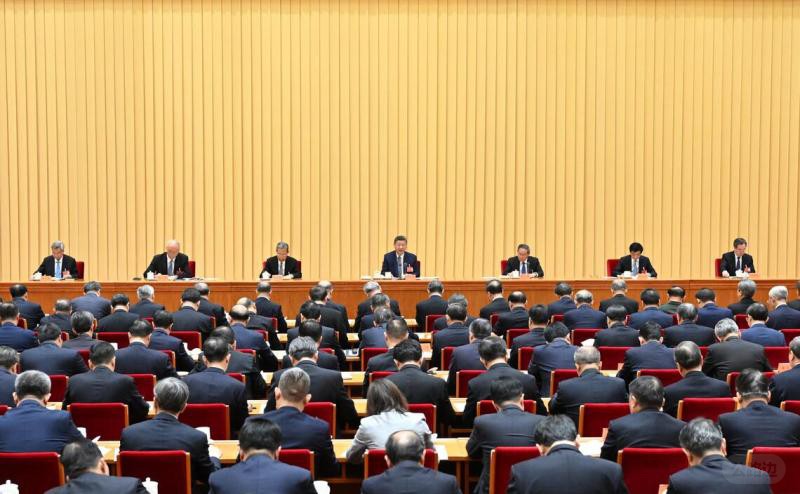
The two-day Central Economic Work Conference concluded in Beijing on Thursday, December 11. In addition to all members of the Standing Committee of the Political Bureau of the Chinese Communist Party (CCP) Central Committee, attendees included other Political Bureau members, Secretariat members, vice chairmen of the Central Military Commission, and relevant leaders from the Standing Committee of the National People's Congress. Notably absent from CCTV’s news broadcast footage was Ma Xingrui, a Political Bureau member who stepped down as Party secretary of Xinjiang Uygur Autonomous Region in July.
Facing weak domestic consumption and external uncertainties, China’s top leadership has set the tone for next year: maintaining “necessary fiscal deficits, total debt levels, and overall expenditure” to further support stimulus measures aimed at boosting domestic consumption and investment and sustaining economic growth momentum.
The CCP leadership also listed domestic demand-led growth and innovation-driven development as the top two priorities for next year’s economic agenda, underscoring strategic emphasis on revitalizing consumption and advancing technological industries. Tasks related to stabilizing the property market and resolving local government debt—previously higher on the agenda—have been deprioritized compared to last year.
Scholars interviewed by Lianhe Zaobao noted that the lower priority given to risk containment reflects concerns that an excessive focus on deleveraging could dampen investment. Given uncertain external demand and insufficient domestic demand, they argue, investment must step in to drive growth. Another scholar observed that this year’s emphasis on domestic demand is more proactive than last year’s, explicitly linking consumption with income growth and aiming to “fundamentally remove barriers to boosting consumption.”
The Central Economic Work Conference, held over two days, wrapped up in Beijing on Thursday, December 11. General Secretary Xi Jinping presided over the meeting and delivered a speech analyzing the current economic situation and outlining next year’s economic priorities.
According to Xinhua News Agency, the conference stated that “major socioeconomic development targets for this year will be successfully achieved,” implying that the annual GDP growth target of around 5% is likely to be met.
Assessing the current economic landscape, the conference noted that “the impact of changing external conditions is deepening, domestic supply outstrips demand, and key sectors face multiple risk factors,” highlighting trade tensions and sluggish domestic demand as China’s main economic challenges.
Next year marks the start of China’s “Fifteenth Five-Year Plan” (2026–2030). The conference stressed the need to better coordinate domestic economic efforts with international trade competition, balance development and security, continuously expand domestic demand, optimize supply, and focus on stabilizing employment, enterprises, markets, and expectations.
In terms of policy direction, the conference called for strengthening both counter-cyclical and cross-cycle macroeconomic adjustments; continuing a more proactive fiscal policy; maintaining necessary fiscal deficits, total debt levels, and overall expenditure; addressing local fiscal difficulties; sustaining a moderately accommodative monetary policy; prioritizing stable economic growth and a reasonable rebound in prices through flexible use of tools such as reserve requirement ratio (RRR) cuts and interest rate reductions; and ensuring the renminbi exchange rate remains basically stable at a reasonable and balanced level.
The conference outlined eight key tasks for next year’s economic work:
Domestic demand-led growth
Innovation-driven development
Deepening reform
Opening-up
Coordinated regional development
“Dual carbon” goals (carbon peak and carbon neutrality)
People’s livelihoods as a top priority
Safeguarding bottom-line risks
Shen Hong, Director and Research Fellow at the Domestic Think Tank Department of the Institute of New Structural Economics at Peking University, pointed out that boosting domestic demand is not only listed as the top priority but also includes specific measures such as “formulating and implementing an income growth plan for urban and rural residents” and “eliminating unreasonable restrictions in the consumption sector.” These formulations are more proactive than last year’s, indicating that “consumption is merely an outcome—raising incomes is fundamental.”
Shen also noted that, compared to last year, this year’s official language describing the economic situation conveys less urgency, possibly because China has weathered trade tensions over the past year. Nevertheless, he believes the leadership’s policy articulation remains comprehensive and robust.
Hsieh Dong Ming, Head of Asia Research and Strategy at OCBC Bank in Singapore, said China’s economic focus next year will remain on promoting growth, as the government seeks a strong start to the Fifteenth Five-Year Plan period.
Hsieh explained that in recent years, China’s economy has relied more on external demand, while investment has played a weaker role. Risk containment now ranks last among the eight priorities because an overemphasis on deleveraging would inevitably hurt investment. Yet, with external demand unpredictable and domestic demand still insufficient, investment must fill the gap to drive growth.
Under proactive fiscal and accommodative monetary policies, Shen Hong forecasts that if the property market stabilizes and stops declining, China’s economic growth next year could range between 5% and 5.5%, with the fiscal deficit exceeding this year’s projected 4%. Hsieh Dong Ming, however, expects growth to remain around 5%, with the fiscal deficit staying near 4%.
Xinhua reported that, in addition to all members of the Political Bureau Standing Committee, attendees at the Central Economic Work Conference included Political Bureau members, Secretariat members, vice chairmen of the Central Military Commission, and relevant NPC Standing Committee leaders.
However, Ma Xingrui, the Political Bureau member who stepped down as Xinjiang Party chief in July, did not appear in CCTV’s news coverage—a second absence from high-level meetings within two weeks, following his non-appearance at a Political Bureau group study session on November 28.
|

 Fear of God ESSENTIALS Hoodie Review: Mi86 人气#fashion
 The Derby of San Francisco Style 300 Cha114 人气#fashion
 Why the Derby of San Francisco Classic S131 人气#fashion
 Romaoss Launches "Rebirth Plan," in Talk70 人气#tech



 WeChat
 douyin