The days of unbridled growth for Russia's cross-border e-commerce are gone for good.
Since the outbreak of the Russia-Ukraine conflict in 2022, under the dual pressures of the war and sanctions, a large number of European and American brands have been forced to withdraw en masse, leaving a huge supply-demand gap in the Russian market. Given Russia’s weak light industry base, which makes it heavily reliant on imports for consumer goods, Chinese sellers with their robust supply chain advantages have flocked in, emerging as the core force supporting local consumption.
There was even a saying in the industry: "Pay off all debts in one year, buy a car and a house in three years." As long as Chinese cross-border merchants dared to enter the Russian market, they could make substantial profits.
Today, however, despite the unchanged external environment, the dividend window period for Chinese cross-border e-commerce is closing at a visible pace.
In October this year, the Russian Ministry of Finance released a tax code amendment, planning to impose value-added tax (VAT) on cross-border small parcels starting from 2027, and gradually phase out the current tax exemption policy for parcels valued below 200 euros. In addition, the "gray customs clearance" model, where goods are cleared through Kazakhstan or Belarus before being transshipped into Russia, will be fully rectified.
The transformation of Russia’s e-commerce market toward standardized competition is inevitable. In this context, how should platforms and sellers respond?
In an interview with Jiemian News on December 11, Huang Xiao, President of Ozon Greater China, a leading Russian e-commerce platform, stated, "This will deal a significant blow to sellers adopting a wide-product SKU strategy, but the impact on those truly rooted in local operations and brand building will be limited." The gradual elimination of tax exemptions on small parcels is an irreversible trend in global markets including Russia, which will also force enterprises to optimize their brands and supply chains, helping enhance their long-term competitiveness.
Drawing a parallel with Amazon’s FBA sellers, Huang Xiao explained, "Even if the tax exemption on small parcels is canceled, it will have little impact on brand sellers. On the contrary, the reduction of low-price competition may even be conducive to brand building."
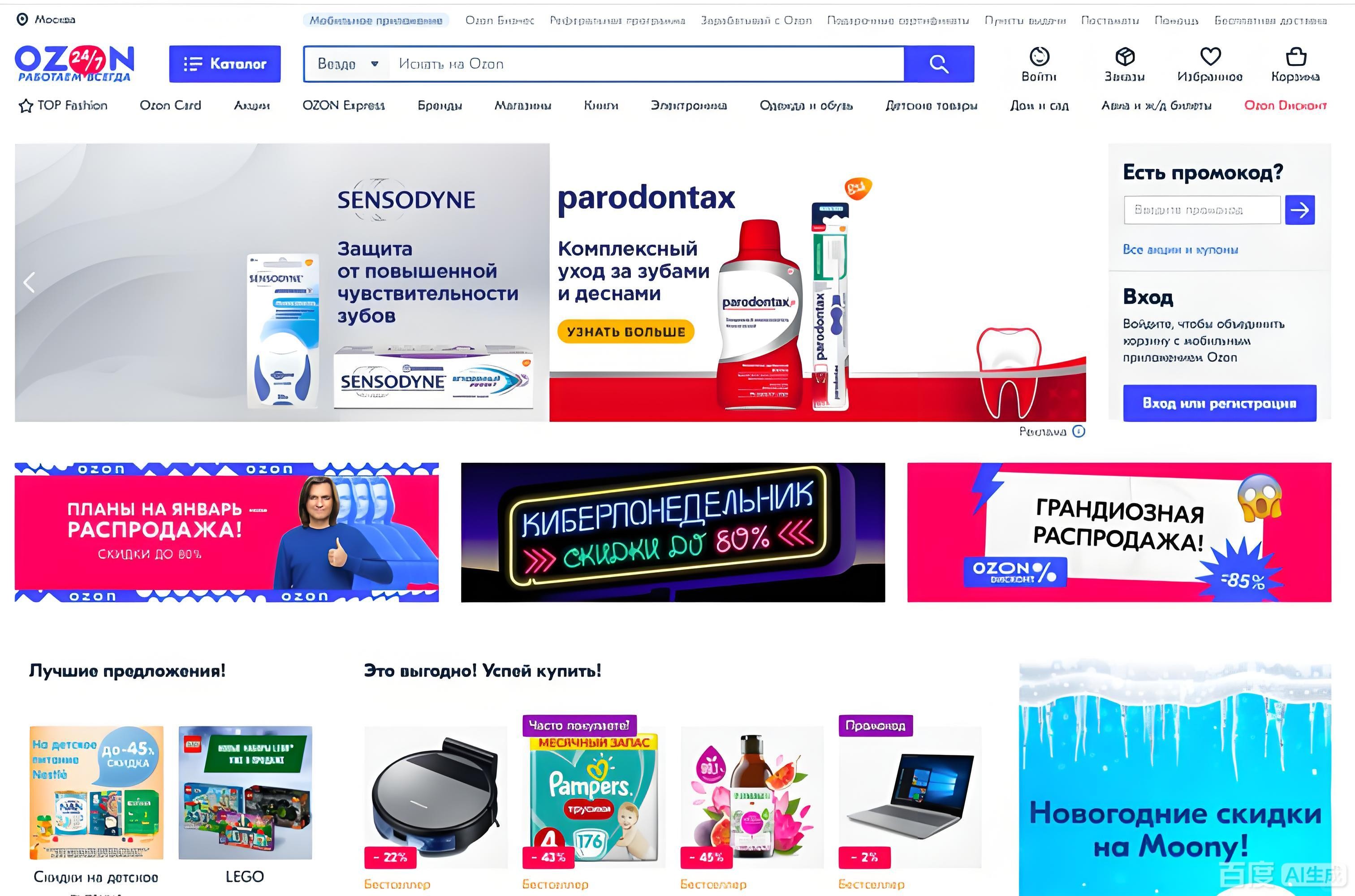
Against the backdrop of the collective absence of Western brands, Russia’s local e-commerce platforms such as Ozon and Wildberries (hereinafter referred to as WB) have experienced explosive growth in recent years. Ozon’s GMV surged from $2.8 billion in 2020 to $31.2 billion in 2024. Behind this growth, "Made in China" products—ranging from small commodities from Yiwu to digital products from Shenzhen—have played an indispensable role, accounting for the lion’s share of the country’s cross-border e-commerce transactions.
The market scale has also expanded in tandem. According to the statistical report released by the Association of Internet Trade Companies (AITC) of Russia, the size of Russia’s e-commerce market reached 9 trillion rubles (approximately $100 billion) in 2024, registering a year-on-year growth rate of as high as 41%. Entering 2025, the growth momentum shows no signs of slowing down, with transaction volume exceeding 5.3 trillion rubles in the first half of the year alone.
With a Russian-speaking population of over 200 million, an internet penetration rate of 90%, and rapidly maturing e-commerce shopping habits, the market still looks highly attractive. However, beneath the surface prosperity, the driving force of industry growth is undergoing a shift. In the early days, consumers were primarily focused on solving the problem of product availability; now, they equally care about delivery speed, product quality, and value for money.
Russia’s vast territory with sparse population has shaped its unique e-commerce ecosystem. Jiemian News learned that local users are accustomed to picking up their purchases at collection points and trying products before making payments. This makes the density of logistics networks and self-pickup points far more crucial than mere express delivery speed.
It is expected that by 2027, Russia’s e-commerce penetration rate will reach the level of mature markets, and the era of refined competition in the stock market will officially begin. The maturation of the market is first reflected in the intensifying competition among platforms. WB, which started as a women’s clothing platform, has captured nearly half of the local market share by leveraging its ultra-low-price strategy and nationwide self-pickup network to cater to price-sensitive consumers who value physical product experience.
The established platform Ozon, on the other hand, has chosen a heavy-asset path similar to Amazon or JD.com, adhering to a "self-operated + third-party platform" model and continuously investing in building its own logistics infrastructure, forming a "dual-polarization pattern" with WB. In addition, Yandex, backed by Russia’s equivalent of Google, has also secured a foothold in the local market by leveraging its advantages in search engines and advertising ecosystems.
A local Russian user told Jiemian News that consumer demand in Russia is becoming increasingly diversified. The per capita consumption level in first-tier cities such as Moscow and St. Petersburg is close to that of Shanghai, where branded products are more popular. However, users in second and third-tier cities are more inclined to consider cost-effective goods, such as small commodities from Chinese industrial belts like Yiwu.
Therefore, an obvious trend has emerged: competing for Chinese sellers has become a new front in the battle among Russian e-commerce platforms. Jiemian News observed that in 2025, several major Russian local e-commerce platforms have accelerated their efforts to expand their pool of Chinese suppliers, rolling out incentives such as green channel access, logistics subsidies, and traffic support.
Huang Xiao revealed that the number of active Chinese sellers on Ozon has exceeded 200,000, and the GMV generated by Chinese sellers surged by more than 250% year-on-year in 2025. In April 2025, WB announced the full opening of its merchant recruitment in the Chinese market, while the Yandex Market platform also planned to recruit 50,000 new cross-border sellers from China in 2025.
In the era of compliance, whoever can attract and retain more Chinese sellers capable of providing stable, high-quality, and brand-oriented products may gain a competitive edge in the next phase of development.
As platforms engage in fierce competition, Chinese sellers caught in the fray are facing both opportunities and higher barriers to entry. First and foremost, they cannot evade the challenges of compliance. In addition to the tax exemption policy changes, Huang Xiao disclosed that platform sales data is now shared with the State Taxation Service, making it increasingly unsustainable for sellers to adopt ambiguous practices such as "buying export invoices" that obscure their corporate identities. With compliance becoming a mandatory requirement, costs will undoubtedly rise.
Secondly, sellers must also make the leap from "selling goods" to "building brands." Huang Xiao pointed out that young Russian consumers, especially those in first-tier cities, are increasingly willing to pay for brand premiums. Currently, categories such as beauty and fashion, home goods, and mother and baby products are experiencing rapid growth on Ozon, with brand building emerging as a clear trend. However, establishing brand awareness from scratch in a foreign market is a high-threshold process that requires continuous investment and localized storytelling, placing far higher demands on sellers’ comprehensive capabilities than simple product sales.
Furthermore, logistics remains a core pain point. Jiemian News learned that the current pure cross-border direct shipping model to Russia takes as long as 15 to 30 days, and is highly susceptible to port congestion and policy changes, which seriously affect consumer experience and repurchase rates.
While platforms are investing in logistics infrastructure, it is almost inevitable for sellers to build or utilize overseas warehouses in the future. This means sellers need to pre-position inventory in Russia and manage overseas stock, which poses enormous challenges to their capital chains, sales forecasting, and supply chain resilience. In addition, Russian consumers’ habit of picking up goods at collection points and paying after trial requires sellers to adjust their product selection and quality control measures to adapt to local preferences.
Although the dividend period is over, Huang Xiao believes that Chinese brands still face an excellent environment for overseas expansion. Compliance, branding, and AI integration will be the core directions for the development of China-Russia cross-border e-commerce. He also acknowledged that the main challenges currently facing platforms include keeping up the construction of logistics infrastructure with the explosive growth of e-commerce, and enhancing sellers’ awareness of cross-border compliance.
It is conceivable that in the future, competition centered on product features, specifications, and iterative upgrades will also unfold in the Russian market. Chinese sellers lacking core capabilities may soon be eliminated. Whether they can overcome the three major hurdles of compliance, branding, and logistics will determine their ability to continue "prospering" in Russia.
|

 Fear of God ESSENTIALS Hoodie Review: Mi86 人气#fashion
 The Derby of San Francisco Style 300 Cha113 人气#fashion
 Why the Derby of San Francisco Classic S131 人气#fashion
 Romaoss Launches "Rebirth Plan," in Talk70 人气#tech




 WeChat
 douyin