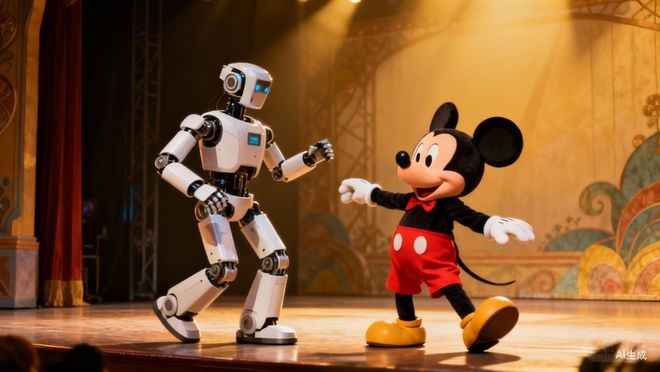
Mickey Mouse and Ultraman are really going to meet now.
According to The Information, on December 11th, Disney announced a $1 billion equity investment in OpenAI and signed a three-year strategic licensing cooperation agreement with it.
The agreement also includes: Sora, an AI video generation platform under OpenAI, will be authorized to generate short videos with Disney's IP as the theme based on user input prompts; Disney can utilize OpenAI's API to develop new products, tools, and immersive experiences, and deploy ChatGPT for employees to improve work efficiency.
Overall, this collaboration is not simply a financial investment, but a strategic move by Disney to deeply integrate OpenAI's generative AI capabilities.
According to the agreement arrangement, it is expected that from early 2026, OpenAI's Sora and ChatGPT Images image and video generation products will officially support many classic IP characters under Disney. Users can use character images from works such as Mickey Mouse, The Lion King, Cinderella, Toy Story, and Zootopia in their creations.
On the same day, Disney also issued a cease and desist notice to Google, accusing Google of "copying" Disney's copyrighted works on a large scale without authorization to train generative AI models, and possibly distributing "generated IP content" to consumers.
Google has neither confirmed nor denied Disney's allegations, only stating that it will communicate with Disney and emphasizing that the company uses open network public data to build AI and has also implemented copyright control (YouTube's Content ID).
So why did Disney invest $1 billion in OpenAI? What kind of competitive landscape will OpenAI face again?
1、 Disney and Ultraman, each taking what they need
For Disney, this $1 billion is like a 'protective investment'.
This investment not only gave Disney a minority stake and potential equity subscription rights in OpenAI, but more importantly, it bought three things: technology, channels, and rule making rights.
In terms of technological empowerment, Sora 2 has the opportunity to become Disney's "magic factory" for reshaping content production.
Disney's core competitiveness lies in its vast IP portfolio. From Snow White to Frozen, Disney has continuously expanded the boundaries of animated films through generations of technological innovations. Now, the emergence of Sora has opened up new possibilities for content production for Disney.
Sora 2, as a large model for cultural and biological videos launched by OpenAI, has made significant progress in its capabilities compared to Sora. It is currently capable of understanding complex natural language instructions and generating high-quality videos that conform to physical logic.
This means that future Disney animators can generate a high-quality preview video in just a few minutes by instructing Sora 2 to have Mickey Mouse fly a Star Wars X-wing fighter jet over Shanghai Disney Castle with dazzling fireworks in the background. This will effectively compress the cost and time of early creative exploration and production, allowing creators to devote more energy to core story ideas and polishing specific details.
The most important and iconic part of this transaction is undoubtedly allowing ordinary users to create using Disney's IP on Sora. This channel innovation marks Disney's transition from a closed IP owner to an open IP platform enabler.
In the past, fans' secondary creation of Disney IP was in a gray area for a long time, but now Disney is actively opening Pandora's Box. Users can have Iron Man and Princess Elsa chat together in Sora 2, and have Buzz Lightyear pilot the Millennium Falcon spacecraft. This open attitude of "official memes, the most deadly" will ignite the huge potential of user generated content (UGC).
In addition, Sora 2 also plans a feature called "Cameo" that allows users to implant their own image into AI generated videos and interact with their favorite characters.
These short videos created by users with strong personal colors will go viral through social networks and become the most vivid and widely used advertisements for Disney IP.
In this way, Disney's IP is no longer just a static asset lying in movies and parks, but has gained "cyber immortality" in the world of AI, constantly being reinterpreted, disseminated, and loved. This not only consolidates the vitality of existing IPs, but also provides a new path for the incubation and promotion of new IPs in the future.
The most crucial thing is that Disney has started to participate in AI rule making through copyright high ground.
The cooperation agreement between Disney and OpenAI clearly stipulates that the authorization does not include the appearance of any actor's portrait or voice character in the form of animation or illustration. This is not only a protection of creators' rights, but also a cautious exploration of the ethical and legal boundaries of AI.
By becoming Sora's first major content licensing partner, Disney has actually gained a first mover advantage in defining copyright usage rules for the AI era. OpenAI also plans to introduce refined copyright control options and revenue sharing models, allowing copyright holders to independently decide how their IP will be used in Sora.
Disney has successfully transformed itself from a potential "victim" to a "rule maker" by choosing to join and deeply collaborating, rather than simply "opting out" or watching like other Hollywood companies. At the same time, it provides a case study for the industry: the copyright issue of AI generated content cannot be solved, but can be regulated through commercial cooperation and technological means.
Once this model is implemented, Disney has opened up a new business model: IP authorization is no longer limited to traditional products and film adaptations, but has expanded to the field of AI generated services. In the future, any AI company that wants to legally use Disney's IP must follow the "Sora paradigm" jointly established by Disney and OpenAI, and pay corresponding licensing fees.
While reaching a deep cooperation with OpenAI, Disney also helped Ultraman "stab" his biggest competitor Google.
Disney's lawsuit against Google has squeezed the gray space of its copyright, objectively playing the role of "surrounding Wei and saving Zhao".
Against the backdrop of the gradual convergence of general big model technologies, high-quality and exclusive training data is becoming the core competitiveness of AI companies.
Through an exclusive partnership with Disney, OpenAI's Sora can move closer to a legitimate AI video platform that generates top-level IP content on a large scale. When users want to create a short video about "Iron Man vs. Thanos", Sora is their safe choice.
By leveraging Sora's powerful traffic effect, more users will flock to the Sora platform due to Disney IP, and their UGC content will bring in more clicks, providing OpenAI with user data and model iteration nourishment.
Google's AI, even though equally powerful in technology, will fall behind Sora in terms of the richness and attractiveness of its content ecosystem, thus slowing down Google's pace in the field of generative AI and buying valuable development time for OpenAI.
Ultraman cleverly transformed a copyright issue that could have choked his own throat into a sharp sword that could grab his opponent's neck. This move of "borrowing a knife to kill" is truly ingenious.
2、 After being pulled down from the pedestal of technology, OpenAI also has to fight "trench warfare"
However, although OpenAI has secured investment and authorization from Disney, adding significant weight to its layout in the fields of content generation and entertainment, its recent days have not been easy.
And all of this starts with Google's latest model, Gemini-3.
As Google's latest generation base model, Gemini 3 has achieved comprehensive suppression of GPT-5.1, demonstrating astonishing "generation gap" leadership in multimodal understanding and complex task processing.
If the past AI was just "reading by looking at pictures", then Gemini 3 truly has "sharp eyes".
Gemini 3 not only recognizes what is in the picture, but also fully understands the complex relationships between images, videos, and sounds. In the video comprehension test, Gemini 3 scored far ahead, achieving a leap from "understanding" to "understanding correlation", undoubtedly bringing a revolution to the fields of content generation and professional analysis.
What is even more powerful is its versatility in handling complex tasks. Gemini 3 has an extremely long contextual memory capability, which can "digest" information equivalent to an entire academic paper at once, while maintaining an astonishing information retention rate. This also allows it to demonstrate abilities far beyond similar models in real tasks.
This comprehensive and extremely obvious technological leadership caught OpenAI off guard.
Brian Collello, Senior Strategist of Technology Stocks at Morningstar, said, "People increasingly believe that Alphabet (Google's parent company) has all the conditions to become a leader in the field of artificial intelligence model building. Just a few months ago, investors would have awarded this title to OpenAI. But now the situation is even more uncertain, the competition is more intense, and there is a greater risk of OpenAI ultimately winning. ”
In response to the impact of Google, CEO Ultraman announced that the company has entered a "red code" state and is fully committed to improving the quality of ChatGPT, thus delaying the development of other products.
The most obvious sacrifice among them is the temporary suspension of the key advertising monetization business rhythm.
According to OpenAI's latest SP release, advertising related business revenue is expected to reach $45 billion by 2030, accounting for over 20% of that year's revenue, making it one of OpenAI's most important future "cash cows". But under the strong impact of Gemini 3, its plan to test the use of millions of ChatGPT users' search behavior to advertise shopping has been suddenly halted, indicating the immense pressure.
In the capital market, companies that choose to side with OpenAI have also been cast with a vote of no trust by the market with real money.
As a strategic partner of OpenAI's cloud computing infrastructure and core services, Oracle's performance in the capital market in recent months has been like riding a roller coaster, fluctuating up and down.
During the third quarter of this year, Oracle signed a five-year, $300 billion cloud computing service contract with OpenAI. This huge cooperation order caused Oracle's stock price to soar nearly 40% overnight in a short period of time, and the market regarded it as the "shovel seller" of the AI era and highly praised it.
But as OpenAI's technology becomes increasingly outdated, the market is also beginning to worry about the prospects of this collaboration, believing that there are variables in the future of this huge order. As a result, Oracle's stock price nearly halved in just three months, fully reflecting the capital's pessimism towards OpenAI.
However, this is just the appetizer that OpenAI is facing. Currently, OpenAI is burdened with a series of astonishing computing power procurement or leasing orders, involving extremely large amounts and scales, including Nvidia AMD、 Billions of dollars in orders from upstream hardware giants such as Broadcom, as well as massive partnerships with cloud service providers such as Microsoft and AWS worth hundreds of billions of dollars.
The business logic behind such a huge investment in computing power is based on a series of assumptions, including sustained model leadership, smooth business implementation, and a successful commercialization path.
However, the core model capability is now being openly questioned, which is equivalent to directly shaking OpenAI's foundation. Once the technological advantage is lost, the trust crisis of the business model follows.
Against the backdrop of outdated models, OpenAI relies on a huge investment to establish a business "positive cycle". This model, which should have attracted users and revenue through leading models, and then continued to purchase computing power to develop models with revenue, has a very low probability of being successfully achieved.
However, the current competitive situation among top models is one of constant competition, constantly changing. It is currently unknown what kind of latest model OpenAI can produce after sounding the red alert.
But what can be confirmed is that OpenAI at the end of 2025 is completely different from the OpenAI that just exploded globally three years ago. Nowadays, it is undoubtedly more mature and larger, but the competition it faces is also more brutal and intense.
|
 Fear of God ESSENTIALS Hoodie Review: Mi83 人气#fashion
 The Derby of San Francisco Style 300 Cha108 人气#fashion
 Why the Derby of San Francisco Classic S127 人气#fashion
 Romaoss Launches "Rebirth Plan," in Talk65 人气#tech



 WeChat
 douyin