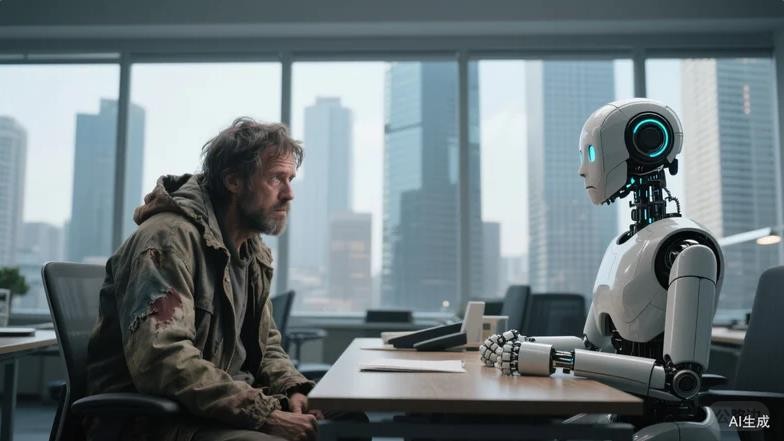
The AI wave, the haze of inflation, and the evolution of smart weapons—these are all major trends, and their overlap has become increasingly prominent on the battlefield of the Russia-Ukraine conflict, as well as within the political and social systems of Europe and the United States that provide backing to Ukraine.
The impact of AI technology is by no means confined to Europe and the United States. In countries that have already completed industrialization, as well as those still undergoing it or yet to embrace it, AI is eroding human jobs. This has led economic development to become largely decoupled from human participation, ultimately resulting in growing imbalances in distribution methods. The prevalence of AI and other advanced technologies has also exacerbated technological monopolies, fostering an unhealthy financial boom that inflates asset prices and drives up living costs. This explains why, despite the fact that a significant number of employed people are earning less than they did several years or a decade ago, living costs continue to spiral out of control.
On one hand, a considerable portion of the population struggles to find stable jobs with decent pay; on the other hand, businesses and employers report difficulties in recruiting workers who meet their requirements. These issues were once attributed to the quality of university education—and while universities certainly need reforms, during periods of high economic growth, businesses still hired graduates trained by universities, and sources of innovative value were also concentrated among graduates from universities, especially top-tier science and technology institutions. If university training models and standards have not undergone drastic changes, then the universities should not, at the very least, be the first to be blamed for the dual predicament of tough job markets and employer recruitment challenges.
The growth momentum unleashed by AI and other advanced technologies is becoming increasingly intertwined with inflation. These technologies have widened the divide in the labor market: salaries for high-value jobs are on the rise, while wages for basic positions have stagnated or even been shifted entirely to outsourced temporary roles overseas. Moreover, the R&D and application processes of advanced technologies extensively utilize user data assets and public infrastructure free of charge, yet the tax contributions of the related corporate giants pale in comparison to those of traditional industries. This has left governments with no choice but to print more money to cover fiscal deficits.
The iterative evolution of smart weapons driven by advanced technologies has not only fueled more brutal killings on the battlefields of Ukraine and the Israel-Hamas conflict but has also exacerbated fiscal distress and inflationary pressures worldwide. The United States has refused to shoulder the fiscal responsibility of supporting Ukraine in the Russia-Ukraine war and has pressured European countries to increase defense spending, artificially fostering prolonged antagonism between Europe and Russia. This has pushed the already strained finances of various nations to the brink and amplified inflationary pressures. To achieve economic growth, countries have no choice but to rely more heavily on the application and transformation of advanced technologies, yet this exerts even more destructive pressure on the balance of economic and social structures.
The newly published book AI, Inflation and Weapons: Facing a Perilous Future with Nobel Laureates compiles 20 expert interviews originally featured in Peking University Financial Review, sponsored by Peking University HSBC Business School and Peking University HSBC Financial Research Institute. The interviewees include six Nobel laureates in Economics, who examine the transformation of economics in the AI era and the historical predicaments of gender equality from a critical perspective. The book also features conversations with numerous experts, discussing the multifaceted challenges of adapting to super-aging societies and coping with high inflation, as well as exploring major issues such as debt crises, elite oversupply, and widespread societal burnout.
Notably, Richard Freeman, the Herbert Ascherman Professor of Economics at Harvard University and a long-time scholar of labor economics, addressed the issue of "machines replacing humans" and the erosion of jobs by AI applications. He pointed out that "whether the productivity and output gains brought by the automation of blue-collar and white-collar jobs can offset the employment losses caused by robots, and raise the incomes of workers and retirees, depends on who owns the robots, how much income the robots generate, and the tax rates on capital and labor incomes." If advanced robots and other cutting-edge technologies are monopolized by a small group of wealthy individuals, who then leverage their influence over legislation to maintain low capital gains tax rates, the future will be a grim one for the majority of people. In other words, the more widely distributed the ownership of robots, the greater the likelihood that automation will benefit everyone. Furthermore, imposing higher taxes on the ownership and use of digital assets would help fill the gaps in pension systems, compensating for the pension shortfalls caused by robot-induced unemployment.
French economist Philippe Aghion believes that economic systems conform to the principles of biological evolution. Unlike the Austrian School, which makes a priori assumptions about human nature; the Chicago School, which constantly emphasizes market efficiency; or Keynesian economists, who defend various forms of government regulation and tax hikes, Aghion argues that innovation is never easily achieved—it emerges with scars, grievances, and disdain, aiming to devalue, destroy, and dismantle the old order. Therefore, to ensure innovation vitality in an era of uncertainty, we must adhere to the principle of "gene-culture coevolution": encourage the spontaneous, unbridled competitiveness, destructiveness, and innovativeness rooted in our genes, while providing certain protections for losers and those left behind, preventing them from becoming destabilizing factors in the social ecosystem. Aghion contends that large-scale unemployment caused by robots is not the root of the problem; instead, the state should provide necessary support to the unemployed, thereby gaining societal tolerance for the existence and development of innovative forces.
In any case, AI technology will continue to evolve and find increasingly widespread applications, both now and in the future. Even the European Union, which has always maintained a high level of vigilance regarding the social and political impacts of technological applications, has had to scale back its regulatory scope in the face of practical pressures. The reason is simple: AI technology can deliver greater growth, and no major economy can afford to lose this race.
Yet more growth means more goods and services, which need to be sold to consumers whose jobs have been taken away by AI. This is the biggest joke of our time.
Another joke is that we are becoming increasingly accustomed to online shopping, visiting physical stores less frequently or even not at all—yet the majority of us can only find jobs offline. Because when it comes to online jobs, AI outperforms humans.
|

 Fear of God ESSENTIALS Hoodie Review: Mi83 人气#fashion
 The Derby of San Francisco Style 300 Cha108 人气#fashion
 Why the Derby of San Francisco Classic S127 人气#fashion
 Romaoss Launches "Rebirth Plan," in Talk65 人气#tech



 WeChat
 douyin