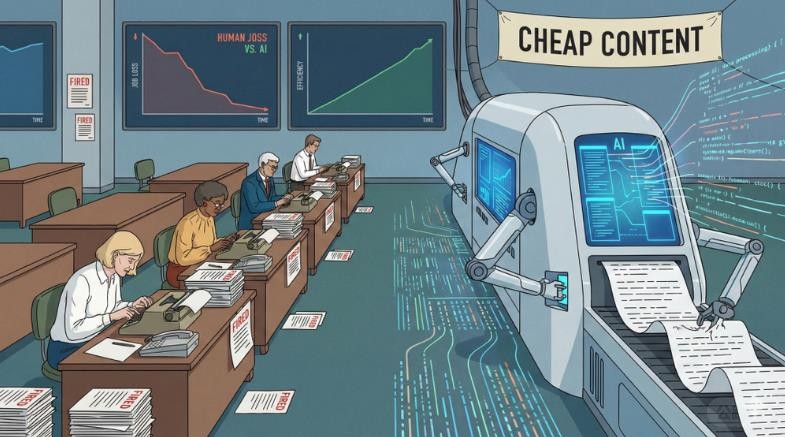
At the end of 2023, we were still worrying about whether AI would "steal our jobs." By the end of 2025, numerous industries have been decimated by AI—but perhaps no group has suffered more than copywriters, who can truly be called the first to be washed ashore by the AI tide.

Quietly, in this silent "massacre," AI has not only destroyed copywriters’ incomes but also their professional dignity, self-identity, and even their entire way of life.
"I went from being a copywriting supervisor to an AI trainer, and finally got replaced by AI."
"My client trained a custom GPT using the copy I wrote, then fired me."
"I used to earn $600,000 a year with a team of 8—now it’s just me, making less than $10,000."
American journalist Brian Merchant recently published a landmark long-read, interviewing dozens of real victims—from copywriters and social media editors to ghostwriters, medical writers, and freelance journalists—telling their true stories of being crushed by AI. The headline says it all: "I Was Forced to Use AI Until the Day I Was Laid Off." Copywriters Reveal How AI Has Decimated Their Industry.
AI has swept in like a tidal wave, destroying the entire industry ecosystem. This is not just about technology advancing too fast; more importantly, in the name of "efficiency," capital is unilaterally stripping ordinary people of their right to make a living.
To many onlookers, copywriting may not be as "visible" a profession as programming, but it is a foundational role across industries such as new media, self-media, marketing, e-commerce, education, advertising, and brand consulting. Now, that foundation has completely collapsed.
What have these copywriters endured?
Some were nicknamed "ChatGPT" by their bosses, then fired without warning.
Some who once made a living writing now rely on online sex work to pay rent.
Some worked full-time for a major client for five years, only to be replaced by AI without so much as a goodbye.
Some watched helplessly as their decade of copywriting experience was used to train AI, before being shown the door.
The common thread among them: it’s not that they were bad at their jobs—it’s that they became completely unnecessary. AI produces "good enough" text, so businesses choose to cut costs, sacrifice quality, and replace humans. And this is precisely the trend unfolding in the Chinese-speaking world.
You might argue: "AI can never write truly great content." They thought the same thing. The problem is: "great content" is no longer a priority for businesses—"cheap" is.
Under the AI tide, the copywriting industry has undergone a brutal evolution: from "creators" to "operators editing AI garbage"; from "shaping a brand’s voice" to "polishing AI templates for clients."
In the second half of the article, the author also reveals a deeper issue: this impact is not a victory for AI alone, but a cold wave jointly created by enterprises, clients, and platforms. It is people who are actively abandoning the warmth of "human-to-human communication" in favor of cheap, "human-like" generative products.
This is the question we must take seriously: if even writing—a profession as inherently human as any—can be swallowed by AI, what job is safe?
This is not just about the loss of jobs; it is a rupture in human heritage. As stated in the article: "It is one of those rare moments in life when a man cries from feeling so dehumanized and unappreciated, even though he poured his life, heart, and soul into something."
Copywriting serves as a leading indicator—one that shows the future facing many professions. It is absolutely worth reading to the end.
Peak Report: What Exactly Is the Wealth Transfer Behind Stablecoins?
"I was forced to use AI until the day I was laid off." Copywriters reveal how AI has decimated their industry
| Author: Brian Merchant | Published: December 12, 2025 |
In May 2025, after I first published the call for submissions AI Killed My Job, I received a thoughtful letter from Jacques Reulet II. He shared his story of working as Head of Support Operations at a software company, where part of his role involved writing user manuals to teach clients how to use the company’s products.
He said: "AI didn’t completely eliminate my current job, but now my main task is training AI to do the work I used to teach human employees to do." He added, "It did kill the job I used to have—the very job that got me to where I am today."
He is worried about his future, and even more so about his junior colleagues. "I have absolutely no idea how entry-level developers, customer service reps, or copywriters are supposed to advance to senior developer, support manager, or marketing roles now that the positions where they would have gained experience are disappearing."
When we reconnected with Jacques six months later, he told us the company had laid him off. "I was actually let go the week before Thanksgiving because AI is now performing ‘good enough.’"
He explained further:
"We brought in chatbots, and my job shifted from managing a customer service team to managing robots. Once the robots were trained well enough to provide ‘decent’ service, I was out of a job. I used to be proud of our capabilities—our company even won a G2 (a software review platform) award for ‘Best Customer Service.’ We were known in the industry for our outstanding service quality. But now, I believe all of that will be drowned in a sea of chatbot responses that may or may not have human review."
2025 has been a painful year for many other professionals as well. This project has documented numerous similar cases: from artists and illustrators losing clients, to translators being mass laid off, to tech workers having their roles restructured by companies in the name of "AI integration."
For our year-end feature in late 2025, we focus on copywriting—one of the first professions identified by tech companies, media outlets, and copywriters themselves as most vulnerable to AI replacement in the early days of the AI era.
People still remember the heartbreaking story of a copywriter who, before being laid off by her company, was referred to as "ChatGPT" by her senior colleagues in a messaging app. Meanwhile, on YouTube, various influencers and opportunists quickly emerged, boasting to audiences about how to make thousands of dollars a month using AI copywriting tools.
Yet few reports have truly tracked the subsequent consequences of these changes. So, in today’s world flooded with AI text generators and where corporate executives are obsessed with AI, what is the actual situation facing copywriters? We once again hand over the microphone to these firsthand witnesses.
Unsurprisingly, their stories remain deeply disheartening. These are stories of disbanded departments, dried-up work, lost clients, and collapsed companies. Some writers now face the risk of losing their homes; others have even switched to the sex industry; still others have reluctantly been forced to start using AI themselves.
If you have been following this series, you will be familiar with several recurring themes: the content generated by AI for client companies is not better—it’s just cheaper, and deemed "good enough." Copywriting jobs haven’t completely disappeared, but they often devolve into temporary work polishing AI drafts for clients. Salaries and rates continue to plummet. Despite this, some still hold out hope that businesses will eventually realize that the "human touch" is the key to standing out from generic AI content.
Jacques has now moved to Mexico, where the cost of living is lower. He is still looking for work, but doesn’t hold out much hope. As he put it: "God, it’s getting darker out there."
2025: The Year the Big Tech Job Market Collapsed
Story 1
They Fired All Freelancers and Replaced Us with AI
Social Media Copywriter | Anonymous
I believe I was among the first wave of people whose careers were destroyed by AI. It’s an "honor" I never asked for.
I worked as a freelance social media copywriter for nearly six years, contracted with a well-known agency that provided social media copy services to clients across various industries—mostly small businesses. Beauty, HVAC, dentistry, even funeral services—I’ve written for every industry you can think of. I had to craft a unique voice for each client and switch between styles seamlessly on any given day.
I was frequently singled out for praise—a rarity at the company—and clients absolutely loved me. I was good at my job: I could quickly adapt to the ever-changing trends of social media platforms and was skilled at studying algorithms to find the best way to connect with audiences.
In early 2022, the agency I was contracted with was acquired. Usually, nothing good comes after such events. I expressed my concerns immediately, but was told everything would remain the same—the new owners had no intention of laying off freelancers or changing the business model.
But a few months later, I began to notice a clear decline in my workload. Longtime clients I’d worked with for years suddenly disappeared from my task queue. When I asked what was going on, I received only vague responses; no one would give me a straight answer, even as my monthly workload was cut in half.
By the start of summer, I had no work at all. Not a single client. I tried to console myself: maybe this was just a "slow week"? Things would pick up next week. But every subsequent week, my task queue remained empty.
I started to panic and contacted my "supervisor." At first, she didn’t know what was going on either. It wasn’t until a week later that she found out from upper management: all freelancers had been fired (without any prior notice), and they had decided to shift the work to a handful of in-house employees—who would be using AI to replace all of us.
The company switched to a new model that allowed clients to "write" their own content. The system was similar to Mad Libs-style templates, with AI generating the copy they needed, while a few in-house employees only had to kickstart the process using some generic template content.
They didn’t care at all that the quality of the posts would decline. They didn’t care that AI couldn’t truly understand the clients, their needs, or their customers’ preferences. And the clients didn’t seem to care at first either, because the company promised them that using AI to write would be far cheaper than hiring humans.
Since then, I have never been able to find another job as a social media copywriter. The entire industry has been completely crushed by tools like Copy.AI. Small clients are constantly being brainwashed into thinking they don’t need to hire real experts—they just need cheap, convenient AI tools—and then they wonder why their sales and engagement rates never improve.
To be honest, I’ve been forced to switch to online sex work now. I’ve never told anyone about this "out loud." There’s nothing inherently shameful about this work; many people truly find fulfillment and autonomy in it. But that’s not the case for me. I’m only doing this to survive—I had no other choice.
I am a person with disabilities and need extremely flexible working hours. My old copywriting job gave me that freedom—as long as I delivered my work on time, no one interfered with my daily schedule. And I always met my deadlines.
I think there’s another side to AI destroying jobs that many people overlook: after AI takes most jobs, what jobs will be left? What rights and benefits will we have? Will we end up having to meekly accept working conditions we should have rejected, simply because we’re grateful to "at least have a job"?
— Anonymous
2026 Entrepreneurship or Personal Brand Building: First Kill All Thoughts of "Cost-Effectiveness"
Story 2
"I Was Forced to Use AI Until the Day I Was Laid Off"
Corporate Content Copywriter | Anonymous
I am a writer. Whether in my creative time outside of work or in my ideal future life, I hope to write full-time about the things I truly care about. But until then, I spent nearly a decade writing and editing corporate content for various companies—until the spring of 2023, when I was laid off from the small marketing startup I was working at, along with most of my colleagues.
The main focus of this job was writing press releases. For the first few months, I wrote everything by hand, without any help from AI. But then, company management decided to restructure the entire operation around AI. Despite my expressed concerns, I was ultimately forced to use AI right up until the day I was laid off.
In fact, even before that, copywriting/editing and corporate content creation had already entered a boom-and-bust cycle—sometimes busy, sometimes completely dry. But after this layoff, I found that opportunities in the entire industry plummeted, while the number of competitors increased dramatically.
More and more companies began relying on AI to generate content instead of hiring human creators. I couldn’t compete with more experienced copywriters and was eventually forced to change careers.
I am now pursuing a graduate degree, preparing to embark on an entirely new career path. While I believe this is the right step in my life, I still feel resentful about being forced to switch careers.
— Anonymous
Seeing a Horse Reminds One of Its Owner: We May Have Seriously Underestimated the Countdown to the AI Inflection Point
Story 3
After My Client Started Using AI, I Had to Shut Down My Business
Freelance Copywriter | Becky
I worked as a freelance writer for 15 years. For the past five years, I focused exclusively on one client—a large online luxury fashion retailer based in Dubai. I was responsible for writing product copy, and the workload was enormous, taking up almost all my time to the point where I couldn’t take on any other clients at all.
They sent me work almost five days a week, sometimes even on weekends. Every month, I had to write over 1,000 product descriptions. There were occasional lulls of a week or two, so when they stopped contacting me—I initially thought it was just a "normal slow period."
But a month passed, then two.
That’s when I reached out to them to ask what was going on. They gave me a very vague response: "We’re now handling more content in-house." And that was it—I never heard from them again. They didn’t even formally notify me that they no longer needed my services.
Later, I saw the product descriptions they were using now—all AI-generated content.
I eventually had to shut down my business. Because I couldn’t afford the self-employment fees required for freelancers in our country, and I couldn’t find new clients who were willing to pay my rates. There was no point in keeping it going.
— Becky
The Influencer Era Is Over, But Everyone Can Still Achieve Success at the "Top of Their Own Ladder"
Story 4
We Used to Have 8 Employees and Earn $600,000 a Year—Now It’s Less Than $10,000
Business Copywriter | Marcus Wiesner
I used to be a business copywriter for e-commerce brands, specializing in B2B sales copywriting. Before 2022, my copywriting agency had a maximum of 8 employees.
But by 2022, clients had completely lost faith in human writing.
At first, we still held out hope, but in the end, we lost everything. I had to lay off all my employees—including my own sister—because we ran completely out of funds.
I consider myself lucky: I have some friends in the business world who recently bought a resort and still value my marketing skills, so they hired me over the past few months. But I can say that 2025 was the worst year ever for me as a freelancer.
Before my friends reached out, I was frantically sending out resumes looking for work.
At our peak, our company earned nearly $600,000 a year and employed 8 people. But in 2025, our income was less than $10,000—until I "miraculously" got my current job.
That feeling… it’s being told directly or indirectly, over and over again: "Your expertise is no longer needed," not even valued—that kind of feeling really causes the painful emotion of "dehumanization."
The past two years have completely destroyed my future in this industry. I’m still trying to recover from the blow I’ve suffered.
It’s one of those rare moments in life when you cry from overwhelming despair and a sense of being unrecognized—even though you poured all your life, heart, and soul into this profession, into this team.
I’m finally stable now, thanks to some people around me who still see me as a "human being" and value me. But I know very well—AI is closing in on the entire marketing industry step by step.
Designers are almost never mentioned anymore. The leadership at my new company even expects that one day, they can use AI to generate marketing videos, replacing the cost of paying over $8,000 to film and produce a single marketing piece. And Meta is rolling out automated AI media buying tools, directly replacing paid advertising agencies.
The question we should be asking is not "Which jobs has AI destroyed?" but: What jobs can it create?
So far, I can barely see any.
The reason I was hit so hard is also because we originally positioned ourselves at the "bottom" of the market: our clients were mostly entrepreneurs and small businesses, many of whom were starting their ventures in their spare time.
I had a partner named Jake, and most of our clients found us through Fiverr (a freelance platform).
Clients on Fiverr are generally not large institutions or multinational corporations—though there are a few exceptions—but mostly small entrepreneurs starting from scratch.
I still remember when I first got into this industry, I often thought to myself: "Wow, you can actually make a career out of writing!" Because I’ve been good at writing since I was a kid. But the reality is, for most people, the first step after starting a business is usually to build a website, choose a template, then stare at a blank page and think: "How do I write this content?"
And what we did was help these people. We also handled conversion rate optimization, especially landing page copy optimization.
At the end of the day, we were helping small businesses: identify their message, identify their market, identify the medium to communicate with that market. We actually had some very successful cases!
But nothing has destroyed my business quite like ChatGPT.
Ironically, our performance was actually good during the pandemic—probably because many people were staying at home and trying to start businesses, so we had more opportunities to help people write website copy.
But AI is truly a dehumanizing force. I’m still struggling with my sense of self-worth.
When you go from being a valuable, respected person with hope for the future to a cheap laborer who only "fixes AI drafts," and clients say "there’s already a draft anyway, you’re just polishing it"—naturally, the pay is also cut drastically…
That kind of mood is truly devastating.
The Era of Narrative Supremacy: Stop Wasting Effort on "Doing the Right Thing"
The shift from 2022 to 2023 was massive, and the decline from 2023 to 2024 was simply catastrophic.
The last remaining people at the company all left. I made a final push in late 2023 (usually our busiest time of year, with events like Black Friday and Christmas), but not only did things not improve, I completely exhausted all my savings.
In early 2024, I had to lay off my last full-time employee—my sister.
My brother and sister-in-law were still doing some contract work for me at the time, and I had to hastily terminate our collaboration as well.
I used to believe that once the market realized: "Having a writing machine isn’t enough—human copywriters can create real value," everything would get better again.
After all, information itself is just cold content—it takes a human to truly understand the interaction between the market and the medium.
But the truth is, AI is only becoming more widespread. The entrepreneurs who once relied on us are now all writing their own content with AI.
The technological breakthrough of GPT-4, along with every company wanting to build its own AI tools, dominated the entire industry dynamics in 2023 and 2024. The speed of technology adoption has also been extremely fast.
Honestly, I can’t even blame these people. To be frank, I also use AI to speed up my work when writing marketing copy.
I still believe that there must be intelligence and strategy behind it—otherwise, no matter how many words you have, they’re just empty content on a screen. But I can also understand that these small businesses with tight budgets are more willing to choose cheap tools rather than spending hundreds of dollars hiring a professional copywriter.
And my company officially closed a few months ago.
Only my partner is left maintaining the Fiverr account we set up 8 years ago. I think this account can barely support one person’s living expenses now, but I’m not sure if it will survive next year.
The decline from 2022 to 2023 was already severe, and the collapse from 2023 to 2024 was simply a cliff-like drop.
Usually, business picks up gradually in April, but by May 2025, the entire platform was almost completely lifeless.
I still believe that there will be a place for copywriters in the future—but like tailors and custom clothing makers—it will become an ultra-high-end niche market serving only top-tier clients.
— Marcus Wiesner
The Invisible Architecture of Modern Society: This Game Never Rewards Intelligence and Effort
Story 5
My Working Hours Were Cut from Almost Full-Time to Only 4–5 Hours a Month
Medical Writer | Anonymous
I am a medical writer, employed on a contract basis by a large digital marketing platform, writing content for pharmaceutical companies to adapt it for our platform. Medical writing is generally divided into regulatory writing, clinical writing, and marketing writing—I belong to the marketing track.
I found this contract job two years ago, and at the time, only a bachelor’s degree (BA/BS) was required to qualify.
But in the past two years, the market has undergone earth-shaking changes. My working hours have plummeted from nearly full-time before March 2024 to a maximum of only 4–5 hours of work per month now. And that’s when I’m "lucky."
I’ve been sending out resumes for over a year now, but have received almost no interview opportunities.
The current industry trend seems to be: first use AI to generate content, then hire professionals with advanced degrees to proofread and review it. But even then, the hourly rate they’re willing to pay is lower than what I’m currently earning (on the rare occasions when I have work).
Nowadays, I’m no longer "qualified" for the job I’ve been doing for two years—it’s really disheartening.
I’m trying to switch career paths, but starting over at 50 is not an easy thing.
— Anonymous
The Game Has Truly Changed: When the "Big Short" Closed His Fund and Started a Paid Group
Story 6
Our Work Was Used to Train Large Language Models, and Finally Outsourced to India
Editor for Gracenote | Anonymous
I lost my last job because of AI—though there were many other factors, but I always like to joke that the "historical trends" that led to my unemployment are simply a microcosm of modern Western social history.
I used to be a Schedule Editor at Gracenote. This company was originally the service provider that added metadata to CDs you imported into iTunes; later, it was acquired by Nielsen (the company responsible for TV ratings statistics), and then began to be responsible for adding metadata to TV program guides. When you press the "program description" button on your remote control, or see the information card that appears when you search for a movie on Google, it’s very likely provided by Gracenote.
What we provided was a set of accurate, consistent, high-quality textual metadata for other companies to embed in their program listings. And Gracenote Description Writing has a very unique style—I can still recognize it immediately whenever I see similar descriptions.
I joined the company at the end of 2021, and from the moment I was hired, everything was already on a downward slope. I was based in the Netherlands, where labor rights protection is quite good, but we kept hearing news from the US headquarters about entire departments being called into "all-hands meetings" and then laid off en masse on the spot—so we all knew the end was near.
We formed a union, but the company kept delaying and refusing to sign a formal Collective Labour Agreement (CAO) that included all our benefits.
Here’s how the job worked: each editor was responsible for a group of channels, editing the program information for those channels. The team I was on was in charge of the UK market, and many people on our team were British who had later moved to the Netherlands to settle. I was responsible for several different channel groups at first, but finally, because I’m Welsh, I took over the channels for Wales, Ireland, and Scotland—such as S4C, RTE, BBC Alba.
The two main "professional competencies" we offered were:
Familiarity with the UK TV market (to judge which programs take priority)
High-level English writing skills
You might think, "I can probably guess how AI replaced you guys"—wait, it wasn’t quite that simple.
In January 2024, the company introduced a new tool into the internal database we used. This tool completely changed the way we worked:
Originally, each of us was assigned a specific group of channels, and we had the autonomy to judge which programs needed priority editing. But now, the interface would automatically load 10 program records from any channel group, sorted by the system according to "priority"—we had no right to intervene.
Then we found out: over the past two years, all our behaviors of selecting program priorities had been used to train a machine learning model, with the goal of teaching the machine how we judged "which programs are more important."
We said: "Wait a minute… aren’t you guys developing a tool to replace us and then outsource the work to low-cost labor overseas?"
Senior management responded: "Nonsense. Don’t believe what you see with your own eyes."
But—that’s exactly what they were doing.
Musk Says AI Will Make Money Disappear, But He’s Only Half Right (Or Only Told Half the Story)
They called this business strategy "Automation as a Movement." We originally thought they would introduce Large Language Models (LLMs) into the workflow, but later they admitted outright: current LLMs are simply not capable of doing our jobs.
There are several reasons for this:
Accuracy issues: We often needed to look up program information online, and many times we were actually "enclosing content from the digital commons" from public platforms like fan wikis, then rewriting it (we called this practice "enclosing the digital commons")
Too diverse sources of information: Information came from various channels—such as news websites, official press releases, emails from channels, Excel spreadsheets, etc.; AI is terrible at integrating this information
Simply put, AI’s writing ability wasn’t the problem—our writing style was already quite "template-based"; but getting AI to obtain the writing materials it needed was almost impossible to achieve at present.
So what did they do? They automated half the job: program priority sorting.
And the writing part was directly outsourced to India.
As I said at the beginning, there are too many historical threads intertwined here. For example, "Why are there so many people in India with extremely high levels of English writing skills?"—well, no need to explain too much, everyone knows the answer.
The final blow: our union and the works council had known all along that this was happening, but they were prohibited from disclosing the truth to us for the sake of so-called "commercial competitive advantage."
They did negotiate a fairly good severance package for us "vastcontract" (a Dutch term equivalent to permanent contract employees). But even so, our team of ten people was cut down to only two in a single month.
— Anonymous
Story 7
A Colleague Told Me to My Face: AI Can Definitely, and Probably Should, Replace My Job
Nonprofit Communications Worker | Anonymous
I currently work as a Communications Worker at a nonprofit organization. Before this, I worked as a broadcast journalist for four years. I graduated from university in 2020 with a degree in Music and Broadcasting.
In my current job, I hear about the benefits of AI almost every week—unfortunately, these "benefits" are exactly the solutions that would replace my current responsibilities.
I’ve already started feeling anxious because I have too much idle time. After all, I used to work in the news industry, where the rhythm of "always rushing to meet deadlines" is in stark contrast to here. (In fact, I’m writing this during work hours…)
My main job responsibilities include:
Writing and producing weekly and quarterly newsletters
Managing our social media accounts
And keeping the website content updated (especially event and community information)
Once, a volunteer—who used to record the audio version of our newsletters—suddenly passed away. We had only known the news for two hours when someone suggested in a meeting: "We can let AI do this work from now on."
I had to remind them: I am an Award-Winning Radio Journalist and Audio Producer, and I also produce podcasts in my spare time (some of which are quite popular). More importantly, I have almost no tasks right now—I would be more than capable of taking over the recording work.
After two weeks of fighting for it, it was finally decided that I would record the newsletters.
The Future: A Person Can Live Without a Salary, But Not Without Positioning
I am also responsible for updating all event and community travel information on our website. At some point, I suddenly noticed that no one was asking me to write event descriptions anymore. Later, I found out: the IT Manager is using AI to write this content now.
The copy is terribly written, but I have no right to express my opinion.
The social media content for our department has always been more "informative," which has become another reason why some people have repeatedly suggested that this work can be done by AI. While this may be technically feasible, this work already takes up a very small part of my workload.
If this part of the content is also taken over by AI, I will have almost no actual work left. No final decision has been made on this yet.
I have been told to my face by colleagues more than once: "AI can definitely, and probably should, replace all the work you’re doing now."
These colleagues are usually very progressive on other issues, but on this matter, they don’t seem to see anything wrong with making me unemployed.
Although I finally fought for the job of recording the audio newsletters, I feel like I am gradually losing my qualifications and dignity to continue working in this industry.
I am 30 years old, earning a meager salary, barely able to afford a one-bedroom apartment. But I spend 3–4 hours a day playing Solitaire on my phone because there’s really nothing to do.
This is not how I planned my life.
The company later gave me some additional tasks, but they’re things like organizing company parties and "spreading joy" in the office.
I hate this kind of work, and I never applied for this kind of role. Moreover, there are almost no communications-related job openings in our area.
If things continue like this… sooner or later, I will become someone who only organizes parties. I hate parties, especially parties for people who think I should be laid off.
In the past six months, I have only seen two communications-related job postings with salaries that would allow me to maintain my current cost of living. I didn’t get either of them.
Currently, I can still write newsletter content, but it no longer brings me any joy. If things continue like this, I will lose even this little bit of work.
At that point, I will really be nothing more than an "office party planner"—serving a group of people who would rather see me unemployed. I don’t want to do this at all.
And I’ve already noticed that the company has almost no qualms about moving forward with replacing my entire position with AI.
Even though I know this is a terrible idea, because the content I write often involves sensitive and private topics, I have no confidence that the company won’t go down this path.
I’m already starting to worry about layoffs, and I’m also anxious about my financial future.
[We reconnected with this interviewee a few weeks after they submitted their story, and they updated their situation:]
I now often receive "articles" from other departments that need to be published on our website. These articles are obviously AI-written at a glance. I verified them with AI detection tools, and the results confirmed my judgment (though I know these tools aren’t always accurate, they were right this time).
Another change is that in the past few weeks, I’ve completely realized: I no longer want to work in this industry.
Although I have an upcoming interview that might lead to a communications-related position at another company, I don’t hold out any hope. Because I know very well that they are most likely promoting AI everywhere too.
— Anonymous
The Republic of Technology: A Book to Understand the Core Variables and Deep Logic of the New World Order
Story 8
I Am a Copywriter. Now, I Hardly Write Anything Anymore
Copywriter | Anonymous
I am a copywriter—it’s my profession. But now, I hardly write anything anymore.
The market demand for my services is shrinking rapidly, and I’m not the only one feeling this way. I’ve talked to many colleagues, and they’ve all clearly felt it—less workload, lost clients, or clients simply writing the copy themselves with ChatGPT and then asking copywriters to "polish" it.
Some of my clients now require me to: "Use AI as much as possible, and tell us how long it took you to complete the work."
The less time it takes, the less money I make.
Some copywriters have completely left the industry.
I’ve actually been coexisting with AI for some time now. I also teach others how to use AI. But I’ve noticed that the entire profession is shifting toward being "operators."
I’ve started learning to craft prompts, revise content based on prompts, and add my professional skills to the process (I believe my copywriting expertise allows me to use AI more effectively than ordinary writers, enabling me to better analyze and optimize the output).
But to be honest, this way of writing no longer gives me the feeling of "writing."
I don’t go through the complete creative process, nor do I experience that sense of relief and satisfaction after working hard to create something.
Everything has become colder, more mechanical, and—far less meaningful than before.
I don’t want to be a "skilled AI operator."
I want to be a real human copywriter.
But I know that such days may be numbered.
— Anonymous
Soaring Youth Unemployment Is Just the Prologue: We Are Witnessing the Death of "Corporate Jobs"
Story 9
I Did "Adapt or Die," But I’m Still in a Precarious Situation
Ghostwriter | Brian Penny
Since 2010 until now, I have been a freelance writer, mainly doing two things:
Writing freelance journalism for various media outlets, such as:
Cannabis Now
High Times
Phoenix New Times
The Street
Working as a ghostwriter on various platforms and agencies, including:
Elance
Fiverr
WriterAccess
Scripted
Crowd Content
Various agencies: Volume 9, Influence&Co, Intero Digital, Cryptoland PR, etc.
While the market for freelance journalism still exists, it is extremely competitive and pays very poorly. Therefore, I mainly rely on ghostwriting to make a living.
But the orders on these platforms have almost completely dried up—unless you have a long-standing account with extremely high ratings. Which I don’t, because I’ve never been willing to grind away at low-paying orders for long periods of time.
I did try using ChatGPT to complete low-paying articles on WriterAccess, but was directly rejected.
My main source of income has always been writing for Influence&Co/Intero Digital. This company is a giant in the content marketing industry, and I’ve written articles for almost every major mainstream media outlet you can think of (though not Vox or The Verge), including:
The New York Times
Los Angeles Times
The Washington Post
The Wall Street Journal
Harvard Business Review
Venture Beat
HuffPost
AdWeek
And many more, too numerous to list.
Moreover, I write ghostwritten articles under the bylines of executives at large tech companies, politicians, business founders, and other high-profile individuals.
The process is very professional and has been systematized. We have a database that compiles the submission guidelines for all major mainstream media outlets.
For example, if a client wants to publish in the Harvard Business Review (HBR), we know all its requirements and customize the topic accordingly.
The process is roughly as follows:
The client approves the topic proposal
We schedule an interview
This interview is the most important link in the entire process—it allows us to obtain three things:
Firsthand information that the client cannot find online
The client’s language style and way of expression (i.e., their "voice")
Raw material for key viewpoints
I combine the interview content with relevant data, research, and current events, then write according to the format requirements of the target media outlet.
The Era of Infinite Leverage: The Most Worthwhile Track to Go All In On
Then, ChatGPT was released at the end of 2022. The first half of 2023 still seemed normal, although Influence&Co was acquired by Intero, and internal problems began to emerge.
Although we writers were not required to use ChatGPT, it still began to seep into the process—especially the "contamination" from the client side.
That key interview link I just mentioned—which was originally the soul of the content—clients started directly submitting a draft they wrote with ChatGPT instead of agreeing to an interview.
In this way, I lost the most important source of material, leaving only empty AI-generated content combined with online information to piece together an article that could barely be submitted.
By the end of 2023, I finally couldn’t stand this degenerate form of work. My original role was as a content distiller, strategy consultant, and language translator—but now I was just an AI draft repairman.
Moreover, mainstream media outlets began to:
Deploy AI detection tools to block external AI-generated content
Generate their own content with AI, no longer accepting external contributions
The stable monthly collaborations that used to earn me $1,500–$3,000 were reduced to only $100 by 2024—and I hated that work.
That used to be my favorite job, because I could keep learning and constantly challenge myself to get published in those heavyweight platforms. Even though I wasn’t the byline author, even though it was a team effort, I wrote many high-quality articles that ChatGPT could never produce.
But now, it’s the clients who destroyed this job with AI. Not my boss, not the technology—but the clients who used to pay me thousands of dollars a month, who decided not to cooperate with our process and write their own content with ChatGPT instead.
This is what I think needs to be made clear: it’s the clients who destroyed this system. And clients who don’t understand the entire content chain will never realize—they are destroying themselves.
They will turn to other agencies, and many "unscrupulous" agencies will disguise their results through paid channels, such as:
Paying $3,000 to join Entrepreneur’s "Leadership Membership Network" to gain byline publishing rights
Actually publishing an article for only $150, completely destroying the remuneration system
The entire Young Entrepreneur Council (YEC) system, along with similar media outlets (such as Forbes, CoinTelegraph, Newsweek, etc.), are pseudo-news channels that sell advertising under the guise of editorial content.
I could write a book about how these behind-the-scenes operations have completely corrupted the submission mechanisms of almost all media outlets.
In any case, ChatGPT completely ruined my job. And now, I’m basically in a state of "semi-retirement."
I still do some PR and marketing writing, helping a few agencies find clients to write for. But this market is now extremely competitive, and it’s getting harder and harder to get work.
Ironically, the reason you and I know each other is because I participated in Adobe Stock’s early testing program for accepting AI-generated images.
I now make $2,500 a month selling AI-generated images—$1 per image, with a stable income. I expect to earn $30,000 from this business this year—while writing only earns me $12,000.
To put this in perspective: from 2011 to 2022, I earned $40,000–$50,000 a year from writing. I did "adapt" and found a new way forward with AI. But this is still a precarious situation.
If Adobe suddenly stops accepting AI-generated images tomorrow, I’m completely finished.
Even more ironically, I once publicly exposed in Bloomberg that Adobe used Midjourney images to train its own model Firefly—and I’m the one making money from Midjourney images on Adobe Stock.
I’m now learning photography and video production, preparing to attend conferences in Las Vegas and Los Angeles next year to build a content library of truly human-created images and videos to upload to more platforms.
So, to sum up my situation: my "human writing" job can no longer support me, but passive income from AI-generated images is barely keeping me afloat.
And I have to work my hardest to build a content asset of "human works" before AI-generated images are completely banned.
Does that sound "easy"?
— Brian Penny
The Greatest Wealth Code Is Not Entrepreneurship or Investment, But This
Story 10
The Agency Once Begged Me to Take More Work—Six Months Later, They Had No Work Left for Me
Freelance Copywriter | Anonymous
I used to be a freelance copywriter.
I’ll be completely honest: I was never the kind of person who "desperately chased orders and solicited work everywhere," but I always had a steady source of work.
Then, AI appeared.
The main agency I worked with at the time once begged me repeatedly to take on more work because they had too many orders. But just six to eight months later, they had absolutely no work left for me.
During that time, I struggled to find new sources of income, and finally found a newly established agency. This company was founded after the first wave of AI enthusiasm, and their client base was businesses that had gradually realized "AI-generated content is garbage."
I thought I had finally found a glimmer of hope going "against the tide."
But just one month after joining, Trump introduced new tariff policies that directly decimated their client base.
I think that when people discuss the impact of AI now, they often overlook a key background: the AI shock is actually happening on top of a long-term employment crisis for young people.
The reason I became a freelancer was not because of some "digital nomad dream," but because—
After graduating from university (class of 2019), I applied for hundreds of jobs, and finally had to move back in with my mom.
Many of my classmates were the same: even before AI appeared, they had spent years finding a barely sustainable temporary job with no insurance benefits.
The emergence of AI has simply sealed the last door leading to stable white-collar jobs.
To be honest, when AI was first released, I saw some condescending literary types on Twitter saying: "If your writing can be replaced by AI, it means you weren’t very good at it in the first place."
When I saw that statement, I really wanted to scream.
The kind of writing I’m truly good at is the kind of work no one is willing to pay me to do. Because the entire media industry has already been destroyed.
And content writing/commercial copywriting—originally a way for artistic creators to make a living—now even this path is gone.
— Rebecca Duras
When AI Generates Everything, Smart People Start Seizing Narrative Capital and Cognitive Programming Power
Story 11
My Biggest Client Trained a Custom GPT Using My Content, Then Replaced Me
Copywriter and Marketing Consultant | Anonymous
I am a long-term solopreneur and small business owner who entered the marketing field about eight years ago.
Actually, this career change was quite unexpected for me, because I used to dislike marketing and marketing people (laughs). But that’s how life is—you unknowingly end up on a certain path.
Although I wouldn’t usually put it this way, looking back, what really changed my career trajectory was realizing that "copywriting is a thing"—it can not only make a huge difference for my own business, but also bring tangible changes to other enterprises.
I have a BA in English, and I also worked part-time on various non-marketing writing projects before. So when I discovered: "So the language we use to introduce our businesses can have such a huge impact!"—at that moment, I was completely hooked.
After receiving some relevant training, I started taking on part-time projects in strategic messaging and website copywriting. A few years later, I officially became a full-time freelancer in 2021.
During that time, the work was really interesting, the marketing community I was part of was amazing, and I was making more money than I ever had in any other job.
Then, in November 2022, ChatGPT was launched. At that time, many people, like me, felt nervous, anxious, and even in a survival crisis.
To be honest, even as I write these words now, I can clearly recall that overwhelming sense of pressure—as if the sky was falling.
But surprisingly, 2023 turned out to be the most prosperous year for me and my copywriting friends. My business grew by a full 30% compared to the previous year. I wasn’t alone—many colleagues around me were also swamped with orders.
Then, in 2024, everything came to an abrupt halt.
At the beginning of that year, the hype around AI reached its peak, which directly impacted my business.
I quickly noticed that potential clients were dwindling, and money was getting tight. Then, in the spring, my biggest client suddenly notified me that they would not be renewing our contract.
This client accounted for half of my income.
And the notification came very suddenly—even their marketing director was caught off guard. She actually valued my work and even cried during our call.
Later, I found out through other channels—the company’s CEO and the people around him decided to replace me with a custom GPT model they trained themselves. This model was most likely trained using the content I wrote before.
But it didn’t end there.
The professional community I originally relied on also nearly collapsed in the summer of 2024 due to some controversial leadership decisions surrounding AI. Most experienced copywriters chose to leave. Although I lost touch with many people, the few friends I still keep in contact with all say: they are now struggling.
Some have been forced to seek full-time jobs in other industries.
The Final Economics: Seven Fatal Lies of Traditional Economics and Seven Fallacies of AI Cognition
As for myself, a lot has happened since then, which I won’t go into detail about today. I’ll also refrain from talking about those clients who made me "edit AI garbage copy" (this job was really painful).
But I can say this: from May 2024 until now, my business has almost completely collapsed, and I have lost the professional community I cherished.
To make ends meet, we burned through $20,000 in savings and racked up nearly $30,000 in credit card debt. Now we’re almost maxed out on all our credit cards, and our accounts are almost empty.
I’ve tried hard to find a full-time job to pay off the debt and start over—but the reality is that such jobs with a salary that can cover the bills and a formal employment contract are almost non-existent.
To be honest, if it weren’t for the support from my family and the two important contracts kindly introduced by local friends, we would probably be bankrupt by now with absolutely no way out.
Despite the difficult situation, continuing to work as a freelancer is still the most realistic, and almost the only option we have.
However, I still want to say one thing: although it’s tough now, I do see signs of a turnaround.
In the past few months, more and more business owners have begun to realize: AI cannot deliver on the promises it made. Moreover, facing the mountain of "AI garbage content" flooding the market, they are even more at a loss.
This means that if you can not only write copy but also understand marketing strategy and consulting, you still have a chance.
But I have to be honest: the days when entry-level copywriters could land high-paying orders, and freelance writers could earn a lot of money by writing original human content—those days are probably gone forever, thanks to AI.
If we writers who insist on creating without relying on AI can survive this dark period, once the AI illusion is shattered, we will become very sought-after.
I just hope that more business owners who truly need high-quality marketing support can wake up before we starve to death.
— Anonymous
The Future Hard Currency Food Chain: Code = Data = Information = Content = Traffic = Attention = Currency = Capital
10,000-Word In-Depth Report: The Golden Rules and Core Principles of the Wealth Game in the Next 10 Years
|

 Fear of God ESSENTIALS Hoodie Review: Mi86 人气#fashion
 The Derby of San Francisco Style 300 Cha112 人气#fashion
 Why the Derby of San Francisco Classic S130 人气#fashion
 Romaoss Launches "Rebirth Plan," in Talk70 人气#tech



 WeChat
 douyin