Have you ever thought that team collaboration might be undergoing a complete transformation? We are moving away from using various standalone AI tools and toward an entirely new collaborative model where AI agents are regarded as team members. This is no minor tweak but a radical paradigm shift. Just think about the work routines we take for granted—being swamped by endless messages in Slack channels, constantly switching between different tools, and spending hours searching for information—all of these are being redefined by AI agent-driven collaboration platforms.

David Sacks has recently launched his new product Glue to the market and just closed a $20 million Series A funding round. You may be familiar with him: he is a member of the PayPal Mafia, the founder of Yammer, and a co-host of the All-In podcast. What interests me more, though, is why he would dive back into the grind of product entrepreneurship when he is already a highly successful venture capitalist and podcast host. The answer is simple: he has spotted a massive opportunity—one to completely revolutionize team collaboration with AI agents. After delving into Glue, I realized it is far more than just another chat tool; it represents a revolutionary challenge to the entire enterprise collaboration software market.
Why We Need to Rethink Team Collaboration
I use Slack every day, and I’m sure many of you do too. But honestly, Slack brings just as much frustration as convenience. I’m part of around fifty channels, and hundreds of messages pour in daily—yet only about ten percent of them are actually relevant to me. The rest is just noise, but I dare not ignore it for fear of missing crucial updates. This "channel fatigue" is an almost universal pain point for Slack users. You get added to a channel because you need to participate in one specific thread, but from then on, every discussion in that channel—including those that have nothing to do with you—floods your feed. Over time, your sidebar becomes cluttered with channels, each marked with an unread message count.
In an interview, David Sacks mentioned that he noticed this problem over a decade ago when he was building Yammer. Back then, they created an enterprise social network based on information streams, a model that later evolved into channel-based messaging represented by Slack and Teams. However, he always believed this model had fundamental flaws; he just never had the chance to implement his vision for a better solution. After Yammer was acquired by Microsoft in 2012, he spent years in investing and podcasting, but this "unfinished business" lingered in his mind. It was not until the recent breakthroughs in AI technology that he saw the possibility of building his ideal collaboration platform.
Evan Owen, the co-founder and CEO of Glue, previously served as the head of engineering at Zinc, an enterprise communication company that was later acquired by ServiceMax. Like Sacks, he had similar experiences and frustrations, finding that existing team collaboration tools were far from satisfactory. When Evan joined Craft Ventures as an in-residence entrepreneur, he and Sacks hit it off immediately and began secretly developing Glue. The development took over two years, and they didn’t officially launch the product until it was sufficiently polished.
I believe their timing is critical. Five years ago, AI technology was not mature enough to truly transform the collaborative experience. But today’s large language models are powerful enough to understand complex contexts, perform various tasks, and integrate with countless applications. This creates the perfect conditions for redesigning team collaboration tools. More importantly, user expectations have shifted. Since the advent of ChatGPT, people have grown accustomed to interacting with AI through natural language, and they are starting to question: Why do we have to put up with clunky, complicated interfaces at work? Why can’t we just tell the software what we want and let it get the job done?
What Problems Does Glue Actually Solve?
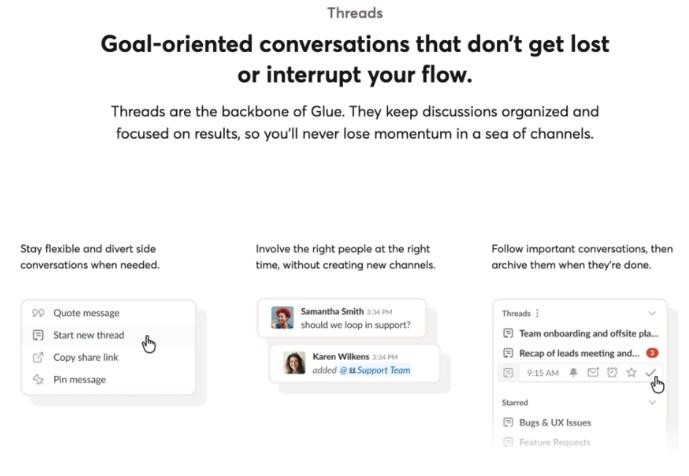
Glue’s core innovation lies in treating "threads" rather than "channels" as the basic unit of collaboration. This may sound like a small change, but it actually changes everything. On Slack, if you want to discuss a specific work item—such as developing an invitation link feature—you might start a thread in the product channel. But if designers need to join the discussion, you have to add all of them to the entire product channel just so they can see that single thread. The problem is that these designers will then be exposed to every discussion in the product channel, even though 90 percent of them are irrelevant to their work.
Glue frees threads from channels entirely. Each thread is an independent conversation unit with its own title, and you can share it with multiple groups or individuals. For example, the thread titled "Invitation Link Feature" can be sent to both the product team and the design team simultaneously. Only these two teams will see the specific discussion—no need to add designers to the entire product channel. As a result, everyone’s inbox only contains threads that are truly relevant to them, drastically reducing noise. When a thread is resolved, you can archive it just like an email in Gmail, so it no longer occupies your attention.
After testing Glue myself, I found this design to be incredibly elegant. You have a unified inbox that includes all the threads you’re part of, new group chats, and private messages. There’s no need to jump between dozens of channels to check for updates. If you want to stay informed about what’s happening across the organization, you can browse the information stream, which aggregates all public discussions—somewhat reminiscent of Yammer’s original design. The key difference is that browsing the stream is optional; you can catch up on company updates when you have time instead of being forced to deal with a flood of irrelevant information.
The advantages of this design were evident in the product demo. Evan showed how work can be organized through threads, each with a clear topic and list of participants. When cross-team collaboration is needed, there’s no need to create new channels or add people to existing ones—just share the thread with the relevant individuals or groups. This significantly reduces collaboration friction and allows everyone to focus on truly meaningful conversations. Additionally, Glue has an intelligent feature where AI automatically generates thread titles, making future referencing and searching extremely convenient.
AI Agent Is the Real Game-Changer
However, if Glue only improved the thread model, it would at best be a better alternative to Slack. What truly sets Glue apart is its deeply integrated AI agent capabilities. This, I believe, is the most exciting aspect of the product, as it demonstrates how AI agents can fundamentally change the way we work.
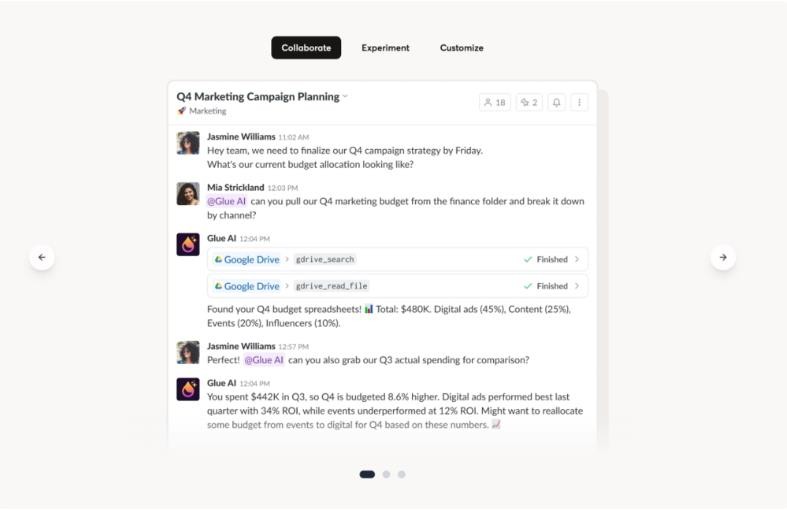
Within Glue, AI is not an independent tool but a full-fledged team member. It resides in your conversation environment, stays updated on all team discussions, and can access various connected applications and data sources. This means it has complete contextual awareness and can provide truly useful responses. For instance, you can directly ask, "What has our designer Jason been working on lately?" The AI will search relevant conversation records and inform you that Jason is handling new user experience design, interface audits, and the invitation link feature—while citing specific threads as sources.
This is a game-changer for managers. In remote or distributed teams, one of the biggest challenges is keeping track of team members’ work and progress. Traditional methods like daily standups and tedious progress reports are time-consuming and inefficient. But with Glue, you only need to ask the AI a question to get instant answers based on real work conversations. And since the AI cites its sources, you can click through to view the original discussions for more details.
Even more impressively, you can ask the AI, "Who in the company knows the most about iOS development?" It will analyze all conversation history to identify the most active and contributing individuals in relevant discussions, again backing up its answer with specific references. This outperforms expensive enterprise knowledge management systems, which rely on manually filled-out profiles that quickly become outdated. Glue’s approach is based on people’s actual work conversations, ensuring the information is always up-to-date and accurate.
Sacks made an important point in the interview: separating AI chats from human chats is pointless. If employees have to switch to ChatGPT to ask AI questions and then return to Slack to discuss with colleagues, the fragmented experience is frustrating. AI should be right where you work, understanding your ongoing conversations and stepping in to help whenever needed. That’s why they named the product Glue—it binds humans, applications, and AI together seamlessly.
Currently, Glue supports multiple AI models, including GPT-4, Claude, Gemini, and open-source models. You can choose a default model or let Glue automatically select the most suitable one based on the type of query. This flexibility is crucial, as AI models evolve rapidly and each has its own strengths. Glue’s strategy is not to tie itself to any single model provider but to let users benefit from advancements across the entire industry.
The Unlimited Possibilities of the MCP Protocol
Glue recently announced the completion of its $20 million Series A funding round, led by Abstract Ventures, with participation from Chapter One, Goldcrest Capital, and its incubator Craft Ventures. A key factor behind this funding round is Glue’s deep support for the Model Context Protocol (MCP). Developed by Anthropic, MCP is an open protocol that enables AI systems to access and manipulate data and functions across tens of thousands of applications.
Glue has built the largest in-app MCP directory, offering 35 applications that can be installed with one click, and supports connecting to thousands of other applications through custom MCP servers. This allows teams to easily integrate their internal tools and workflows, enabling AI to perform cross-application operations. For example, you can connect tools like Linear, Notion, Sentry, Vercel, and Zapier, and then use natural language in Glue to instruct the AI to retrieve information or execute actions across these platforms—all without leaving the chat interface.
In the funding announcement, Evan Owen stated: "MCP is a game-changer. We designed Glue as an AI-native platform from the start, and now with MCP, we can deliver the ultimate collaborative space for humans and agents. MCP exponentially expands Glue’s capabilities. The future is agentic." I couldn’t agree more. The MCP protocol addresses a critical challenge: how to enable AI to securely and standardly access data and functions across various applications.
Before MCP, integrating AI with an application required developing specialized interfaces—a cumbersome and non-scalable process. MCP provides a universal protocol, allowing any MCP-supported application to seamlessly connect to AI systems. This is similar to the advent of the USB interface, which standardized device connections and drastically reduced integration costs.
For Glue, MCP means it can rapidly expand the AI’s capabilities. When a user says, "Create a bug report in Linear" or "Pull up last quarter’s product roadmap from Notion," Glue’s AI can automatically select the right application and action to complete the task. This cross-application workflow automation is what makes AI agents truly powerful.
Ramtin Naimi, a partner at Abstract Ventures, commented: "Collaboration software has remained static while AI has advanced at breakneck speed. Glue represents the future—a platform where agents and humans work side by side to drive real impact within the right context." This assessment perfectly captures Glue’s core value proposition: not replacing humans with AI, but integrating AI as a team member that provides intelligent support when needed.
The Evolution from Promptful to Promptless
In the interview, Sacks put forward an intriguing concept: the evolution from "promptful" to "promptless." Today’s AI only responds when actively prompted by humans, but in the future, AI should be intelligent enough to proactively join conversations and offer assistance at the right moment—just like a real virtual teammate.
This vision is incredibly exciting. Imagine you and your colleagues are discussing a technical problem, and the AI recognizes that the issue was resolved in a previous conversation. It could then take the initiative to share relevant threads or document links. Or when you’re planning a project, the AI might notice a key stakeholder is missing from the conversation and remind you to include them.
Of course, realizing this vision comes with challenges. First, there are speed and cost considerations. For AI to actively participate in conversations, it needs to analyze every message in real-time to determine if intervention is necessary—this could incur significant computing costs. Second, quality control is essential. The AI must be sophisticated enough to know when to speak up and when to stay quiet. If it constantly offers irrelevant suggestions, it will quickly become annoying and get disabled.
But Sacks believes these issues will soon be resolved. AI models are becoming faster, more cost-effective, and more capable by the day. Glue is already moving in this direction by allowing each group to set its own AI guidelines, tailoring the AI’s behavior to the team’s specific needs.
I particularly agree with another point Sacks made: this is why AI belongs within enterprise chat applications rather than standalone services like ChatGPT. Only in a chat environment can AI access sufficient context to proactively join conversations and add value. If AI is separated from your work discussions, it cannot understand what you’re talking about, let alone offer timely assistance.
Product Refinement and Marketing Strategy
The Glue team has invested significant effort in polishing the product. Instead of rushing to launch a rough minimum viable product, they spent over two years developing it in secrecy, only releasing it once it was fully refined. Sacks explained that this was because their competitors are not small startups but established products like Slack and Microsoft Teams. Users have high expectations for team collaboration tools, and if you launch an unfinished product, you rarely get a second chance to win them over.
This was a wise decision. Products like Superhuman have built a strong reputation through waitlists and refined user experiences—but this only works if the product itself is excellent. If Glue had launched with numerous bugs or missing key features, users would have quickly returned to Slack, as switching chat tools involves significant costs. By prioritizing excellence, Glue ensures a positive first impression.
For its market launch, Glue adopted a Superhuman-style white-glove onboarding process. Users must join a waitlist, and the team then schedules one-on-one onboarding calls to help them set up the product, import data, and connect applications. While this approach is not scalable, it is highly valuable in the early stages. It guarantees every user has an optimal experience, and the team can learn from each onboarding session to continuously improve the product and processes.
Evan noted that the team gains new insights from every demo and applies them immediately to the next one. This rapid iteration has steadily enhanced the product experience. Moreover, Glue has little value for individual users; teams need to fully adopt it and connect their data sources to unlock its full potential. The onboarding calls ensure users overcome this activation barrier.
By the time of its launch, Glue’s waitlist had grown to approximately 6,000 people—a clear sign of market demand for a Slack alternative. Many users are dissatisfied with existing tools and eager for better solutions. Glue’s challenge now is to scale quickly while maintaining product quality and user experience.
In terms of pricing, Glue has positioned itself slightly below Slack at $7 per user per month, with a generous free trial period. This pricing strategy is smart: it is competitive enough to attract users without making the product seem cheap. Separate pricing plans are available for enterprise clients. Importantly, AI features are included in the base price—unlike Slack, where advanced AI capabilities require upgrading to expensive enterprise tiers.
Glue also offers a Slack import feature, allowing users to migrate historical conversations and channel memberships. This significantly lowers switching costs, enabling users to retain critical historical context instead of starting from scratch. This is particularly crucial for companies that have accumulated years of data on Slack. The imported historical data is also indexed by the AI, so users can start asking questions and get answers based on past conversations right away.
Thoughts on Remote Work and Team Culture
The interview touched on an interesting topic: remote work and team culture. Evan mentioned that their team of just eight full-time employees built such a sophisticated product—something unimaginable 14 years ago. Technological advancements, improved development tools, and the emergence of AI coding assistants have empowered small teams to create products that once required dozens of people.
However, when it comes to work models, both Sacks and Evan agree that in-person collaboration still offers irreplaceable value. Sacks shared that when he ran previous companies, he favored "management by walking around." He would randomly strike up conversations with engineers to ask about their work, often uncovering issues—such as someone working on low-priority tasks or heading in the wrong direction. This kind of spontaneous interaction is difficult to replicate in a remote setting. Chance encounters in the office, casual chats by the water cooler, and product and sales teams working side by side—all these can drive value.
I can relate to this personally. While remote work provides flexibility and access to talent worldwide, it also comes with drawbacks. This is especially true for junior employees, who struggle to grow quickly without in-person apprenticeship opportunities. In an office, new hires can shadow experienced colleagues, observing how they work, think, and solve problems. Transferring this kind of tacit knowledge is extremely challenging in a remote environment.
Sacks argues that we don’t have to choose between one extreme or the other. Companies can have a main office while setting up small hubs in other regions for team members to gather. Exceptions can also be made for top talent who prefer to work remotely. However, a fully atomized model—with 100 people spread across 100 locations—becomes difficult to manage, especially as the company scales.
This discussion made me think: perhaps remote work should be viewed as an employee benefit rather than something falsely promoted as better for the company. It can help attract senior talent, who often value flexibility. But for startups that rely on rapid learning and close collaboration, office-based work still offers distinct advantages.
Data Privacy and Model Choices
Glue takes a clear stance on privacy and data usage: it will never use clients’ company data to train models. This stands in stark contrast to the recent controversy surrounding Slack, which was exposed for using user data to train models. Users had to proactively contact Salesforce to opt out, sparking widespread backlash.
Sacks explained that Glue does not engage in model training at all. Instead, it uses foundational models provided by companies like OpenAI and Anthropic—organizations investing billions of dollars in building infrastructure to develop better, faster, and more affordable models. Glue has no need or capacity to compete with these giants. Its value lies in seamlessly integrating these powerful models into team collaboration scenarios, providing the right context and tool connections.
I fully endorse this strategy. In the AI era, not every company needs to train its own models—just as not every company needs to build its own data centers or lay fiber-optic cables. The key is to leverage existing infrastructure to create differentiated value. Glue differentiates itself by understanding team collaboration scenarios and knowing how to maximize AI’s impact in this space.
Furthermore, since Glue supports multiple models, users can choose providers they trust. If concerned about a provider’s privacy policies, users can connect other models using their own API keys. This flexibility allows enterprises to make choices based on their specific needs and policies rather than being locked into a single technology stack.
Glue emphasizes that data belongs to users, not the platform—a fundamental principle. In an era where data is a competitive advantage
|
 Fear of God ESSENTIALS Hoodie Review: Mi83 人气#fashion
 The Derby of San Francisco Style 300 Cha108 人气#fashion
 Why the Derby of San Francisco Classic S128 人气#fashion
 Romaoss Launches "Rebirth Plan," in Talk66 人气#tech



 WeChat
 douyin