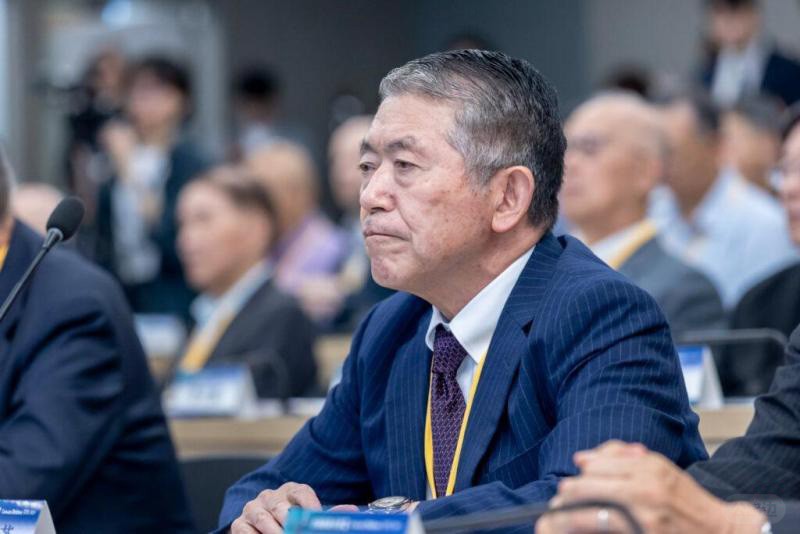
China has imposed sanctions on Shigeru Iwasaki, former Chief of Staff of Japan’s Joint Staff, accusing him of serving as a policy advisor to Taiwan’s Executive Yuan and “openly colluding with ‘Taiwan independence’ separatist forces.” This move is seen as Beijing’s latest response to Japanese Prime Minister Sanae Takichi’s recent remarks on “a Taiwan contingency.” Analysts interviewed say China intends to issue a stark warning to Japanese political figures and retired officials, leveraging a chilling effect to maintain pressure on Takichi’s cabinet.
On Monday, December 15, China’s Ministry of Foreign Affairs announced countermeasures against Iwasaki under the Anti-Foreign Sanctions Law, stating he had “seriously violated the one-China principle and the spirit of the four political documents between China and Japan, grossly interfered in China’s internal affairs, and gravely undermined China’s sovereignty and territorial integrity.”
Under the sanctions, China will freeze Iwasaki’s movable and immovable property and other assets within Chinese territory, prohibit any Chinese organizations or individuals from engaging in transactions or cooperation with him, and deny him visas and entry into mainland China, including Hong Kong and Macau. The measures took effect on December 15, 2025.
At a regular press briefing the same day, Chinese Foreign Ministry spokesperson Guo Jiakun stated that the Taiwan issue lies at the very core of China’s core interests and constitutes an inviolable red line. He emphasized that China firmly opposes Iwasaki’s acceptance of the so-called “policy advisor” role for the Taiwan authorities, noting that Beijing had repeatedly lodged solemn representations with Japan on this matter. Guo added that instead of showing remorse, Iwasaki had escalated his actions by “colluding even more closely with ‘Taiwan independence’ separatist forces and repeatedly provoking China,” thus warranting the announced sanctions.
Last week, Taiwan’s Liberty Times cited sources reporting that Beijing had pressured Iwasaki to resign from his advisory role with Taiwan’s Executive Yuan, yet he chose to remain engaged as a policy consultant and recently made a low-profile visit to Taiwan to meet with political figures.
Iwasaki previously served as Chief of Staff of the Japan Air Self-Defense Force and as Chief of Staff of the Joint Staff—the highest-ranking military position in Japan—from 2012 to 2014. Even after retirement, he has retained considerable influence in Japan’s political, defense, and corporate circles.
He assumed the unpaid (honorary) position of policy advisor to Taiwan’s Executive Yuan on March 21 of this year for a one-year term, primarily offering policy recommendations and strategic advice.
Bao Chengke, a council member of the Chinese Association for Japanese Studies, told Lianhe Zaobao that Taiwan had previously hired former Imperial Japanese Army officers—organized under the “Practice Society” (also known as the White Group)—as military advisors in the 1950s, which was viewed as Japanese interference in China’s internal affairs. He described Iwasaki’s current role as “highly sensitive” for similar reasons.
“He was the Chief of Staff of the Joint Staff, and his entire career has been in the military and the Self-Defense Forces,” Bao said. “Therefore, any cooperation he engages in with Taiwan cannot possibly be unrelated to military matters.”
Bao believes Beijing’s sanctions on Iwasaki—coming amid Takichi’s controversial statements—are intended as a clear warning to Japan: “Whether they are current government officials or retired personnel, no one should interfere in China’s internal affairs.”
Li Shihui, Director of the Master’s and Ph.D. Program in Japanese Studies at National Chengchi University in Taiwan, noted that interactions between retired Japanese military officials and Taiwan have long existed, but Iwasaki’s formal appointment as a policy advisor reflects a more institutionalized and comprehensive level of engagement between retired Japanese officials and Taiwan’s government.
Li speculated that Iwasaki likely holds little tangible interest in mainland China, so the sanctions may carry limited practical impact. However, he suggested Beijing’s real aim is to create a chilling effect among Japan’s political and business communities.
He pointed out that besides Iwasaki, China also sanctioned Ishihira Taira—a sitting Japanese Diet member of Chinese origin—in September. “Many retired Japanese officials go on to serve as corporate advisors in Japan,” Li said, adding that current officials might now think twice about their statements on Taiwan and China, considering how such remarks could affect their post-retirement career prospects.
Li further observed that while Takichi’s “Taiwan contingency” remarks continue to provoke reactions, Beijing’s true target is not Takichi herself but rather “anti-Takichi voices within the Liberal Democratic Party.” By applying political and economic pressure, China hopes to weaken her administration. However, based on current Japanese public opinion and polling data, the effectiveness of these efforts remains quite limited.
|

 Fear of God ESSENTIALS Hoodie Review: Mi86 人气#fashion
 The Derby of San Francisco Style 300 Cha112 人气#fashion
 Why the Derby of San Francisco Classic S130 人气#fashion
 Romaoss Launches "Rebirth Plan," in Talk70 人气#tech



 WeChat
 douyin