First, media reports revealed that Volcano Engine would bring Doubao to center stage as the exclusive AI Cloud partner of China’s Spring Festival Gala. Then came rumors that Doubao’s DAU (Daily Active Users) had surpassed 100 million. Combined with Volcano Engine’s disclosure that Doubao’s large model now processes over 50 trillion tokens per day, a highly publicized AI narrative battle erupted just before 2026.
ByteDance isn’t the only one stirring: Alibaba swiftly gathered hundreds of engineers in Building C4 of its Xixi campus for a closed-door development sprint on Qwen; Tencent followed by establishing dedicated AI Infra, AI Data, and Data Computing Platform divisions to comprehensively strengthen its AI R&D infrastructure.
All signs point to internet giants aggressively pursuing a dual-track commercialization strategy: advancing foundational model research while simultaneously driving consumer-facing product adoption.
This puts ByteDance squarely back in its comfort zone—extreme ROI and operational efficiency are hardwired into the company’s DNA. From news feeds and short videos to e-commerce and short dramas, ByteDance has consistently executed lightning-fast “blitzkrieg” strategies to overtake competitors in arms races. Now, amid the AI free-for-all, it’s quietly delivering tangible results.
ByteDance Catches Up
Looking back at ByteDance’s rise, aside from brief hesitations in local services and gaming, it was rarely the first mover in core sectors like news, short video, e-commerce, or short dramas—yet it repeatedly emerged as the ultimate winner.
In early 2024, CEO Liang Rubo repeatedly emphasized a sense of “crisis” during company-wide All Hands meetings. He admitted that internal feedback indicated ByteDance was exhibiting all the classic symptoms of “big company disease.” The biggest fear? That the organization was becoming mediocre and incapable of breakthrough innovation—especially appearing sluggish in responding to the large-model wave.
That meeting marked a clear strategic pivot and became the catalyst for ByteDance’s determined catch-up effort. Over the next two years, multiple media reports noted Zhang Yiming’s deepening interest in AI: not only engaging in in-depth discussions with researchers in Singapore but also regularly returning to China to consult with core technical teams.
These developments fueled intensifying rumors in late June this year that “Zhang Yiming has returned to ByteDance’s front-line operations.” After all, he previously led ByteDance into Tencent and Alibaba’s “forbidden hunting grounds,” successfully reshaping the landscapes of news, short video, and e-commerce despite fierce resistance—and launching multiple products with over 100 million DAU.
According to HuXiu, since the second half of 2024, ByteDance’s Seed team—the unit behind Doubao—has been designated a core strategic business. Top executives not only attend Seed team retrospectives but also deeply engage in planning AI technical roadmaps, model strategies, and frontier research topics. The company rapidly shifted from initial sluggishness to full-speed pursuit.
Meanwhile, in 2025, the Seed team completed integration with several departments, including AI Lab, with Wu Yonghui appointed as the “No. 1 leader” overseeing both foundational research and application deployment—demonstrating a “do-or-die” strategic resolve.
The underlying reason is clear: China’s mobile internet has entered a mature phase with user and traffic growth plateauing, while regulatory focus has shifted toward industrial internet development. This places technology at a pivotal moment for ecosystem restructuring—making it impossible for Zhang Yiming to remain a passive observer. As he presciently stated four years ago upon stepping down: “The external environment for tech companies is changing, and technology’s societal impact is growing. These factors mean ByteDance must break free from business inertia and explore new frontiers.”
Concurrently, ByteDance’s large-model narrative has transformed into a textbook “comeback story,” with Doubao steadily widening its competitive lead.
In terms of user scale, QuestMobile data from early 2025 showed that by November 2024, China’s AIGC apps had collectively surpassed 100 million monthly active users—double the figure from June 2024. Doubao alone captured half of this market share. The gap between Doubao and other top-tier players like Kimi and Wen Xiaoyan continues to widen.
Today, Doubao’s DAU has exceeded 100 million, achieved with the lowest marketing cost in ByteDance’s history for any product reaching this milestone.
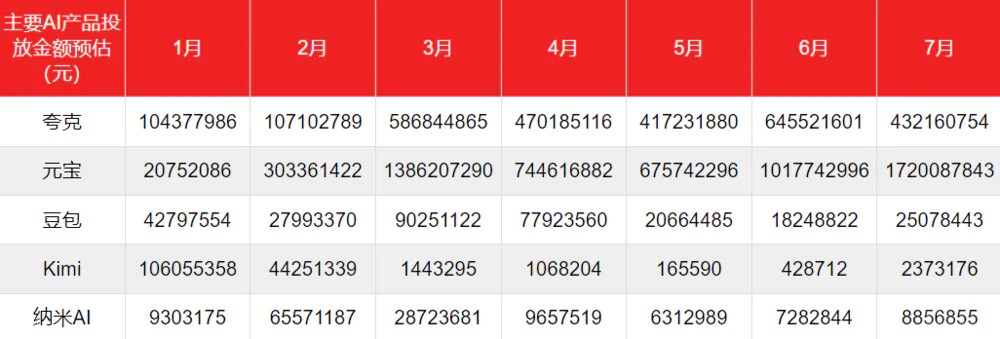
Source: AppGrowing (2025)
According to DataEye Research, in November 2025, mainland China saw 891,000 ad creatives for native AI products. Tencent’s Yuanbao accounted for 46%, Qwen 34%, and Doubao just 11%.
In the broader market, Tencent Yuanbao, Alibaba Quark, and ByteDance Doubao firmly occupy the top three spots in 2025. Tencent’s Yuanbao adopted the most aggressive ad strategy: AppGrowing data shows that since February 2025, Yuanbao’s ad spending surged, especially after Chinese New Year. With massive investment, it overtook Doubao and DeepSeek on the App Store free chart, ultimately claiming the No. 1 spot in China on March 3.
Alibaba is equally formidable: Qwen launched its public beta on November 17 and, according to third-party data, set a record for the fastest-growing AI app in China—emerging as a serious challenger.
Thus, in this new AIGC battleground, internet giants seem to have reverted to the mobile internet era’s playbook: burning cash on ads and fighting for channel dominance.
A large-model industry insider told HuXiu that ByteDance demonstrates systematic execution in AI, reflected in three key areas: precise strategic direction, efficient R&D resource allocation, and rapid market-responsive iteration.
“In less than two years since Liang Rubo’s internal reflection, ByteDance has swiftly locked onto critical strategic priorities, reallocated resources, and caught up in the large-model race,” the source said. “On the consumer side, it launched demand-aligned products like Doubao, CatBox (AI companion app), CapCut (video editor), and Coze (AI agent development platform). On the enterprise side, Volcano Engine continuously optimizes its AI cloud services. In contrast, some rivals have shown restraint in market responsiveness and technical support, gradually falling behind.”
Wu Di, Head of Intelligent Algorithms at Volcano Engine, previously told HuXiu that AI is a long-term endeavor whose true value will unfold over 10 or even 20 years. Short-term speed matters little in this historical arc—much like the gradual rollout of 3G, 4G, and 5G in the mobile era. Real transformation requires deep user penetration and scenario-based adoption, though consumers and media often overinterpret near-term progress.
“What truly matters is building great products,” Wu emphasized. “Enterprise customers care about cost-performance; consumer users care about experience. Ultimately, users should get convenient, practical service—no matter which product they choose.”
Indeed, from TikTok to Hongguo, from Doubao to Jimeng and CatBox, ByteDance’s comprehensive product strategy and agile positioning enable it to serve diverse user segments and reinforce control over traffic gateways:
On one hand, consumer apps like Doubao, CatBox, CapCut, and Coze generate interaction data that feeds back into model optimization, enhancing user stickiness and loyalty.
On the other, addressing AI “hallucinations” requires continuous improvements in data quality, model architecture, and evaluation mechanisms—making large-scale data collection, cleaning, and annotation essential to avoid overfitting and improve generalization.
As the competitive landscape clarifies, the core differentiators for large models have shifted to reasoning efficiency, accuracy, and real-time performance. Leading players are racing to launch model development platforms and build open ecosystems:
In June 2023, Volcano Engine launched “Volcano Ark,” a MaaS (Model-as-a-Service) platform integrating models from multiple AI firms and research institutes, offering end-to-end enterprise services for fine-tuning, inference, and evaluation—and gradually opening to individual developers.
In October 2023, Alibaba Cloud launched “Bailian,” integrating Qwen series and DeepSeek models, supporting text generation, multimodal processing, and code generation, and promoting AI adoption via MCP services and vertical solutions.
On May 21, 2025, Tencent Cloud upgraded its “Large Model Knowledge Engine” into the Tencent Cloud Agent Development Platform (TCADP/ADP), leveraging HunYuan models and YouTu Lab algorithms to enable low-code/no-code custom agent creation.
A large-model startup founder believes these high-quality platforms empower smaller teams to penetrate niche verticals in three ways:
Focus on R&D to optimize model performance for specific scenarios and deliver high-quality specialized services;
Build end-to-end solutions covering data collection, preprocessing, and deployment to enhance user experience;
Explore innovative monetization—subscriptions, technical support, custom development—to boost profitability.
This aligns perfectly with Tan Dai, President of Volcano Engine, who views AI as a marathon. In the early stages, teams shouldn’t fixate on the finish line but instead focus on “early signals of success.” His team prioritizes product refinement through frequent customer interaction and market-driven iteration to validate if they’re on the right track.
A Unique Global Case Study
As Doubao surges ahead, a striking signal has emerged.
While Alibaba Cloud, Tencent Cloud, and Baidu AI Cloud leveraged early-mover advantages and talent reserves, Volcano Engine only joined the table nearly a decade late. Yet thanks to Doubao’s explosive growth—its daily token usage exceeding 50 trillion (a 200% increase in six months)—it now ranks globally behind only OpenAI and Google Cloud, prompting media jokes that ByteDance is becoming “TokenDance.”
Tan Dai explained that unlike the cloud computing era, in the AI Cloud era, models are the software core. As large-model capabilities advance, consumer-facing sectors like internet services, retail (including smartphones and autos), and education are growing fastest. “But B2B is strong too—one client built over 100 agents internally, consuming tens of billions of tokens daily.”
He added that in traditional cloud computing, token usage followed the 80/20 rule (85% enterprise, 15% individual). In the AI Cloud era, that ratio is shifting to 75/25—and “I think individuals will take an even larger share in the future.”
At its core, AI application development in the large-model era represents a new technical paradigm. Competitiveness hinges on three factors: model intelligence, response speed, and cost control—directly determining user experience and adoption, and defining the new battleground for AI cloud providers.
Tan also shared key metrics: “Internally, we’ve calculated that we have 100 customers each consuming over 1 trillion tokens—more than AWS—indicating solid AI progress.” Client coverage includes 80% of top coffee/tea brands, 90% of mainstream auto brands, 80% of leading securities firms, 80% of systemically important banks, 70% of China’s 985 universities, and 9 of the world’s top 10 smartphone makers by shipment volume.
For comparison, in October 2025, OpenAI disclosed only 30 customers surpassing 1 trillion tokens—mostly in education, sales, and coding.
“The model race is intensifying—with new SOTA (state-of-the-art) models emerging every two to three months,” a seasoned industry observer told HuXiu. “By 2026, the global MaaS field will likely consolidate to just five or six top-tier players.” In this brutal competition, foundational model advances will force companies to pour more into compute, while engineering upgrades demand lower costs and higher usability—making “cost-performance ratio” the ultimate metric.
This AI-fueled momentum is propelling ByteDance toward becoming a globally influential tech powerhouse.
Over the past year, ByteDance has accelerated expansion in e-commerce, short dramas, and AI. Its suite of apps now boasts an estimated 4+ billion MAU, with commercialization scaling rapidly.
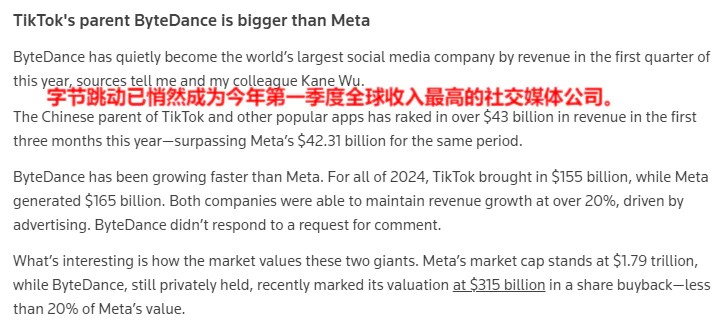
In July 2025, foreign media reported that ByteDance’s Q1 revenue exceeded 43billion—surpassingMeta’s42.31 billion to become the world’s highest-revenue social media company in Q1 2025.
Source: Tech News Hub
On December 19, citing insiders, foreign outlets reported ByteDance’s 2025 net profit is set to stabilize above 50billion—exceedingitsannualtarget—withrevenuerisingfrom155 billion in 2024 to approximately $186 billion.
For context, Meta’s 2025 revenue is projected at ~200billion,withprofitsaround60 billion. ByteDance is steadily closing the gap with Meta across key metrics: global users, revenue, and profit.
Moreover, on December 23, foreign media reported ByteDance plans to invest RMB 160 billion (~22.4billion)inAIin2026—halfearmarkedforAIchipprocurement.Atanestimated50 billion 2025 profit, this means AI spending will consume nearly half of last year’s earnings.
From accelerating AI ambitions to aggressive chip investments, capital markets have responded enthusiastically: SoftBank Vision Fund raised ByteDance’s valuation above 400billion;FidelityandT.RowePriceassignedvaluationrangesof41–45 billion in their models.
Even higher premiums emerged in recent secondary market transactions: Today Capital, led by Xu Xin, acquired ByteDance shares at an implied valuation of ~480billion.Still,thispalesagainstMeta’scurrent1.7 trillion market cap.
Tech analyst Wei Yahui sees ByteDance as a unique global exemplar among Chinese internet firms: “It achieved massive profitability within two or three years of founding—a rarity in China’s internet history. Moreover, it competes head-to-head with global giants overseas. With nearly $50 billion in annual net profit—roughly double Tencent’s and on par with Meta—it has truly reached global profitability scale.”
“Earlier Chinese internet companies struggled with profits because their founders didn’t prioritize profitability; expecting them to generate high earnings quickly was unrealistic,” Wei added. “But a new generation—ByteDance, DJI, Pinduoduo, miHoYo—stands out for exceptional profitability. Our hopes should rest on these companies.”
|

 Fear of God ESSENTIALS Hoodie Review: Mi86 人气#fashion
 The Derby of San Francisco Style 300 Cha112 人气#fashion
 Why the Derby of San Francisco Classic S130 人气#fashion
 Romaoss Launches "Rebirth Plan," in Talk70 人气#tech





 WeChat
 douyin