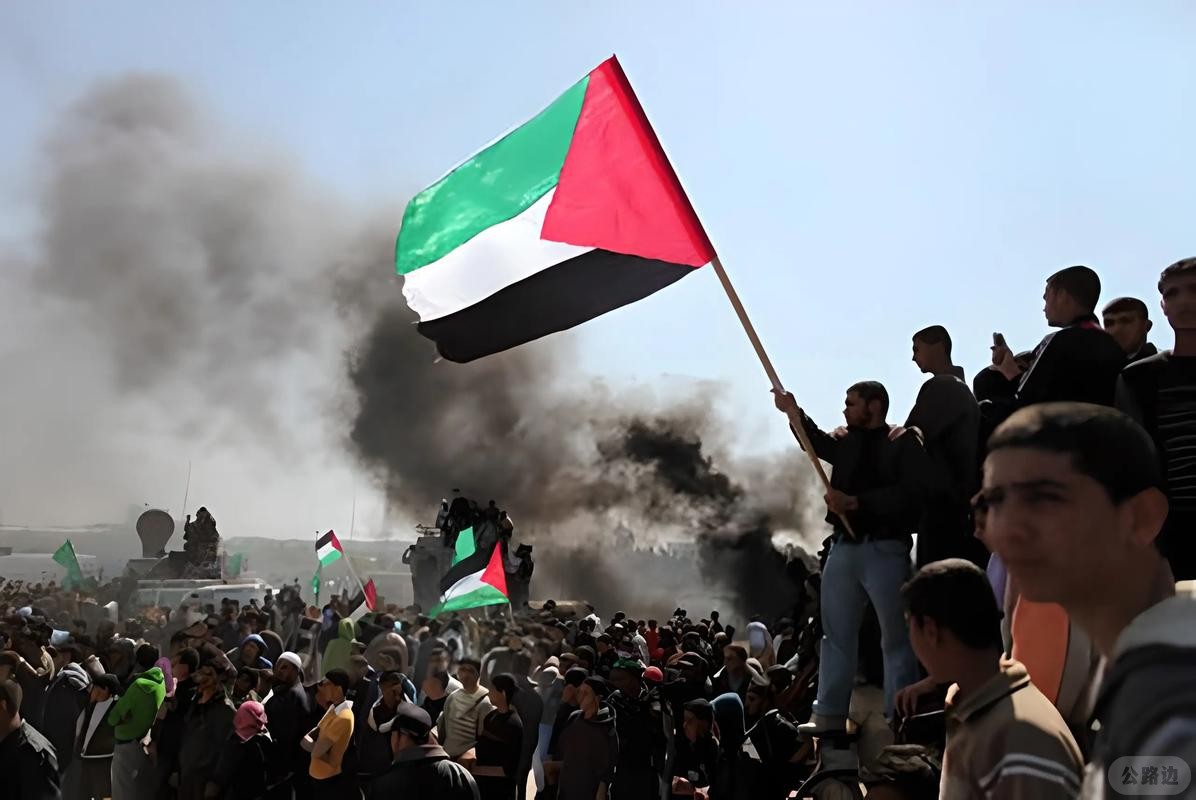
The suffering of Palestinians is a heart wrenching and complex topic, as their lives have been filled with war, displacement, and endless conflicts for decades. When it comes to reasons, people often think of Israel's occupation and policies first, but things are not that simple. The Palestinian people's own choices and the support of neighboring countries have further exacerbated their situation.
To understand the suffering of the Palestinians, we must first go back in time and see how this chaos began. Palestine has been a multi-ethnic place since the Ottoman Empire era, with Jews, Arabs, and Christians crowded together. At the end of the 19th century, Zionism emerged and a large number of Jewish immigrants came to settle down. At that time, it was the British who were in charge of this land. They issued the Balfour Declaration in 1917, stating their support for the establishment of a 'Jewish national homeland' here. Now it's great, the Arabs are quitting, thinking this is going to push them out.
The contradictions accumulated more and more, and in 1947, the United Nations stepped forward and said, "Let's divide." They proposed a partition plan, dividing Palestine into a Jewish state and an Arab state. Although the Jews were not very satisfied, they believed that having a country was better than not having one, so they accepted it. But on the Palestinian Arab side, they simply say it's not feasible, thinking that this plan is too biased and the distribution of land is not fair enough. At that time, Arab leaders, such as the Arab High Council, shouted for a unified Arab country and completely refused to accept division.
What was the result? In 1948, as soon as Israel declared its founding, neighboring Arab countries - Egypt, Jordan, Syria, Iraq - immediately formed groups to attack and strangle Israel in its cradle. But this war was fought to a pulp, and the Arab side did not coordinate well, each with their own ulterior motives. In the end, Israel not only stood firm, but also occupied more territory. More than 700000 Palestinians have been forced to flee their homes and become refugees, which is what they call 'Nakba', also known as the Great Disaster.
Looking back, the Six Day War of 1967 was another turning point. Israel engaged in a conflict with Egypt, Jordan, and Syria, resulting in the occupation of the West Bank, Gaza Strip, and East Jerusalem. The Palestinian territory has further shrunk, and life has become even more difficult. Later on, there was the first uprising in 1987, the second uprising in 2000, the Oslo Accords in 1993, and Israel's withdrawal from Gaza in 2005... Each time seemed like a glimmer of hope, but in the end, they all collapsed. History is like a vicious cycle, with Palestinians always struggling in conflict and disappointment.
First, let's talk about the partition plan of 1947. At that time, the United Nations gave an opportunity, although not perfect, at least to have one's own country. But the Palestinian leaders refused outright, betting on the Arab Brotherhood to help them win. What was the result? Brother didn't help, he actually lost the ground. This move went wrong, directly leading to 'Nakba'. If I had nodded back then, would today be different? No one knows, but missing the opportunity is a fact.
Let's take another look at peace negotiations. The 1993 Oslo Accords were a major breakthrough, as the Palestinian Liberation Organization (PLO) shook hands with Israel and promised to resolve the issue through negotiations. The agreement got stuck shortly after, with mutual distrust and ongoing violence. At the Camp David Summit in 2000, Israeli Prime Minister Barak proposed a plan: to give Palestine 97% of the West Bank, plus Gaza, and to build a capital. The conditions are not bad, but Arafat did not accept and did not propose any alternative solutions. The second uprising that broke out later resulted in the death of thousands of people and nothing was salvaged. This rejection is considered a big mistake by many people.
There is also internal division. In 2005, Israel withdrew from Gaza, and Palestinians had the opportunity to carry out some construction there. In 2006, Hamas won the election, and in 2007, they directly seized Gaza by force, driving Fatah to the West Bank. Since then, Palestine has been divided into two parts: the West Bank is under the jurisdiction of Fatah, and Gaza is under the jurisdiction of Hamas. The two sides are fighting against each other, and politically they can't get together at all. This gives Israel reason to say, 'You can't even figure it out yourself, who am I talking to?'
Hamas is more troublesome on this side. Since taking control of Gaza in 2007, they have launched rockets and dug tunnels to launch surprise attacks on Israel. Their logic is to resist occupation, but what is the outcome? Israel retaliated by bombing Gaza frequently, causing widespread civilian casualties and leaving houses, schools, and other structures in ruins. Gaza is blockaded by Israel and Egypt, with unemployment rates soaring to over 50% and supplies unable to enter. Life is unbearable. The armed route of Hamas may seem tough, but in reality, it has caused great suffering to the common people.
These choices - rejection of peace plans, infighting, violent resistance - have made the situation for Palestinians even more difficult. It's not that they have no reason to be angry, but as they walk down these paths, they mostly have to swallow the bitter fruits themselves.
Speaking of neighboring countries. Egypt, Jordan, Lebanon, Syria and other neighboring countries, while shouting to support Palestine, are not doing very well. Their 'help' sometimes turns into a nightmare for Palestinians.
The 1948 war is an example. Arab countries forming groups to attack Israel may sound righteous, but in reality, each has their own tricks. Jordan's King Abdullah had no intention of helping Palestine establish a state, he was thinking of swallowing the West Bank into his own pocket. Egypt is no exception, occupying Gaza without letting go. After the war, Jordan really designated the West Bank under its own name, while Egypt managed Gaza, but no one said they wanted to establish a state for the Palestinians. What kind of support is this?
The refugee issue is even more heart wrenching. After 1948, hundreds of thousands of Palestinians fled to neighboring countries and ended up living like second-class citizens. Lebanon is particularly harsh, as Palestinian refugees are unable to buy houses, do many jobs, and even have difficulty obtaining basic medical care. Syria is not much better, refugees there have no identity and live like shadows. Although Jordan granted citizenship to some refugees, in the "Black September" of 1970, the Jordanian government fought against the Palestinian Liberation Organization, resulting in a large number of deaths and the expulsion of Palestinians.
These countries still use Palestine as a political bargaining chip. Egypt and Syria used to give money and weapons to the Palestinian Liberation Organization, and later supported radical factions such as Hamas and Hezbollah. This may sound like help, but in reality it's adding fuel to the fire. Hamas has money, rockets hit harder, Israel retaliates more fiercely, and Palestinian civilians suffer in the middle.
In recent years, the attitude of Arab countries has become even more chilling. In 2020, the United Arab Emirates, Bahrain, and Israel signed the Abraham Accord, establishing direct diplomatic relations with Israel and setting aside Palestine. Although Saudi Arabia has not officially established diplomatic relations, it can be seen by everyone that they have exchanged glances with Israel. At first glance, Palestinians cannot rely on their so-called 'Arab brothers', and their feelings can be imagined.
The selfish and hypocritical attitude of neighboring countries not only fails to help the Palestinians solve their problems, but also keeps pushing them into the pit. To put it simply, they care about their own interests far more than the lives of Palestinians.
Of course, Israel cannot escape the suffering of the Palestinians. After occupying the West Bank and Gaza in 1967, Israel built settlements, constructed the separation wall, set up checkpoints, and cut Palestinian territory into pieces. There are so many checkpoints on the west coast that people feel dizzy. Driving several kilometers may require passing several checkpoints, making it impossible for people to do anything in a day. Gaza is even worse, sealed off for over a decade, unable to enter or leave, like a large prison.
Settlements are a big problem. There are now hundreds of thousands of Israeli settlers in the West Bank, occupying an increasing amount of land. It is almost impossible for Palestinians to form a contiguous state. The Israeli government claims that this is a "security need" and a "historical right," but in the eyes of the Palestinians, this reason is just an excuse to seize territory.
Military action is also indispensable. As soon as Hamas launches rockets, Israel retaliates with frequent airstrikes on Gaza. In several major wars in 2008, 2014, and 2021, Gaza was bombed and devastated, with countless casualties. According to United Nations data, more than 2000 people, mostly civilians, died in the 2014 conflict alone in Palestine. Israel claims it is for self-defense, but this' self-defense 'has cost the Palestinians too much.
However, to be fair, Israel is not just causing trouble. Hamas' rockets and past suicide bombings have indeed scared Israelis. Their starting point for building walls, blockades, and counterattacks is to protect themselves. This is a deadlock: Palestinians feel oppressed and resist desperately; Israel feels insecure, so it presses even harder.
The suffering of Palestinians is not caused unilaterally by either side. The mess left by history, the mistakes of the Palestinians themselves, the hypocrisy of neighboring countries, and Israel's stubbornness have been mixed together to form this mess. They refused the peace plan, continued internal strife, and violent resistance, which missed the opportunity to turn things around. Arab neighbors shout slogans loudly, but in reality, they only do things that add to the chaos. Israel is holding onto the land and its policies are getting harder and harder, leaving Palestinians breathless.
To untie this knot, relying solely on blame is useless. Palestinians need to unite first, put down their guns, and sit down to talk. Neighboring countries should sincerely help, don't always think about your own tricks. Israel also needs to let go and not take settlements as its lifeline. Only when everyone moves can the lives of Palestinians be better. Otherwise, this suffering will continue without end.
|

 Fear of God ESSENTIALS Hoodie Review: Mi86 人气#fashion
 The Derby of San Francisco Style 300 Cha114 人气#fashion
 Why the Derby of San Francisco Classic S131 人气#fashion
 Romaoss Launches "Rebirth Plan," in Talk70 人气#tech



 WeChat
 douyin