The Singapore market has strong purchasing power and frequent cross-border travel demand, which is a huge opportunity that has not yet been fully developed.
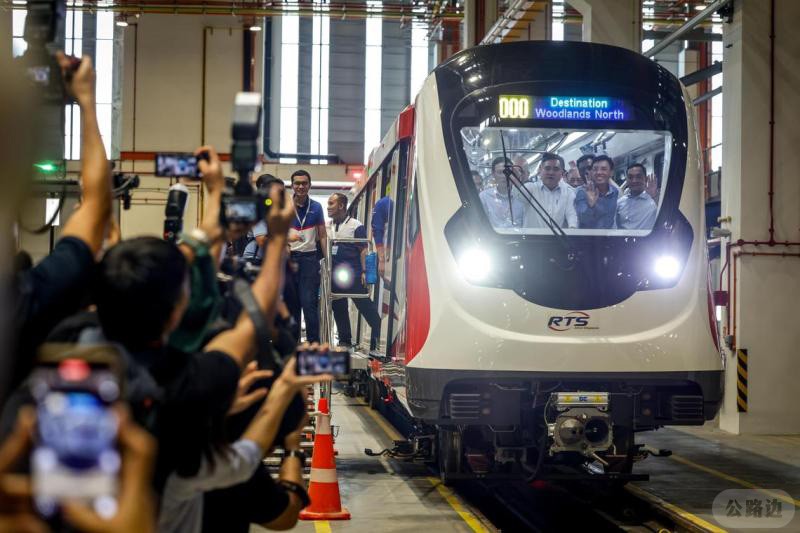
On June 30th, officials from Singapore and Malaysia experienced the Xinrou subway train.
The railway transportation system in Malaysia will undergo significant changes. Firstly, it is necessary to mention the New Johor MRT, which is not only a cross-border infrastructure project highly anticipated by Johor people, but also has high expectations for the economic benefits that this system will bring.
As of June this year, over 56% of the subway system spanning the Johor Strait has been completed, and the first train has been showcased to the public, which is impressive. After the scheduled opening at the end of next year, it will become a brand new and beautiful scenic line.
This 4-kilometer subway connecting Woodlands in Singapore and Johor Bahru in Malaysia will completely reshape the regional commuting mode. It can carry up to 10000 people per hour in each direction, and it only takes 5 minutes to travel from Bukit Chaka in Johor Bahru to Woodlands North in Singapore. Therefore, this development plan is hailed as a significant shift in the commuting paradigm.
The Xinrou subway is expected to fundamentally alleviate the traffic bottleneck problem of long-term congestion on the Xinrou embankment. At present, the daily number of people passing through Changdi has exceeded 300000, and it has been under long-term pressure. The authorities estimate that the subway system will divert at least 35% of daily commuting during peak hours, significantly reducing commuting pressure and shortening waiting times.
However, the Malaysian government and people's vision of transportation connectivity must go beyond connecting Johor Bahru and Singapore's Woodlands, and look forward to extending the connectivity route to Kuala Lumpur, Penang, Thailand and Laos, and even further to China, to achieve the grand plan of the Pan Asian Railway network. I believe Singapore has the same idea.
For decades, the southern section of Malaysia's railway network has been the weakest link, limited by slow diesel trains, outdated tracks, and lengthy travel times, putting railway transportation at a disadvantage in competition with road or air travel. Once significant progress is made in southern railway services, not only will Johor have more options for connecting with the central northern part of the Malay Peninsula, but Singapore will also benefit.
The dawn has come, as the Jinma Si Johor Bahru electric double track train project will enter Johor Bahru by the end of this year, the railway services on the west coast of the Malaysian peninsula will enter a new stage of transformation, bringing Johor Bahru closer to Kuala Lumpur, Ipoh, Penang, and even Thailand. Accelerating this strategic transformation will connect the southern economic corridor of Malaysia with other regions of the country, as well as Singapore.
In addition, we need to broaden our horizons to other railway development plans in Malaysia.
Malaysia's Minister of Transport, Lu Zhaofu, stated in July this year that it would be a regrettable regret if the East Coast Railway connecting the east and west coasts of the Malay Peninsula could not be extended to Thailand. According to the existing route plan, the endpoint of the East Rail only reaches Kota Bharu, the capital of Kelantan state, and has not yet been connected to the Thai railway network. The stance of the Malaysian Ministry of Transport is to extend the East Rail from Kota Bharu by an additional 32 kilometers to Rangdoubanrang, in order to establish a railway connection with the border between Malaysia and Thailand. Once the plan comes true, it will not only improve the regional railway network, but also significantly enhance Malaysia's strategic position in regional connectivity, driving cross-border trade and people to people exchanges.
We can imagine that passengers from the east coast of Malaysia and Thailand can transfer to a dual track electric train in Kuala Lumpur and then connect to the Singapore MRT to reach Singapore. Malaysia hopes to negotiate and implement this plan with Thailand as soon as possible.
One of the catalysts for the imagined railway connectivity is undoubtedly the Xinrou Special Economic Zone actively promoted by the governments of Singapore and Malaysia. The special zone is expected to combine Singapore's advantages in research and development and high-tech industries, as well as Malaysia's comparative advantages in manufacturing infrastructure, land resources, and costs, to form a complementary and mutually beneficial regional development pattern.
In view of the strong driving role of rail transit in regional development, Johor State Minister Weng Hafiz suggested during his meeting with Singapore Prime Minister Huang Xuncai at the end of July this year that both sides explore the establishment of a second subway system connecting Singapore and Malaysia, with the proposed route extending from Tuas, Singapore to Princess Margaret City in Johor.
Once all planned projects are successfully implemented, Johor Bahru, as the second largest city in Malaysia and the gateway to the south, will usher in a true upgrade of railway connections, promoting the development of investment, tourism, and labor mobility.
The Singapore market has strong purchasing power and frequent cross-border travel demand, which is a huge opportunity that has not yet been fully developed. Imagine the enormous transformation that would be brought about by thousands of commuters, shoppers, and tourists choosing to take trains instead of congested embankments or expensive flights every day.
However, we will find that the once imaginative Kuala Lumpur Singapore high-speed rail project seems to be buried in the annals of history. Compared to double track electric trains, high-speed trains have a faster travel time, but the cost is extremely high, accompanied by heavy political burdens and high land acquisition costs. After the high-speed rail plan was stillborn, the Malaysian and Singaporean governments had intended to renegotiate, but as time passed and more other plans were implemented, it seemed that high-speed rail was no longer an option, at least for Malaysia.
|

 Fear of God ESSENTIALS Hoodie Review: Mi86 人气#fashion
 The Derby of San Francisco Style 300 Cha112 人气#fashion
 Why the Derby of San Francisco Classic S130 人气#fashion
 Romaoss Launches "Rebirth Plan," in Talk70 人气#tech



 WeChat
 douyin