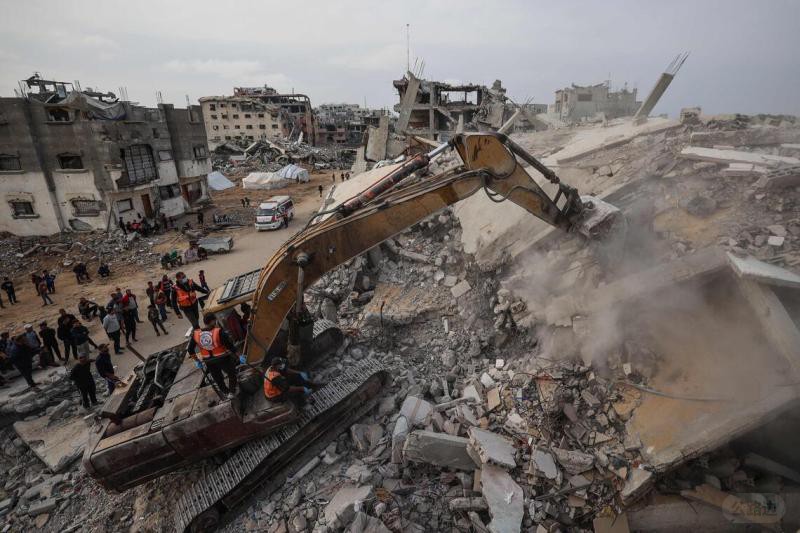
On December 6th, in the Brej refugee camp in central Gaza, civil defense personnel used excavators to search for the remains of victims in the ruins of destroyed buildings. (Agence France Presse)
Hamas' chief negotiator and Gaza Strip leader, Aya, said that Hamas will surrender to the Palestinian Authority, which governs the area, after Israel ends its occupation.
Ha'aya issued a statement on Saturday (December 6th) stating that Hamas is armed and self reliant due to Israel's aggression and occupation. If the occupation ends, these weapons will be placed under national jurisdiction, "Haya later stated during questioning, referring to a sovereign and independent Palestinian state.
Haya also said that Hamas only agreed to the deployment of United Nations forces to perform border patrols and ensure the ceasefire in Gaza. This means he opposes the deployment of international forces aimed at disarming Hamas into Gaza.
Hamas had previously refused to disarm, viewing it as an insurmountable red line; Israel insists that the disarmament of Hamas and other Palestinian factions in Gaza is a key condition for the second phase of the Gaza ceasefire agreement.
However, Türkiye, one of the guarantors of the ceasefire agreement between Israel and Kazakhstan, believes that the disarmament of Hamas is not the current priority. Türkiye's Foreign Minister Feidan said in an inquiry at the Doha Forum on Saturday: "Disarmament cannot be the primary task of the peace process. We must go step by step and be pragmatic."
The other two ceasefire agreements, Qatar and Egypt, called on Israel to withdraw its troops and deploy international stabilization forces at the Doha Forum, believing that this is a necessary step towards fully implementing this fragile agreement.
The Israel Kazakhstan peace plan proposed by the United States and supported by the United Nations clearly outlines these steps. At present, according to the first phase plan, the fighting in Gaza has basically stopped, and the Israeli army has withdrawn behind the so-called "Yellow Line" within Gaza. Hamas has released all hostages and handed over the bodies of all victims except for one. However, the warring parties have not yet reached an agreement on how to proceed with the second phase of the peace agreement.
The second phase of the plan not only requires Hamas to disarm, but also calls for Israel to withdraw its troops. Gaza will be managed by a transitional governing body called the "Peace Council", and an international stabilization force will be deployed.
However, Arab and Islamic countries have always been cautious about joining the International Stabilization Force, fearing that this force may eventually engage in combat with Palestinian militants.
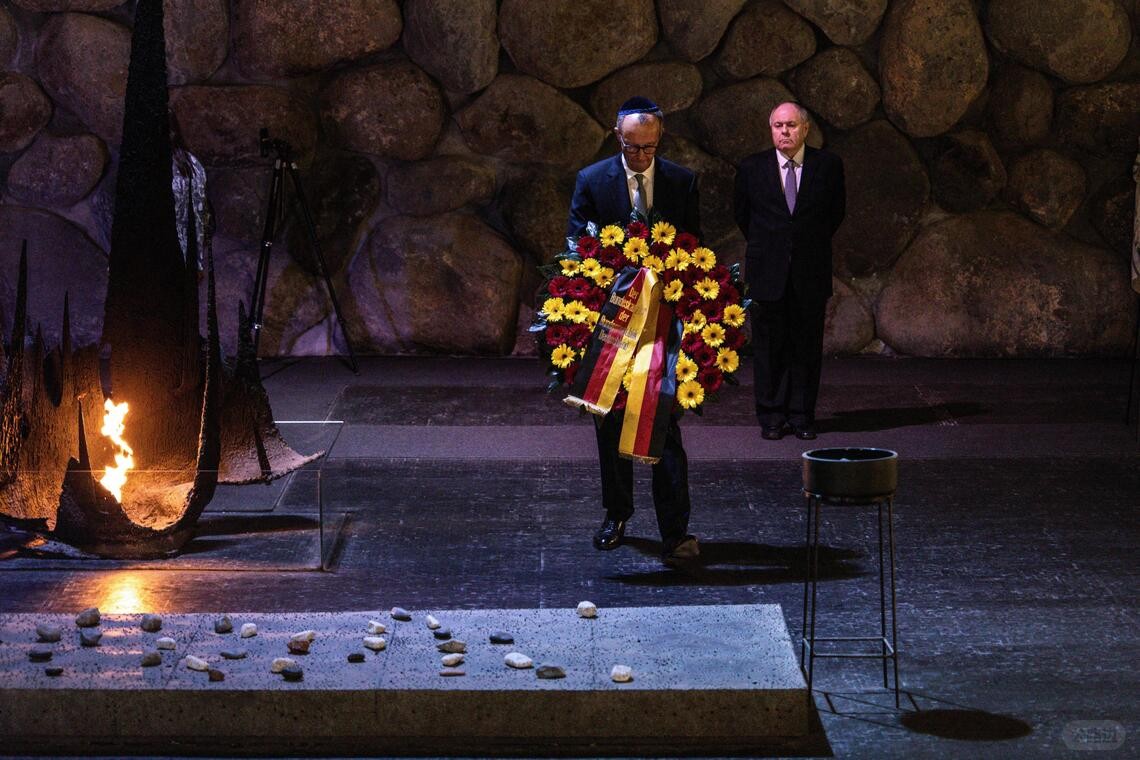
On December 7th, German Chancellor Mertz laid a wreath during his visit to the Holocaust Memorial Museum in Jerusalem. (Agence France Presse)
German Chancellor Merkel reiterates support for Israel
On the other hand, German Chancellor Merz reiterated Berlin's support for Israel during his visit to Israel on Saturday. This is his first visit since taking office.
The traditional stable relationship between the two countries has been shaken by the Gaza War. But during his meeting with Israeli President Herzog in Jerusalem, Mertz said, 'Standing on the same side as Israel is and will continue to be the core principle of Germany's unchanged policy.'.
Israeli Foreign Minister Saar, when welcoming Mertz at Tel Aviv airport earlier, referred to Mertz as a "friend of Israel" and Germany as an "important partner of Israel".
Mertz briefly stayed in Jordan before and held talks with King Abdullah II of Jordan. He told reporters that the discussions between the two sides mainly focused on the fragile peace process in Israel and Palestine, and said that Jordan and Germany are still committed to reaching a two-state solution through negotiations.
Mertz said, "In a shared future, terrorism and anti Semitism have no place
|

 Fear of God ESSENTIALS Hoodie Review: Mi86 人气#fashion
 The Derby of San Francisco Style 300 Cha114 人气#fashion
 Why the Derby of San Francisco Classic S131 人气#fashion
 Romaoss Launches "Rebirth Plan," in Talk70 人气#tech



 WeChat
 douyin