|
Luckin Coffee, Once Mired in Accounting Fraud, Eyes a U.S. Stock Market Return with 30,000 Stores
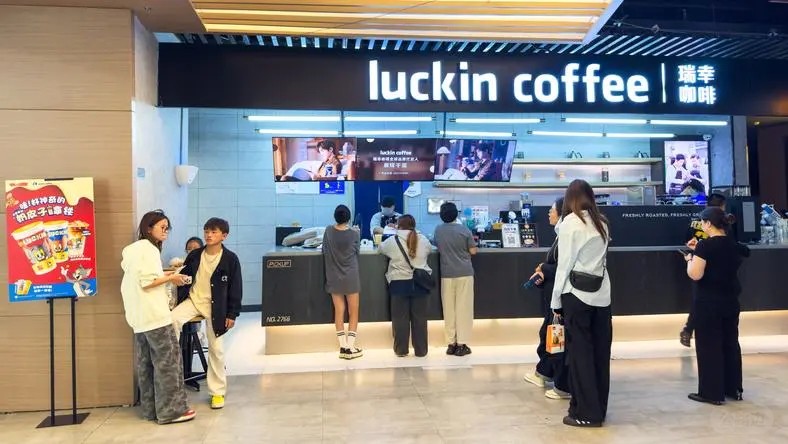
Luckin Coffee, which was once trapped in an accounting fraud scandal and forced to delist to the OTC Pink Sheets, is now set to re-enter the U.S. stock market with nearly 30,000 stores.
The news came from Guo Jinyi, co-founder and CEO of Luckin Coffee. He admitted at a recent Xiamen Entrepreneurs' Day conference that the company is actively promoting its return to the U.S. main board. The third-quarter results released shortly afterward also timely added fuel to this ambition.
The financial report is filled with impressive figures: total revenue in the third quarter reached 15.287 billion yuan, a year-on-year increase of more than 50%; the average monthly transaction customers exceeded 112 million, a record high; the same-store sales of self-operated stores increased by 14.4%, and the performance of partner stores was equally strong—revenue was nearly 3.8 billion yuan, a surge of 62.3%.
Growth is always the story that capital loves to hear. Therefore, aside from the stricter procedural and compliance issues caused by accounting fraud, Luckin still faces a core question: how long can such growth last?
This requires considering the following issues—what is the ceiling for the number of stores? After 30,000 stores, how many more dividends can be brought by further densification? And what is the limit of single-store output? When the popularity of food delivery fades, how will Luckin be affected?
I. How Many More Stores Can Be Opened?
Luckin has set many records worthy of being included in business textbooks.
In terms of business model, Luckin "does coffee with internet thinking," cultivates user habits through subsidies, and drives operations with data; in terms of products, Luckin has created many hit products such as Coconut Latte and Moutai-Flavored Latte; in terms of marketing, from co-branding cross-border collaborations to social communication, Luckin is good at creating "viral" events.
Then there is the myth of store opening speed.
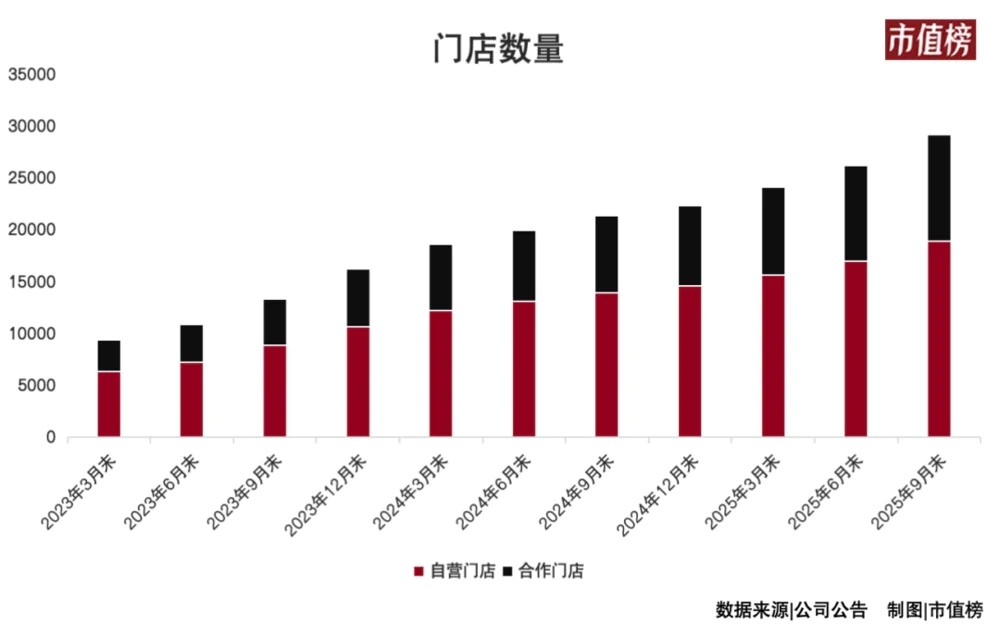
Starting from 2023, in the process of competing with Cotti Coffee, Luckin accelerated its expansion through the "store-with-store franchise" model. In June, the number of stores exceeded 10,000; in July 2024, it surpassed 20,000; by the end of September 2025, the number of stores reached 29,214. In the past two years, Luckin has added one store every 1.1 hours on average. Luckin's store count has left Starbucks (over 8,000 stores) far behind. So, what is the upper limit of Luckin's store count?
Guo Jinyi pointed out in a conference call that China's coffee industry is still in the early stage of development and high-growth phase, so "business growth and market share expansion remain our strategic priorities at this stage."
A research report by Huayuan Securities estimated based on per capita disposable income that if the per capita disposable income of urban residents remains unchanged (compared to 2024), the upper limit of Luckin's store opening space is 39,000, meaning there are less than 10,000 more stores to open.
In the middle of this year, the number of Mixue Ice Cream & Tea stores (excluding Lucky Coffee) exceeded 40,000, and single-store revenue has already come under pressure, prompting the company to take the initiative to slow down the pace of expansion.
In theory, judging from the two sets of data—"10,000 more stores to open" and "14.4% same-store sales growth of self-operated stores"—the inflection point of internal competition between Luckin stores and the decline in single-store revenue seems far away.
However, we have also noticed some worrying signals.
Take the self-operated stores in Q3 as an example: the same-store sales increased by 14.4%, while it decreased by 13.1% in the same period of 2024. Calculated this way, the single-store sales are almost the same as those in Q3 2023, or even slightly lower this year.
Let's look at the partner stores.
There is no year-on-year data for single-store sales of partner stores. We use the amount of materials purchased by partner stores from Luckin as a reference, after all, higher revenue and order volume require more consumption of coffee beans, coconut milk, milk and other materials.
Changes in the amount of materials purchased by partner stores from Luckin to a certain extent represent changes in the average number of cups sold per store.
Calculated by average, the number of partner stores increased by 29.2% and 36.7% year-on-year in Q2 and Q3 2025. In the same period, the materials purchased by partner stores from Luckin were 1.75 billion yuan and 2.02 billion yuan, with year-on-year growth rates of 29.2% and 22.5% respectively.
In other words, the average amount of materials purchased by each partner store from Luckin is declining. It was 204,000 yuan and 231,000 yuan in Q2 and Q3 2024 respectively, and 197,000 yuan and 207,000 yuan in the same period of 2025.
If we consider that the food delivery "subsidy war" in the second and third quarters generated a large number of tea and coffee orders, this signal is even more pessimistic.
As mentioned earlier, the revenue that Luckin obtained from partner stores is close to 3.8 billion yuan, a sharp increase of 62.3%, while the growth rate of material sales is not high. The notable growth points are profit sharing and equipment sales.
In the second and third quarters of this year, the growth rates of profit sharing (tiered sharing based on the gross profit of different stores) and equipment sales that Luckin obtained from partner stores far exceeded the growth rate of the number of stores.
The tilt of product structure towards low-cost categories has led to an increase in gross profit margin, which can explain part of the reason. But there is another possibility: Luckin's partner stores have undergone a significant replacement.
Profitable old partner stores have achieved higher gross profits due to food delivery subsidies, so they share more profits with Luckin; a large number of unprofitable old stores have closed down, while a large number of new stores have opened, which need to purchase more equipment. The new stores are in the order volume climbing period, thus pulling down the average material purchase per store.
The large-scale replacement of partner stores: the optimistic scenario is closing stores with poor traffic locations and opening stores in better locations; the pessimistic scenario is that the good locations are almost fully occupied.
In fact, as early as July 2024, when Luckin had a total of 20,000 stores, Jihai Brand Monitoring stated that 47% of Luckin Coffee stores were intensive stores, and the average shortest distance between stores was only 403 meters.
This distance is even shorter than what Guo Jinyi imagined many years ago: "In the core areas of cities, you can see a Luckin Coffee every 500 meters, so that busy people can get coffee more conveniently."
Although the number of Luckin stores is still growing at a high speed, and there is theoretically nearly 10,000 store opening space, the physical ceiling of the store network may actually be very close. Opening more stores will face the challenge of "competing with oneself."
II. Food Delivery Subsidies Will Fade, but the "9.9 Yuan" Label Is Hard to Remove
When the ceiling of the number of stores is faintly visible, Luckin is facing a more fundamental challenge: how to restructure the profit model. This inevitably involves a key factor that has recently disturbed Luckin's profits: food delivery.
In the third quarter of 2025, although Luckin's revenue increased by 50.2% year-on-year, its net profit decreased by 2.7% year-on-year. Among them, a key data is: delivery costs soared by 211.4% to 2.89 billion yuan, accounting for 18.9% of revenue. In other words, for every 100 yuan of revenue, nearly 19 yuan needs to be paid to the delivery link.
Guo Jinyi also admitted that "in the short term, the significant increase in the proportion of food delivery will indeed have a certain negative impact on profit margins." From the data, the operating profit margins of Luckin's self-operated stores in the second and third quarters were 21.0% and 17.5% respectively, compared with 21.5% and 23.5% in the same period of 2024.
At the same time, Guo Jinyi also said that "food delivery is only a short-term starting point" and "the long-term development of the coffee industry will still be centered on takeaway."
So, if Luckin successfully returns to the normal state dominated by takeaway, what does it mean?
This is a complex trade-off.
On the positive side, the huge fulfillment costs will be significantly reduced, which opens a key window for profit recovery. But challenges also follow: when the tide of food delivery traffic recedes, store order volume will inevitably decline. However, the fixed costs of stores (such as rent and equipment depreciation) will not decrease accordingly. What Luckin needs to accurately calculate is: can the saved delivery costs cover the profit loss caused by the decline in order volume?
When the marginal benefit of increasing the number of stores decreases and the tide of food delivery subsidies fades, Luckin's sustainable growth also depends on pricing.
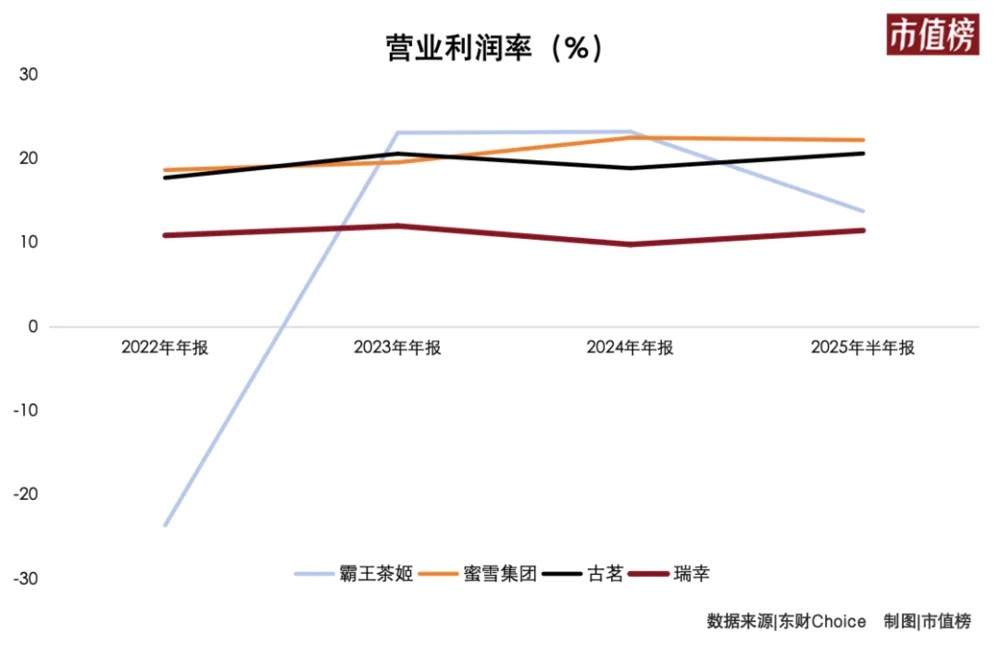
Being able to maintain profitability under the low-price model, Luckin's organizational and operational capabilities are naturally worthy of recognition. However, overall, Luckin's operating profit margin is lower than that of milk tea chains that also focus on takeaway, such as Mixue Ice Cream & Tea, Guming, and Bawang Cha Ji. Now, Luckin has been firmly locked in by the "9.9 yuan" price perception it created, and food delivery subsidies have pushed this figure even lower.
On the surface, Luckin's co-branding methods are endless—from Moutai, Black Myth: Wukong, Line Friends to Moutai again—trying to soften consumers' price sensitivity with emotional added value.
Most of these co-branded products cannot fundamentally change the brand's value perception. The current co-branding strategy is more like a series of superficial "packaging creativity competitions." On social platforms, consumers are keen to discuss "which co-branded packaging looks better" rather than "Luckin's coffee tastes better."
Luckin's co-brands come and go like flowing water, and other brands can also engage in co-branding, such as Cotti's co-branding with Nezha. This kind of interaction that stays at the level of visual freshness is increasingly limited in stimulating consumer impulse.
More importantly, besides the intensive co-branding, although Luckin's new product launch frequency remains high and the number of stores has increased significantly, it is difficult to reproduce the phenomenal hits like "Thick Milk Latte" and "Coconut Latte." Innovation has degenerated from a sharp weapon to establish category barriers into a regular action to maintain market visibility.
On the other hand, Luckin is no longer facing competition solely from the coffee industry. As Li Hui, Chairman of Luckin and founder of the largest shareholder Centurium Capital, said in an interview, "The coffee market and the milk tea market are not absolutely separated but interconnected." This means that Luckin's pricing should not refer to Starbucks, but to Mixue Ice Cream & Tea's average price of 6-8 yuan and Heytea's fresh milk tea around 15 yuan.
III. New Challenges in Overseas Markets
As competition in the domestic milk tea and coffee markets becomes increasingly fierce, Luckin has to turn its attention to farther borders—the overseas market.
Currently, Luckin has opened 118 overseas stores in Southeast Asia, North America and other places. The scale of 118 stores is less than 0.4% compared with the nearly 30,000 stores in China.
More importantly, overseas operations face brand-new challenges. Compared with the concentration and unity of the Chinese market, overseas markets are highly fragmented.
Fragmentation is reflected in many dimensions: different countries, and even different regions within the same country, have significant differences in consumer tastes, laws and policies, and supply chain infrastructure. This means that the successful Chinese model cannot be simply copied and pasted; instead, high-cost localized adaptation is required from scratch in each new market.
Fragmentation also directly pushes up operating costs, making it necessary for enterprises to reach a certain store density and business scale to cross the profit threshold.
This means that the supply chain needs to be rebuilt, consumption habits need to be cultivated, brand awareness needs to be fostered, and localized tastes need to be explored. Guo Jinyi once described that in the global coffee market, China is a market where you can "pick up money," while overseas is a market where you have to "fight for money."
In the U.S. market, Luckin has abandoned the low-price strategy and focused on mid-range product pricing, slightly lower than Starbucks. This differentiated positioning shows Luckin's expectation for profit margins in overseas markets.
The same is true for the Singapore market. For example, the signature Coconut Latte is priced at 8 Singapore dollars in Singapore stores, with a discounted price of 5.6 Singapore dollars (approximately 31 yuan in RMB), while Starbucks' prices in Singapore range from 6.0 to 8.7 Singapore dollars (approximately 32-47 yuan in RMB). Although Luckin attracts new customers through preferential strategies such as 0.99 Singapore dollars for the first cup, its overall price advantage over Starbucks is not obvious. Luckin's first store in Singapore opened in 2023, but in the first three quarters of 2024, Luckin's business in Singapore has not yet been profitable.
In summary, Luckin's overseas expansion story is still in the preface. There is great room for imagination, but the path to realization is unclear and requires a long verification period. Luckin needs to prove that it can successfully replicate its business model, not just serve the Chinese community.
Overseas markets may lay the foundation for the next round of growth, but they are not a quick fix to solve the current growth anxiety. Luckin still needs to answer the most fundamental question in the main battlefield of its core business: how to make each store profit healthily on the basis of 30,000 stores.
Would you like me to help you create a **concise English executive summary** of this article, highlighting key financial data, growth challenges, and strategic directions for quick reference?
| 
 Fear of God ESSENTIALS Hoodie Review: Mi83 人气#fashion
 The Derby of San Francisco Style 300 Cha108 人气#fashion
 Why the Derby of San Francisco Classic S127 人气#fashion
 Romaoss Launches "Rebirth Plan," in Talk65 人气#tech



 WeChat
 douyin