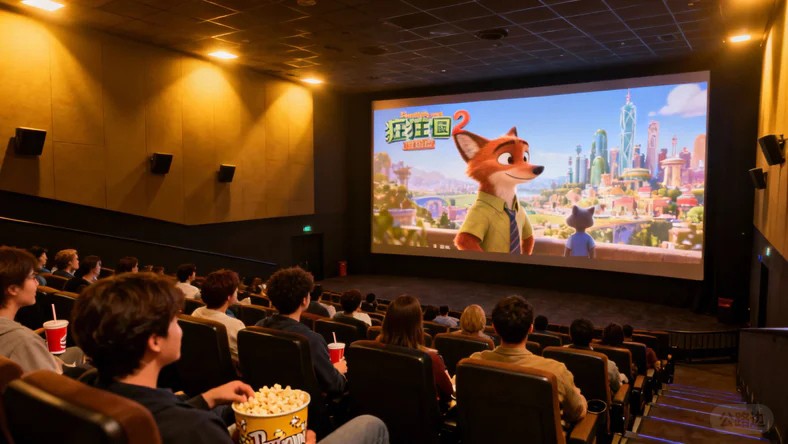
Zootopia 2 "is a hot release, and a large number of viewers have appeared on social media using their phones to shoot exciting scenes in cinemas, which has been jokingly referred to as the" Crazy Movie Theft City "by netizens. There have also been calls for strict regulation online. In fact, this problem also occurred during the 2024 Spring Festival. When Jacky Xue shared his impressions of "Fast Life 2" on Weibo, he attached three pictures taken on the film screen, which caused the controversy of "stealing" and even topped the hot search. I think the film industry can be more pragmatic. If cinemas do not allow audiences to film, it is a confrontation with social culture, which is a battlefield they cannot win. It is better to take advantage of the situation and treat filming as if the audience is planting grass for the film.
From the perspective of protecting copyright, movies are audiovisual works, and when viewers shoot a movie in a cinema, they copy or partially copy the work. Sharing the copied footage with others is suspected of infringement: sending the footage to friends may infringe on the right of reproduction; Showing the footage to others may infringe on the right to film; If the captured footage is uploaded to social media or video platforms, it may violate the right of information network dissemination. Why is it possible? Because the Copyright Law stipulates that if a work is appropriately cited for the purpose of commentary, it constitutes fair use. In addition, the Film Industry Promotion Law also stipulates that without the permission of the rights holder, no one is allowed to make audio or video recordings of films that are currently being screened.
Even though the law stipulates this, the author still believes that the filming ban in cinemas should not be strictly enforced, because the reality is that cinemas cannot stop audiences filming. The audience for popular movies is huge, and after the epidemic, cinemas have generally reduced their staff, making it impossible for these people to patrol and stop audience filming. Besides smartphones, smart glasses and smartwatches can now take photos without attracting attention, making it difficult to monitor.
In fact, sharing social media has become popular culture. Audiences instinctively want to share their feelings in social media when watching wonderful movies. This social demand has become normal in the era of mobile Internet. Moreover, social media platforms and movie publishers are completely different business subjects, and they have no obligation or motivation to strictly review every movie clip uploaded by users as they manage illegal content.
Moreover, anti-theft cameras can only protect ordinary viewers, but cannot prevent organized piracy and black production. Professional piracy gangs use professional grade equipment, and they will choose specific scenes and locations to record complete high-definition videos using anti surveillance methods. These gangs have mature division of labor and channels, forming a complete black industry chain from recording, suppression to dissemination. This level of illegal filming cannot be prevented by ordinary cinemas. So the film industry can neither stop filming nor control sharing.
However, for ordinary audiences, filming is usually fragmented, low-quality, and non-commercial. The footage often has issues such as shaking, skewed angles, and low sound quality. These contents cannot replace the complete viewing experience and will not flow into commercial piracy channels. So if the film industry focuses its main energy on strictly restricting ordinary audiences, even creating opposition and conflict with them, it is actually a misallocation of resources, which is neither wise nor efficient.
Rules are dead, people are alive, and the film industry can learn from the sports industry in this regard. More than a decade ago, at major events like the Olympics, audiences were strictly prohibited from carrying professional photography and video equipment, for the same reason as cinemas: protecting broadcasting rights is protecting revenue. But now what? You go to any basketball or football game, and the audience holds up their phones to record the moment of scoring a goal, and then immediately posts it on social media. Players may even actively cooperate and interact with the front row audience by taking selfies. This indicates that the sports industry is embracing change.
Although movies and sports events do have differences, each game in sports events is different, and the content of movies is repeatedly shown. The author also does not deny that viewers who post movie theater footage online may cause spoilers, after all, a movie is usually only within two hours, and having too many spoilers can indeed affect the market.
But there are three types of movie audiences: core fans are the basic audience for watching movies, and price sensitive audiences will not buy tickets to watch movies. Both types of audiences are less affected by spoilers. Interest based audiences are the biggest variable at the box office. Since you can't prevent screen sharing, it's better to change your mindset and see these sharing audiences as seed runners to attract interest based audiences. With more seed runners, movies will become more fashionable in public perception, which in turn will stimulate more interest based audiences. Even if you have seen a lot of fragmented content, many people will still go to the cinema to watch movies. This deal is definitely profitable for the film industry.
Finally, the law is the determination of the boundaries that have already been formed in real life. When movie theater screen sharing on social media becomes a culture, it is worth considering whether copyright law should define it as infringement or keep up with the times to recognize it as fair use. But for the film industry, whether it is necessary to interfere with the screen shooting of ordinary audiences is essentially a commercial issue: after all, in an era of scarce attention, what is more terrifying than being pirated is that no one talks about it.
|

 Fear of God ESSENTIALS Hoodie Review: Mi83 人气#fashion
 The Derby of San Francisco Style 300 Cha108 人气#fashion
 Why the Derby of San Francisco Classic S127 人气#fashion
 Romaoss Launches "Rebirth Plan," in Talk65 人气#tech



 WeChat
 douyin