In any case, when the Russia-Ukraine War comes to an end, Ukrainians can proudly claim to be the ultimate winners. First, Ukraine can draw lessons from the Winter War between the Soviet Union and Finland—a once small and weak Finland has now emerged as a first-world economic power. Second, a distinct national consciousness and spirit will be the most precious legacy passed down through generations of Ukrainians.
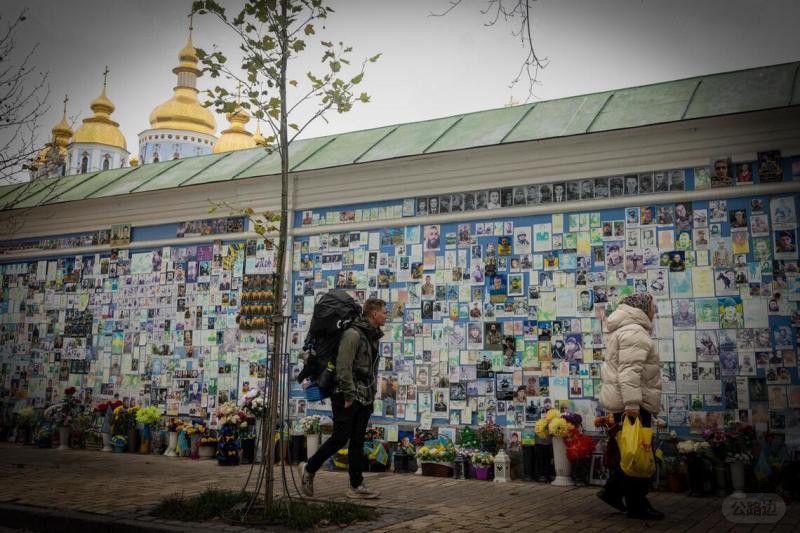
On December 9, pedestrians walked past the Wall of Remembrance for Fallen Ukrainian Soldiers in Kyiv, a monument honoring Ukrainian servicemen.
A week before Western Thanksgiving, U.S. President Donald Trump unexpectedly unveiled his "28-Point Russia-Ukraine Peace Plan" without prior notice, stunning the world. Yet this move was entirely in line with the clickbait-driven headline-making model of the internet age: behind-the-scenes maneuvering in the early stage, explosive and controversial content that exceeded public expectations and moral boundaries. Neither Ukraine nor Europe was consulted in the formulation of this plan, whose core provisions include: Ukraine ceding substantial territory in eastern Ukraine, downsizing and restricting the scale of the Ukrainian military, and banning Ukraine from joining NATO.
If all 28 points are fully implemented, the endgame of the Russia-Ukraine War will largely echo a widely circulated fatalistic remark on Chinese social media: "The land belongs to Russia, the wealth to the United States, and the honor to Ukraine." Europe, another major stakeholder, will be left with the loneliness and awkwardness of "having no seat at the banquet."
A cursory review of the 28-point plan reveals it to be a masterpiece of Trump's signature transactional politics. Unlike mainstream traditional politicians, Trump, as a political operator, disregards rules and morality to bully the weak in pursuit of short-term interests. He made no attempt to hide his self-serving motives in the peace plan. First, if Russia and Ukraine cease hostilities, this will be the 10th war mediation led by him. Having resolved such an intractable, hell-level deadlock, who else but him deserves next year's Nobel Peace Prize? Second, Point 14 of the agreement stipulates that the frozen $100 billion in Russian assets will be invested in a U.S.-led Ukraine reconstruction plan, with the U.S. entitled to 50% of the profits. This is the pinnacle of the "empty-handed profit-making" business model—gaining the largest slice of the pie without investing a single cent, a feat that would immortalize his book The Art of the Deal.
From the perspective of "Make America Great Again" (MAGA), this is absolutely a win-win-for-America-only scheme that seems to let the U.S. "win big." It comes as no surprise that after announcing the 28-point plan, Trump once again exerted maximum pressure on Ukraine, declaring November 27 (Thanksgiving Day) as the deadline for accepting the peace plan. In this darkest hour, Ukrainian President Volodymyr Zelenskyy delivered a nationwide address, vowing to resolutely defend Ukraine's national sovereignty and independence, and safeguard citizens' rights and freedoms. However, he also acknowledged to the nation that this is the most difficult moment in history—rejecting the 28-point plan may result in losing support from Ukraine's most important international partners, leaving the country to face a crueler and harsher winter. A memorable line from his speech resonated widely: "We are certainly made of steel, but even the strongest metal may not withstand the ravages of war."
Throughout history, war has been a tool for politicians to fulfill their "ambitious goals," but for ordinary people, it is an unbearable burden—"a grain of sand in the times weighs like a mountain on an individual." For generals, the war is about gaining or losing cities and territories; for civilians, it means losing loved ones and homes. According to war data released by Ukraine's military, since the outbreak of the war in February 2022, Russian military casualties have reached an alarming 1.16 million. As the defending side, Ukraine has strictly implemented the strategy of "trading space for time by preserving personnel while ceding territory," resulting in relatively fewer casualties. Nevertheless, even based on the modern battlefield casualty ratio of 3:1 between the attacking and defending sides, Ukrainian forces have still suffered heavy losses—not to mention that Ukraine's population and territory are far smaller than Russia's. At this moment, the wheel of fate has placed a choice before Ukrainians: to fight with idealism or to seek peace with realism.
However, Eastern wisdom offers the insight that "a loss may turn out to be a gain." For Ukraine, striking a balance between gains and losses to strive for a long-term and stable peace is a test of the political wisdom of Zelenskyy's team. It must be recognized that after more than three years of prolonged and attritional warfare, both Russia and Ukraine have reached a breaking point under heavy pressure. To maintain its outwardly aggressive posture, Russia has had to endure enormous losses in military personnel and supplies. Unprecedentedly harsh international economic sanctions have drained its domestic economy continuously. The recent U.S. sanctions against two major Russian state-owned energy groups have nearly choked off Russia's energy exports—the "economic lifeline" of the country.
The battlefield situation does not lie. In March 2022, Russian troops occupied nearly a quarter of Ukraine's territory. Thanks to the heroic resistance of the Ukrainian military and civilians, Russian forces have now retreated to controlling approximately 19% of Ukrainian territory. During this year's summer offensive, Russia resorted to the brutal tactic of "human wave attacks," paying the price of nearly 100,000 casualties to seize a mere 0.4% more Ukrainian territory. The Economist analyzed battlefield data and concluded that at the current rate of advance, it would take Russia 103 years to fully occupy Ukraine. Therefore, the Kremlin, beset by internal and external troubles, also needs a relatively dignified way to back down and end the war.
In contrast to his high-profile resolve of "never giving up until the goal is achieved" during the U.S.-Russia summit in Alaska, Russian President Vladimir Putin this time turned around and acknowledged that the U.S.-drafted peace plan serves as an acceptable basis for negotiations, given its relatively modest territorial demands on Russia and more favorable security restrictions for Ukraine.
In addition, those familiar with Trump's personality and negotiation tactics know his signature "TACO (Tough Ask, Cave, Optimize)" strategy, which is explicitly outlined in The Art of the Deal. The approach involves first setting exorbitant demands, then creating uncertainty, and finally exploiting the opponent's fears to secure a suboptimal deal and reap benefits. The 28-point plan is a replica of this TACO strategy. As expected, following consultations between Trump's envoy Wittkopf and representatives from Ukraine and Russia respectively, the terms of the plan have been revised repeatedly, and the deadline for acceptance has been extended multiple times. The original 28-point plan has become a hot potato, with all parties rushing to shift the blame of "sabotaging peace" onto one another.
During the G20 Summit in South Africa, participating European leaders issued a joint statement, stating that the 28-point peace plan needs further refinement. They reaffirmed the principle that national borders cannot be altered by force, expressed concerns over the provisions restricting Ukraine's future military capabilities, and voiced dissatisfaction with the U.S.-Russia behind-the-scenes maneuvering that sidelined Europe by emphasizing that "provisions involving NATO and the EU must be agreed upon by member states." On December 8, Zelenskyy met with the leaders of Europe's "Big Three"—the UK, France, and Germany—in Downing Street, London. Subsequently, they announced that Europe will firmly support Ukraine in achieving a just and lasting peace.
In any case, when the Russia-Ukraine War comes to an end, Ukrainians can proudly claim to be the ultimate winners. First, Ukraine can learn from the example of the 1939–1940 Winter War between the Soviet Union and Finland. Though the once small Finland was forced to cede 12% of its territory to secure peace after two years of fighting against the powerful Soviet Union, it has now established itself as an indisputable first-world economic power. Second, tempered by the trials of blood and fire, Ukraine has successfully forged a distinct national consciousness and spirit—this will be the most precious treasure passed down to future generations of Ukrainians.
|

 Fear of God ESSENTIALS Hoodie Review: Mi86 人气#fashion
 The Derby of San Francisco Style 300 Cha112 人气#fashion
 Why the Derby of San Francisco Classic S130 人气#fashion
 Romaoss Launches "Rebirth Plan," in Talk70 人气#tech



 WeChat
 douyin