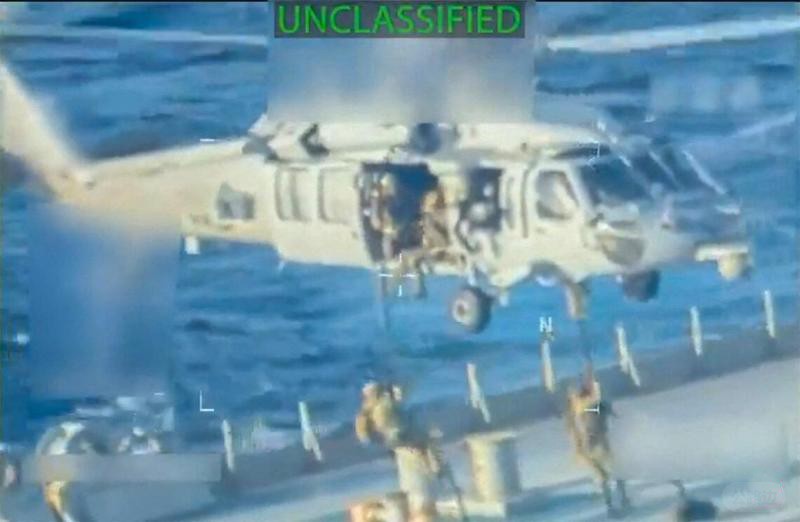
A video released by the U.S. Department of Justice on December 10 shows U.S. military personnel fast-roping from helicopters onto the deck of a Venezuelan oil tanker, subsequently taking control of the vessel.
The U.S. military has seized a large oil tanker off the coast of Venezuela—the first such enforcement action against a sanctions-violating vessel since former President Donald Trump ordered a military buildup in the Caribbean. The move has sharply escalated tensions between the United States and Venezuela and pushed up oil prices.
On Wednesday, December 10, Trump told reporters at the White House that this was the largest tanker ever seized and added, “Other things are happening,” without providing further details.
On the same day, U.S. Attorney General Pam Bondi posted on social media platform X that the FBI, Department of Homeland Security, and Coast Guard—assisted by the U.S. military—executed a seizure warrant targeting a tanker transporting sanctioned oil from Venezuela and Iran. She alleged the vessel was part of an illicit oil network supporting foreign terrorist organizations.
Bondi also shared a 45-second video showing two helicopters approaching an oil tanker, followed by several camouflaged armed personnel rapidly descending via ropes to board the ship and search its compartments. The Trump administration did not disclose the tanker’s name or its location at the time of seizure.
Venezuelan Foreign Minister Yván Gil issued a government statement the same day on social media, condemning the U.S. seizure as “an act of international piracy” and calling on the international community to denounce America’s illegal actions.
The U.S. first imposed sanctions on Venezuela—including a ban on oil exports—during Trump’s initial term in 2019, but this marks the first time Washington has physically seized a Venezuelan oil tanker. Since returning to office, Trump has repeatedly hinted at possible military intervention in Venezuela. Recently, the U.S. has deployed multiple warships near Venezuelan waters under the pretext of anti-narcotics operations, carrying out repeated strikes on vessels allegedly involved in drug trafficking.
Venezuelan President Nicolás Maduro has accused the U.S. military deployment of aiming to overthrow his government and seize control of Venezuela’s vast oil resources.
Maritime risk management firm Vanguard believes the very large crude carrier (VLCC) was seized early Wednesday morning just off Venezuela’s coast. U.S. media reported the seized vessel is a VLCC capable of carrying up to 2 million barrels of oil and was en route to Cuba at the time.
News of the seizure immediately drove up international crude futures prices. Analysts say the move could make it even harder for Venezuela to export oil going forward, as shipping companies may now be more reluctant to load Venezuelan cargo. Due to sanctions risks, most of Venezuela’s oil is currently exported to China via intermediaries at steep discounts.
Leonardo Serrano, head of geopolitical analysis at Rystad Energy, said the tanker seizure shows U.S. sanctions on Venezuela have escalated from financial restrictions to physical interdiction, raising export risks. “Such actions inject geopolitical volatility into oil markets. Even if trade volumes are small, market sentiment is affected when risks involve maritime routes and escalating conflicts between nations.”
Meanwhile, traders and sources say that with abundant supplies of discounted Russian and Iranian crude flooding the market—and heightened risks of loading in Venezuela due to increased U.S. military presence in the Caribbean—Asian buyers are demanding even deeper discounts on Venezuelan oil. In this context, Venezuela has little bargaining power.
A trader who sells crude to Chinese refiners said that ample and heavily discounted supplies from Russia and Iran have left Chinese buyers largely uninterested in Venezuelan crude in recent weeks—even though Venezuelan oil is already trading at a $14-per-barrel discount to Brent, it remains largely unsold.
|

 Fear of God ESSENTIALS Hoodie Review: Mi86 人气#fashion
 The Derby of San Francisco Style 300 Cha112 人气#fashion
 Why the Derby of San Francisco Classic S130 人气#fashion
 Romaoss Launches "Rebirth Plan," in Talk70 人气#tech



 WeChat
 douyin