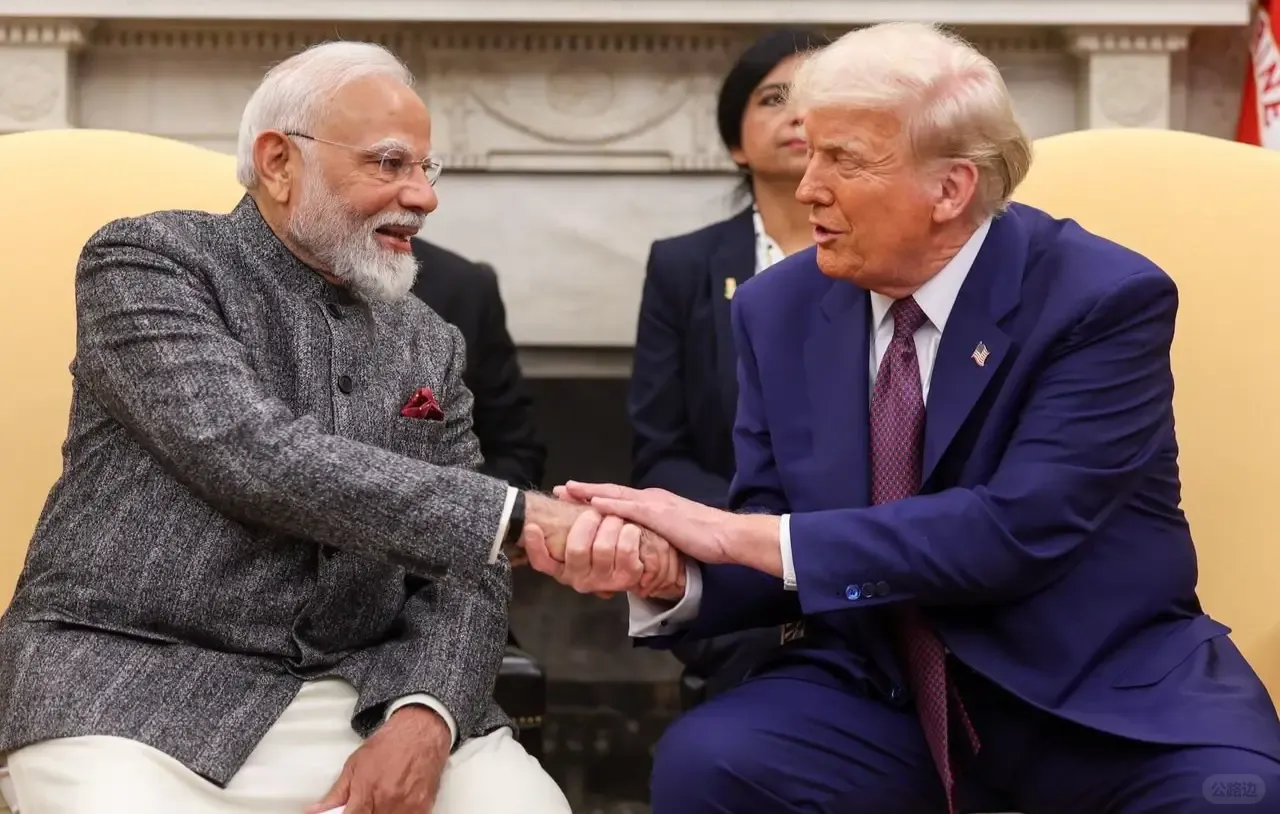
The sixth round of U.S.-India trade negotiations concluded on December 10–11. According to Xinhua News Agency, on the final day of talks, Indian Prime Minister Narendra Modi held a phone call with U.S. President Donald Trump on December 11 (local time) to discuss expanding bilateral trade and enhancing energy cooperation.
Since Trump imposed tariffs as high as 50% on Indian goods—impacting exports in textiles, chemicals, and seafood such as shrimp—Modi and Trump have spoken three times. Modi described their December 11 conversation as “warm and engaging,” adding that both countries would continue working together for global peace, stability, and prosperity.
The recently released U.S. National Security Strategy expressed willingness to deepen economic engagement with India and encouraged New Delhi to assume greater responsibility for security in the Indo-Pacific. However, The Diplomat noted that although the Quad (the U.S.-Japan-India-Australia security dialogue) was mentioned in the report—with emphasis on “preventing any single rival from dominating”—it lacked clarity on broader strategic objectives. Moreover, the frequency of references to India in the document was halved compared to previous versions, sparking external debate over whether the U.S.-India strategic focus is shifting decisively toward economic cooperation.
Zhang Jiadong, Director of Fudan University’s South Asia Research Center and Vice President of the China South Asian Studies Association, told The Paper (
www.thepaper.cn): “It is premature to conclude that the United States is undergoing a comprehensive strategic retrenchment. A more accurate assessment is that while the U.S. shows signs of global-level strategic contraction, it continues advancing regionally—the Indo-Pacific being a prime example. Although the report somewhat moderated its overall characterization of China, related deployments have continued moving forward. This nuance deserves attention.”
He observed that ongoing economic frictions between the U.S. and India have not spilled over into the security domain, and strategic-security collaboration continues, though earlier external expectations of a “quasi-alliance” may have hit a ceiling and are unlikely to break through in the short term.
Is India a “Tough Nut to Crack”?
According to The Times of India on December 10, U.S. Trade Representative Jamieson Greer stated on December 9 that India is a “tough nut to crack,” but also noted that India’s proposal for a prospective trade deal was “the best offer we’ve ever received.” Indian media interpreted Greer’s remarks—made just before the U.S. delegation traveled to India—as a significant positive signal, marking a critical step toward finalizing the first phase of a bilateral trade agreement.
Per The Telegraph (India), the U.S. side was led by Deputy U.S. Trade Representative Rick Swan and Chief Negotiator Brendan Lynch, while India dispatched Commerce Secretary Rajesh Agarwal and Foreign Secretary Vikram Misri, aiming to finalize the first-phase trade deal by year-end.
On December 9 (local time), Greer indicated that India remained reluctant to open its markets for specific commodities such as corn, soybeans, wheat, cotton, meat, and other agricultural products. “They really are a tough nut to crack… but they’re also quite constructive… Their proposal is the best we’ve ever gotten, so I think this is a viable alternative market,” he said.
The Telegraph viewed Greer’s comments as a clear shift in tone amid long-standing negotiation stalemates. On December 11, Indian Minister of Commerce and Industry Piyush Goyal expressed cautious optimism, stating, “Many pieces are falling into place,” and “talks are progressing well.”
However, just as the new round of U.S.-India trade talks began, Trump, during a White House meeting on December 9, accused India of “dumping” cheap rice into the U.S. market, harming American farmers, and warned of potential new tariffs on Indian rice exports.
Agriculture remains the core sticking point in U.S.-India trade negotiations. Washington seeks greater market access for major U.S. crops—corn, soybeans, wheat, and cotton—while India firmly resists due to fears of domestic political backlash.
Zhang Jiadong explained that agricultural and agri-food trade represents a non-negotiable red line for India and a persistent U.S. priority. “Agriculture supports the livelihoods of hundreds of millions of Indian farmers and is foundational to India’s domestic social stability, political security, and even national security. Thus, New Delhi cannot afford to make light adjustments in this sector.”
He further elaborated that the U.S. aims to establish long-term leverage through grain trade, making India more amenable on key issues, while India fears that dependence on U.S. food imports could compromise its domestic and foreign policy autonomy. “This reflects a deep-seated strategic divergence: the U.S. seeks to integrate India into a more binding strategic framework, whereas India insists on strategic autonomy,” Zhang said.
Notably, concurrent with the trade talks, U.S. Under Secretary of State for Political Affairs Allison Hook led a delegation to India to strengthen strategic and economic cooperation. This flurry of high-level interactions has raised external expectations for a thaw in bilateral relations, particularly in trade.
Indian manufacturers and exporters widely hope for a swift conclusion to negotiations, as U.S. punitive tariffs have already negatively impacted their exports to America. Although India is diversifying into other markets to sustain export revenues, the U.S. remains a crucial partner—accounting for 18% of India’s total exports in FY2024.
Zhang Jiadong believes the current talks will yield some interim progress, but a comprehensive final agreement remains uncertain. “The core disagreement on agriculture persists. Breakthrough is possible, but only if both sides make concessions—India compromising moderately in other areas, and the U.S. significantly lowering its core demands. Otherwise, finding common ground will be difficult.”
According to The Economic Times, India’s Chief Economic Adviser V. Anantha Nageswaran stated on December 11 that most outstanding trade issues between India and the U.S. have been resolved, with an agreement expected by March next year.
If a breakthrough is indeed achieved, Washington would begin lifting the 50% punitive tariffs on Indian goods—25% targeting general exports and another 25% linked to India’s purchases of Russian oil. The Telegraph noted that India views the latter as an additional U.S. lever to pressure concessions. This “persuasion tariff” appears effective: India has already reduced its Russian oil imports and agreed to purchase 2.2 million tons of liquefied petroleum gas (LPG) from the U.S.
Nevertheless, New Delhi insists it is not capitulating passively. Goyal repeatedly emphasized that India “will never sacrifice its farmers and small industries,” seeking reciprocal investment and supply-chain partnerships—not one-sided concessions—and will not abandon Russian crude oil purchases, which are vital to its energy security.
Is the U.S. Strategically Retrenching from India?
The White House recently released the Trump administration’s latest National Security Strategy, which mentions the “Indo-Pacific” eight times, focusing on freedom of navigation, military deterrence, and ensuring global economic flows. India is referenced four times—half as often as in the 2017 version.
Specifically, the report states the need to “continue improving commercial (and other) relations with India,” encourages India to contribute more to Indo-Pacific security through mechanisms like the Quad, seeks to align European and Asian partners (including India) to reinforce U.S. standing in the Western Hemisphere, and calls for enhanced cooperation in critical minerals in Africa. It also pledges to “prevent any competitor from controlling the South China Sea” and cooperate with all affected nations—from India to Japan.
Some Indian media interpreted this as India’s elevation to a “key partner.” However, The Diplomat and the Chicago Council on Global Affairs argued that the current U.S. administration appears less focused on India’s strategic potential, casting doubt on the reliability and depth of America’s Indo-Pacific commitments for partners like India.
Yet actual cooperation shows no signs of retrenchment in military or economic domains.
Zhang Jiadong pointed out that U.S.-India strategic alignment and military cooperation have not weakened in 2025. “Joint exercises this year number 17—on par with last year—and their substantive content has deepened. Military collaboration continues advancing.”
He added that while economic cooperation has lagged slightly behind military ties, it has not regressed significantly. India’s exports to the U.S. are heavily weighted toward services and other zero-tariff items, keeping the overall tariff burden manageable.
According to the Economic Daily, following positive signals from both sides in October, India’s merchandise exports to the U.S. rose month-on-month for the first time since May. Data from India’s Ministry of Commerce and Industry show October exports reached $6.3 billion—a 14.5% increase from September.
In energy and defense procurement, India—among the world’s largest LPG consumers—recently signed its first LPG purchase agreement with the U.S., committing to import 2.2 million tons in 2026, roughly 10% of its annual demand. In early November, the two sides signed a 10-year defense cooperation framework agreement, under which India pledged to increase arms purchases from the U.S.
During their December 11 call, Modi and Trump also discussed expanding cooperation in critical technologies, energy, defense, security, and other priority areas. Clearly, military-defense ties, technology transfer, and economic linkages with the U.S. remain pivotal elements in India’s strategic calculus.
Zhang Jiadong believes that even though India is mentioned less frequently in the latest National Security Strategy, this does not signify strategic retrenchment by the Trump administration, nor does it substantially undermine India’s regional ambitions. For instance, India’s demand for U.S. military hardware has grown—especially after the May India-Pakistan conflict exposed gaps in its capabilities—and Washington is well-positioned to supply advanced technology and equipment. “The U.S. aims to lock in the Indian market, while India urgently needs high-end U.S. military tech,” he said.
However, evolving U.S. foreign policy underscores the necessity of diversification. As The Diplomat noted, overreliance on a single partner carries risks for India, especially under a Trump administration characterized by “shifting priorities and transactional diplomacy.”
Indeed, just a week before this round of trade talks, New Delhi hosted Russian President Vladimir Putin, who visited India on December 4–5—their first meeting in four years. According to Reuters, India and Russia agreed to adjust their defense relationship to support India’s push for indigenous development through joint R&D and production of advanced defense platforms, including co-producing spare parts, components, and assemblies in India for maintaining Russian weapons systems.
Russia has long been India’s largest arms supplier. Most of India’s 29 fighter squadrons operate Russian Su-30 jets. Ahead of Putin’s visit, Indian Defense Minister Rajnath Singh indicated that India might discuss purchasing additional S-400 systems or the upgraded S-500 air defense systems from Russia.
Currently, India is pursuing defense procurement diversification—not only from Russia but also from Germany for submarines. The Indian Express argues that by strengthening regional leadership and deepening ties with Europe, Russia, Japan, and other major powers, India enhances its bargaining position vis-à-vis a transactional Trump-led U.S.
However, India’s hedging on Russia-related issues contrasts sharply with U.S. Asian allies like Japan and South Korea.
In Zhang Jiadong’s view, this has sustained a trust deficit between Washington and New Delhi for years, with many disputes stemming from this duality. “Despite this, India maintains its course. It responds to U.S. pressure through ‘soft resistance’—making limited concessions under pressure while employing a strategy of trading time for space and space for time. This approach is closely tied to India’s aspiration to become a great power.”

 Fear of God ESSENTIALS Hoodie Review: Mi83 人气#fashion
 The Derby of San Francisco Style 300 Cha108 人气#fashion
 Why the Derby of San Francisco Classic S127 人气#fashion
 Romaoss Launches "Rebirth Plan," in Talk65 人气#tech



 WeChat
 douyin