On December 11 local time, OpenAI officially released its latest model, GPT - 5.2, marking a full - scale counterattack in the face of the fierce challenge posed by Google's Gemini 3. Focusing on optimizing professional work scenarios, the new GPT - 5.2 has achieved remarkable improvements in core capabilities such as programming, scientific tasks, and long document processing. OpenAI stated that GPT - 5.2 is by far the best - performing model in terms of professional knowledge work, boasting faster speed, more accurate information retrieval, and significant enhancements in writing and translation.
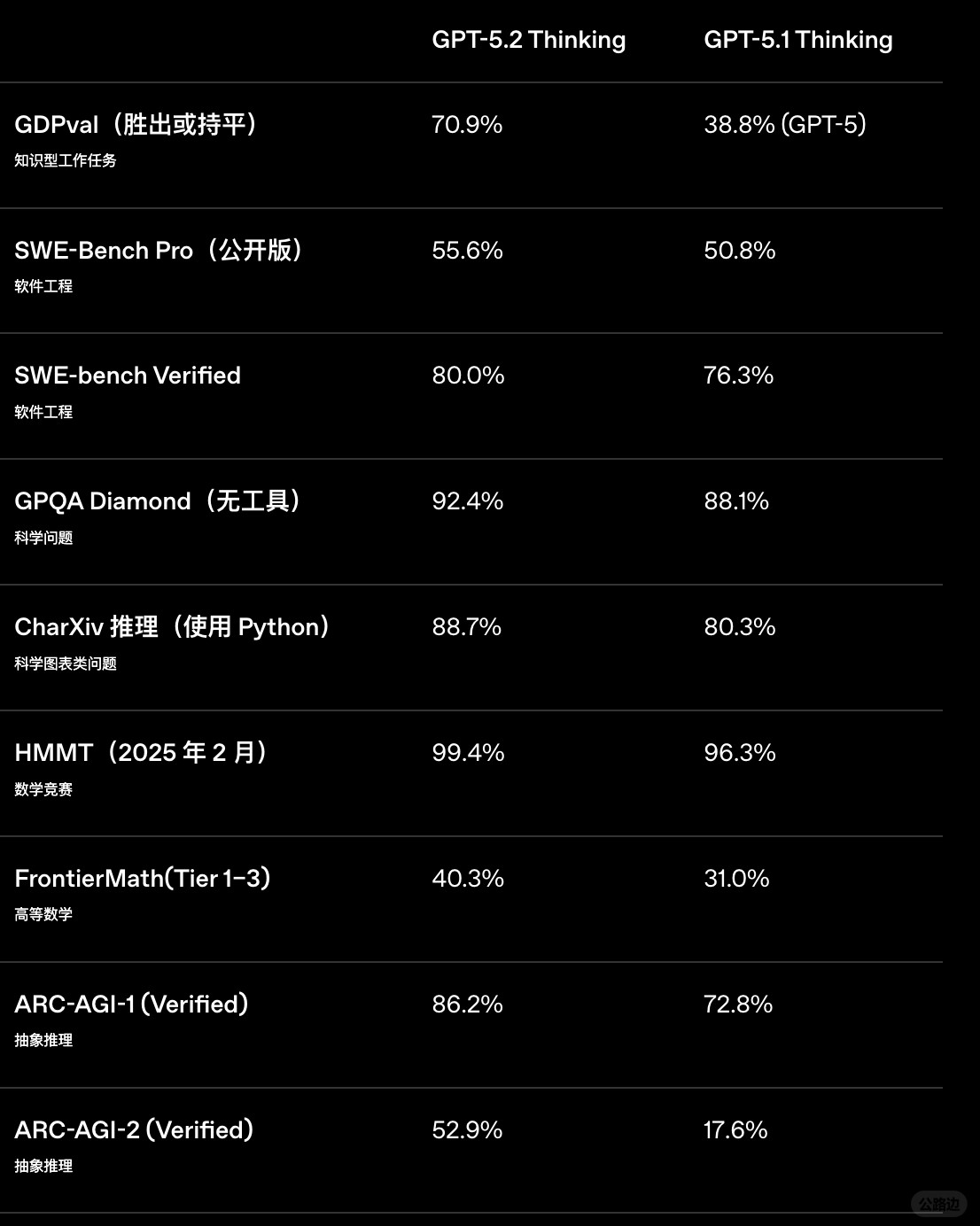
GPT - 5.2 vs. GPT - 5.1
GPT - 5.2 comes in three versions: Instant, Thinking, and Pro, which will be rolled out to paid ChatGPT users one after another starting today. It is priced at $1.75 per million input tokens and $14 per million output tokens.
The core advantage of GPT - 5.2 lies in the precise optimization of specialized tasks. According to official data from OpenAI, the new model has set new records in multiple benchmark tests. In the GDPval test that assesses 44 professional knowledge - based tasks, it became the first AI model whose overall performance has reached or exceeded that of human experts. It performed on par with or outperformed industry experts in 70.9% of the tasks, completing them more than 11 times faster than human experts, with the total cost accounting for less than 1% of that incurred by human experts.
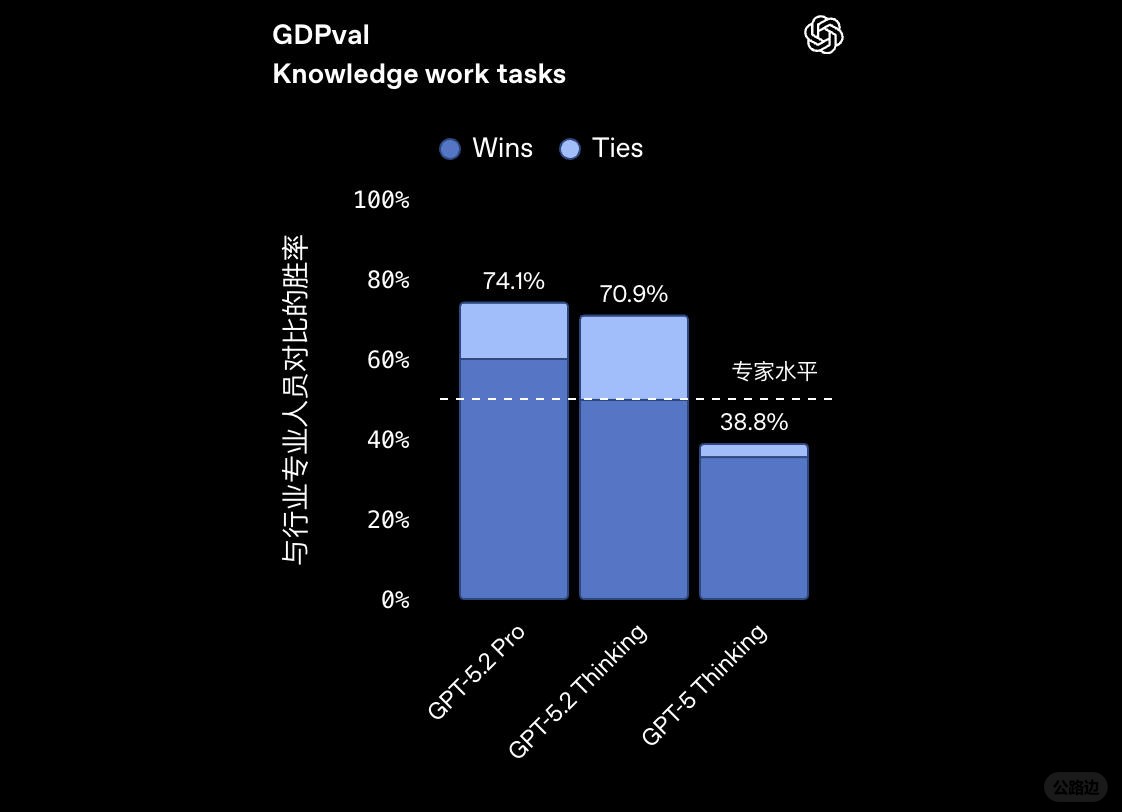
GDPval Test Results of GPT - 5.2
In terms of the two key capabilities of long text processing and visual understanding, data from OpenAI's MRCRv2 benchmark test shows that within the ultra - long context of 256,000 tokens, GPT - 5.2 achieved an accuracy rate of nearly 100% in multi - document information integration tasks. It performed particularly well in tests that require distinguishing multiple similar information points, making it highly suitable for in - depth document analysis and multi - source information integration.
In terms of visual processing, GPT - 5.2 Thinking has been officially hailed as "the most powerful visual model currently available". The error rate in chart reasoning and software interface understanding has dropped by approximately 50% compared with the previous generation. It can accurately interpret professional visual content such as data dashboards, technical drawings, and visual reports, and is well - adapted to work scenarios centered on visual information, including financial operations, engineering design, and customer service.
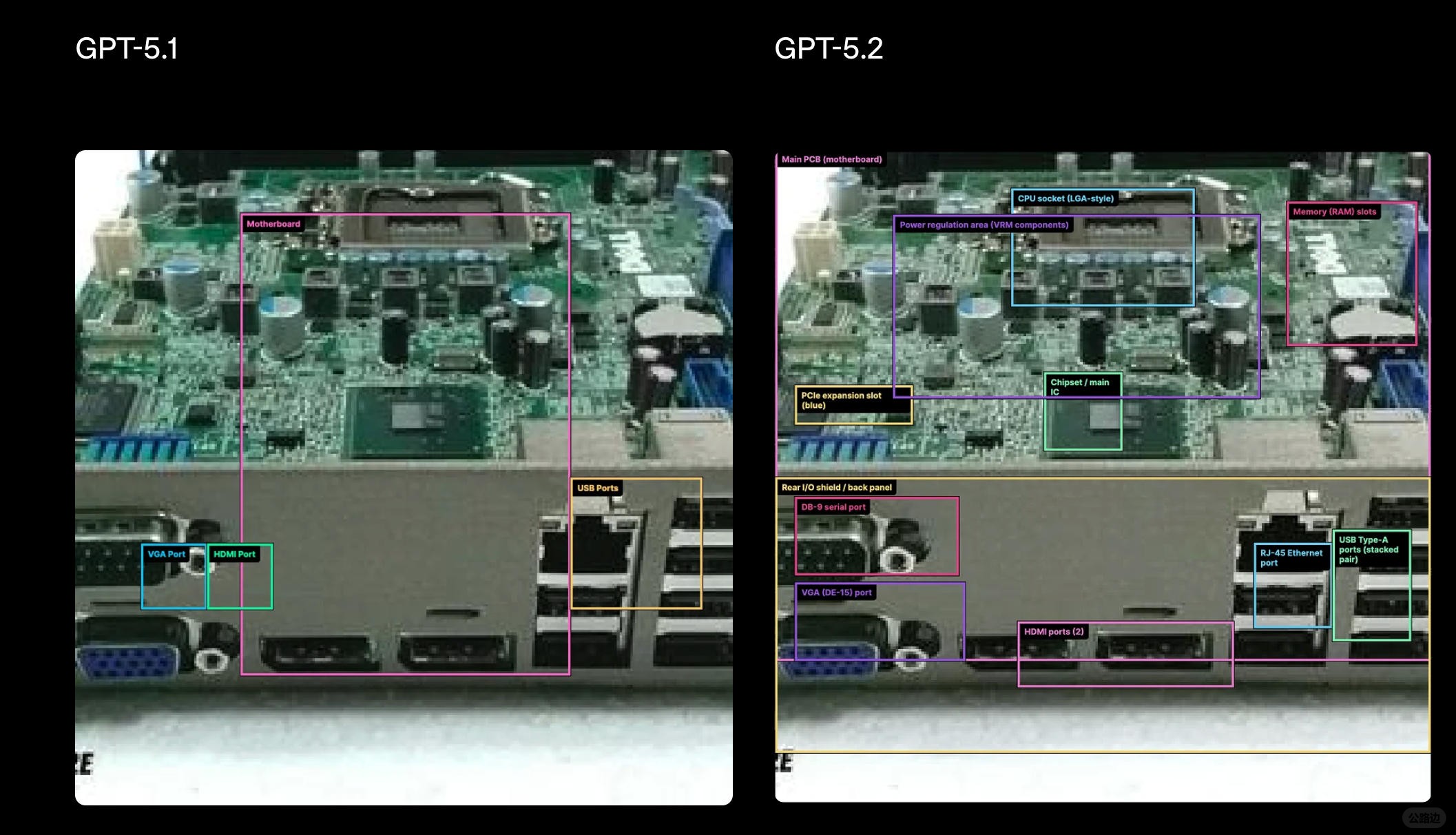
Visual Processing Comparison Between GPT - 5.2 and GPT - 5.1
Compared with GPT - 5.1, the new model has a significantly reduced hallucination rate and greatly improved credibility in professional knowledge - intensive scenarios. Even when the reasoning intensity is set to the lowest level, the overall performance of GPT - 5.2 is still significantly better than that of both GPT - 5.1 and GPT - 4.1.
By launching GPT - 5.2 with a focus on professional knowledge work, OpenAI aims to attract more enterprise clients and increase revenue to support its infrastructure investment plan of over $1 trillion in the coming decades.
In August this year, OpenAI launched the highly anticipated GPT - 5, but it faced doubts due to chart errors, shortcomings in professional knowledge, and sub - par functional optimizations. Although the urgently upgraded GPT - 5.1, released in November, brought minor improvements, it failed to turn the tide. Shortly afterward, Google launched its large Gemini 3 model in November, which achieved a remarkable breakthrough by virtue of its strengths in multimodality and long text processing.
In response to the competition from Google, Sam Altman, CEO of OpenAI, stated that "the impact of Gemini 3 has been lower than expected". He also revealed that the company's current "red alert mode" will end by January next year, after which it will concentrate resources on optimizing core capabilities to make a strong comeback in the market.
|

 Fear of God ESSENTIALS Hoodie Review: Mi83 人气#fashion
 The Derby of San Francisco Style 300 Cha108 人气#fashion
 Why the Derby of San Francisco Classic S127 人气#fashion
 Romaoss Launches "Rebirth Plan," in Talk65 人气#tech



 WeChat
 douyin