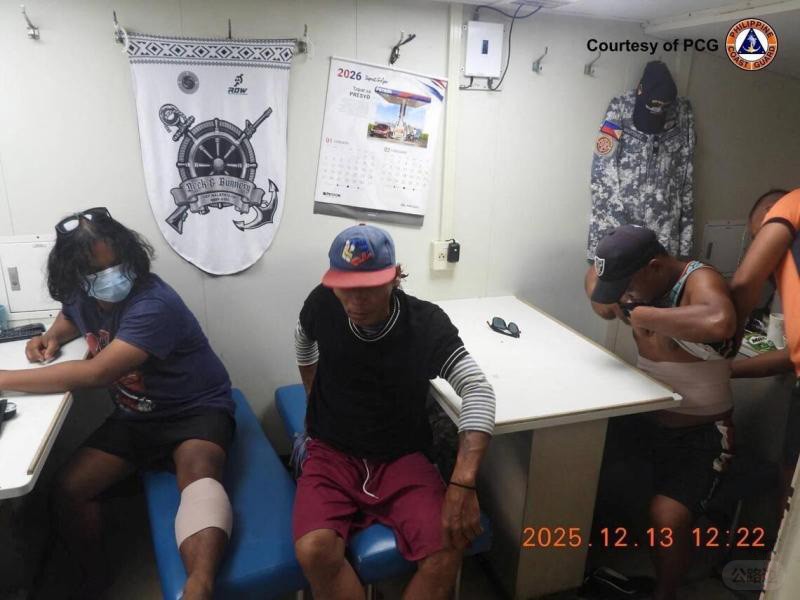
Photos provided by the Philippine Coast Guard and taken on December 13 show Philippine coast guard personnel assisting injured fishermen following a clash between a China Coast Guard ship and Philippine fishing boats in disputed waters of the South China Sea. (AFP)
A fresh confrontation broke out between China Coast Guard vessels and Philippine fishing boats in the South China Sea. Multiple Philippine fishing boats sailed to the waters near Second Thomas Shoal (known as Ayungin Shoal in the Philippines) on Friday (December 12), only to be expelled by the China Coast Guard. Manila accused China of using water cannons during the operation, leaving three fishermen injured and two fishing boats severely damaged.
The China Coast Guard (CCG) issued a statement on Friday, stating that multiple batches of Philippine vessels, under the pretext of fishing, deliberately intruded into the waters off Second Thomas Shoal in the Nansha Islands to stir up trouble and provoke incidents, disregarding repeated dissuasion and warnings from the Chinese side. The CCG took necessary control measures such as "verbal warnings and expulsion by outward interception" against the Philippine vessels in accordance with laws and regulations.
Liu Dejun, spokesperson for the China Coast Guard, emphasized that China has indisputable sovereignty over the Nansha Islands, including Second Thomas Shoal, and their adjacent waters. The CCG will continue to conduct rights-protection and law-enforcement activities in China’s jurisdictional waters in accordance with the law, and "resolutely safeguard national territorial sovereignty and maritime rights and interests".
Jay Tarriela, spokesperson for the Philippine Coast Guard, pointed out on Saturday (13th) that the CCG’s statement was in fact an admission of China’s improper conduct.
The Philippine Coast Guard stated in a release that nearly 20 Philippine fishing boats were subjected to water cannon attacks and interception during the incident, causing three fishermen to suffer bruises and external injuries, and two fishing boats to sustain severe damage from the impact of high-pressure water cannons. In addition, a small China Coast Guard vessel cut the anchor chains of multiple Philippine fishing boats, endangering the safety of the crew members.
The statement added that Philippine vessels dispatched to rescue the injured fishermen were repeatedly blocked from reaching the incident site. It noted that despite facing "unprofessional and illegal interference", the Philippine Coast Guard successfully reached the fishermen’s location on Saturday morning, provided emergency medical treatment to the injured, and delivered necessary supplies.
The Philippine Coast Guard also called on the China Coast Guard to abide by internationally recognized standards of conduct, prioritize the safety of lives during law enforcement operations, and avoid endangering innocent fishermen.
Recent frictions between China and the Philippines over territorial disputes in the South China Sea have been on the rise. The Southern Theater Command of the Chinese People’s Liberation Army (PLA) also issued a circular on Friday, stating that "in recent days, multiple small Philippine aircraft illegally intruded into the territorial airspace of China’s Huangyan Island (known as Scarborough Shoal in the Philippines) without the approval of the Chinese government". The Southern Theater Command deployed naval and air forces to "track, monitor, strongly warn, and resolutely expel them in accordance with laws and regulations".
For its part, the Philippine Coast Guard claimed that Chinese vessels had besieged Philippine ships near Huangyan Island on the same day. While multiple vessels from the Philippine Coast Guard and the Bureau of Fisheries and Aquatic Resources were on a resupply mission, three China Coast Guard ships and seven vessels identified as Chinese maritime militia hovered nearby to exert pressure, with both sides engaging in continuous radio communications and verbal exchanges. Analysts believe that such standoffs have gradually become the new normal in the relevant waters.
|

 Fear of God ESSENTIALS Hoodie Review: Mi86 人气#fashion
 The Derby of San Francisco Style 300 Cha114 人气#fashion
 Why the Derby of San Francisco Classic S131 人气#fashion
 Romaoss Launches "Rebirth Plan," in Talk70 人气#tech



 WeChat
 douyin