Paradoxically, the business models of many AI companies are currently unsustainable from a cash flow perspective, with many services effectively operating at a loss to capture market share. This is what analysts describe as a prisoner’s dilemma: if you maintain pricing discipline while your competitor aggressively subsidizes, you lose; but if you also join the subsidies, everyone gets dragged into an unsustainable price war.
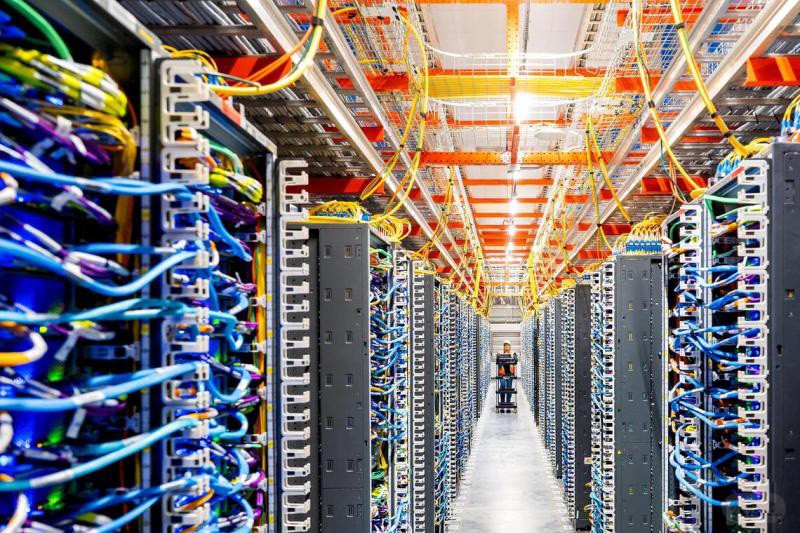
In the AI industry, players aren’t choosing between confessing or staying silent—they’re choosing between aggressive acceleration or cautious safety. Once both sides expect the other won’t back down, they slide into an equilibrium where both act aggressively. (Photo: An Amazon Web Services data center in Indiana, USA. Reuters)
“The cost of absence is higher than the cost of massive investment”—this phrase best captures the current dynamics of artificial intelligence (AI) development. On the surface, tech giants like Microsoft, Google, Amazon, and Meta appear to be recklessly betting on the future: pouring hundreds of billions, even trillions, of dollars into data centers, graphics processing units (GPUs), and power infrastructure, sharply escalating capital expenditures. But viewed through the lens of game theory, this isn’t mere greed—it’s a textbook prisoner’s dilemma: each company makes a rational choice from its own perspective, yet collectively pushes the entire system toward greater systemic risk.
In the classic prisoner’s dilemma, two suspects are interrogated separately. If both cooperate by staying silent, each serves one year—a collectively optimal outcome. But because they can’t trust or communicate with each other, each realizes that regardless of what the other does, confessing is always personally advantageous. The result: both confess and serve five years each—ten years total, worse than if they’d cooperated. The issue isn’t morality; it’s the incentive structure that forces betrayal. Apply this logic to the AI arms race, and we understand why all major players know the risks are huge, yet none dare hit the brakes.
In the AI context, Player A and Player B don’t choose between confessing or silence—they choose between aggressive acceleration or cautious safety. If both opt for caution—slower product launches, emphasis on risk management, model alignment, and social stability—the long-term outcome benefits both the industry and society, yielding a stable payoff of 100 points each. But if either believes the other won’t play conservatively, the rational response becomes: “I must accelerate full throttle to secure market share and technological leadership, even if it imposes external costs.” Once both sides expect the other won’t relent, they slide into an equilibrium of mutual aggression—each still earns some profit but bears significantly higher risk and uncertainty, resulting in lower collective welfare than initial mutual caution would have delivered.
Capital markets further amplify this dilemma. Tony Yoseloff, Chief Investment Officer at hedge fund Davidson Kempner, noted that tech giants feel compelled to keep increasing AI spending out of fear of losing competitive advantage. Today’s AI infrastructure investments don’t just reshape corporate balance sheets—they’re already intertwined with the macroeconomy: mega-cap tech stocks dominate major indices and are seen as primary engines of growth; data center and GPU investments have even become significant contributors to U.S. GDP growth. This means companies are no longer accountable only to shareholders—they’re also tethered to national growth narratives. Pulling back on investment suddenly could not only punish your stock price but also be interpreted as betraying the broader AI narrative.
More paradoxically, many AI business models remain cash-flow negative, with services often sold below cost to grab market share. Rationally, if all players priced according to actual usage and cost structures, the market could operate at a healthier equilibrium. But under pressure to acquire users and tell compelling growth stories, every firm has an incentive to offer unlimited, ultra-low-cost, or even free plans—trading subsidies for growth. Everyone buys the most expensive, latest GPUs, builds the largest models, and offers the most generous free quotas. Short-term metrics look great, but long-term profitability across the entire industry gets squeezed. This is what analysts call the pricing prisoner’s dilemma: if you stay disciplined while your rival floods the market with subsidies, you lose; if you join in, everyone plunges together into an unsustainable price war.
The risks extend beyond corporate earnings—they could evolve into macro-financial problems. Currently, rising valuations of AI-related assets boost stock prices, drive real estate demand, and even stimulate employment and industrial investment, creating a self-reinforcing flywheel: capital spending lifts economic data, which in turn supports higher valuations and easier financing conditions. But as past real estate bubbles have shown, once markets begin questioning the true returns on these AI investments—due to delayed profits, falling GPU prices, or users shifting to cheaper alternatives—the collateral narrative underpinning everything could unravel, triggering asset devaluation that spreads into credit contraction and abruptly halting the AI–finance–economy flywheel.
At a higher level, the prisoner’s dilemma among AI giants is tightly linked to the national-level race for artificial general intelligence (AGI). Policy researchers have already modeled this formally: if both the U.S. and China believe the strategic gains of being first to achieve AGI outweigh its safety risks, both will be locked into a national-scale prisoner’s dilemma. If either side slows down to strengthen safety and governance, it fears being overtaken by the other, falling behind in critical technologies, and consequently losing military, economic, and discursive advantages. The result: all participants recognize the dangers but are structurally incentivized to accelerate rather than decelerate, leaving global governance needs constantly squeezed by the anxiety of technological competition.
Escaping this trap requires more than corporate self-restraint or moral declarations. From a game-theoretic perspective, breaking the prisoner’s dilemma demands changes to both information structures and incentive mechanisms—making cooperation not a naive choice but a sustainably maintainable strategy. First, greater transparency around risk disclosure and return expectations is needed so investors and regulators can clearly see the real profitability of AI capital expenditures, rather than being dazzled solely by impressive growth curves. Second, the industry itself could adopt shared standards, safety protocols, foundational models, and safety tools to reduce redundant development and the impulse that “if you build it, I must rebuild it myself.” At minimum, collaboration—not pure rivalry—should prevail in safety and risk management.
For national-level competition, various forms of international coordination, verification mechanisms, and joint risk assessments are essential to transform a one-shot, zero-sum race into a repeated, long-term game. Only within frameworks that enable monitoring and penalizing defection can cooperative equilibria emerge. Otherwise, all sides will assume their rivals will accelerate at the critical moment—and thus feel unable to step back themselves.
In this sense, the prisoner’s dilemma facing AI giants is not merely an industry story—it’s a mirror of contemporary techno-capitalism: individual rationality, short-term incentives, and institutional design intertwine, making everyone feel they have no choice but to go “all in” on AI.
|

 Fear of God ESSENTIALS Hoodie Review: Mi86 人气#fashion
 The Derby of San Francisco Style 300 Cha114 人气#fashion
 Why the Derby of San Francisco Classic S131 人气#fashion
 Romaoss Launches "Rebirth Plan," in Talk70 人气#tech



 WeChat
 douyin