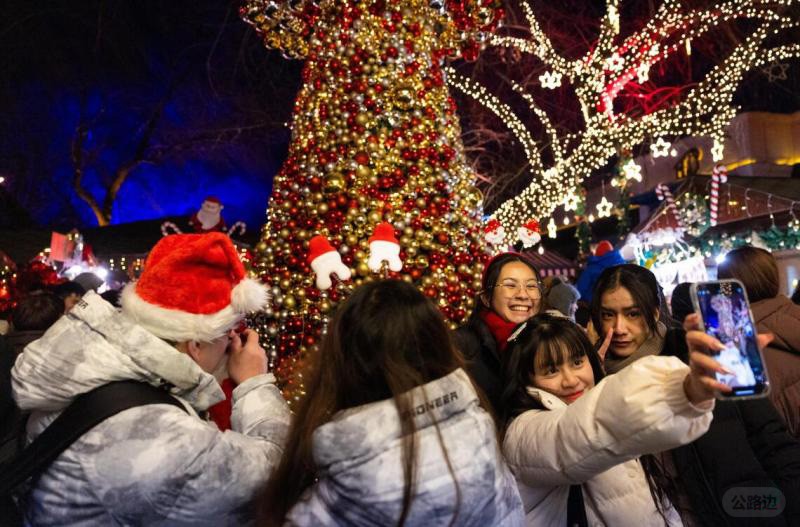
On the eve of Christmas, crowds of people gathered to take photos beside the light decorations at a Christmas market in Beijing. (Reuters)
On the eve of Christmas, calls to reject Western festivals have resounded again on campuses across many parts of China, but there has been no obvious boycott at the social level. The festive atmosphere of Christmas remains strong in first-tier cities, with many merchants launching promotional activities; however, Christmas has had a limited effect on boosting consumption, and sales of cheap "Ping An Guo (peace apples)" are also not as good as before.
The so-called Ping An Guo refers to exquisitely packaged apples, named for the homophony between "ping (apple)" and "ping (peace)". Among Chinese people, the custom of exchanging Ping An Guo on Christmas Eve has been popular for many years. Schools in Beijing, Tianjin, Jilin, Shaanxi, Jiangxi and other places issued initiatives on Thursday (December 25), the eve of Christmas, calling on teachers and students to reject Western festivals, including banning the exchange of Ping An Guo.
Beijing Jingshi Sunshine Sanyi Road Kindergarten issued an initiative titled "Reject Western Festivals, Start with Me" on its WeChat official account on Tuesday (23rd), stating that Christmas is an important religious festival in Western countries, and suggesting that teachers, students and parents should not overemphasize the festive atmosphere. The kindergarten clearly required teachers not to accept Ping An Guo from children and parents, and also prohibited students from bringing Ping An Guo into the kindergarten during Christmas.
Xinqiao School in Qingyuan District, Ji'an City, Jiangxi Province, which has both middle and primary school sections, further stipulated in its initiative issued on the same day that in addition to banning the exchange of gifts, greeting cards, Ping An Guo and other items in the name of Western festivals, it also prohibited hanging Western festival decorations on campus or in classes, and purchasing Christmas trees, Christmas hats and other Western festival supplies to bring into the campus. In addition, the school also required teachers, students and parents not to forward or spread videos, tweets, text messages, Weibo, WeChat and other content related to Western festivals.
However, Xu Tianchen, a senior analyst at the Economist Intelligence Unit, said in an interview with Lianhe Zaobao that the overall attitude of Chinese society towards Christmas this year is "if people want to celebrate, let them", with Christmas markets and other activities still held among the people in various places, and the official attitude is "neither support nor boycott".
Xu Tianchen analyzed that on the one hand, this shows that China's cultural confidence has increased, and it will not be upset by people celebrating Western festivals; on the other hand, China is continuing to expand opening up, "if we openly boycott Christmas, it will not be conducive to our own image."
In China's first-tier cities, the Christmas celebration atmosphere is still strong. Netizens in Beijing, Shanghai, Shenzhen, Guangzhou and other places have posted photos with Christmas decorations on social media. According to observations by our reporter, Christmas trees can be seen everywhere in Sanlitun, a downtown business district in Beijing, and many merchants have launched holiday gift boxes to attract consumers; the Christmas market activity at Shanghai Kerry Centre kicked off at the end of November, with a huge crowd last weekend.
However, the overall economic headwinds have made Chinese consumers more rational, and the consumption promotion effect of Christmas is also fading. A Beijing resident surnamed Li, who works in Australia and returned to China during the Christmas holiday, said in an interview: "In the past, Chinese people would spend money for Christmas, but now it's different... Now people spend money if they want to, not for fixed festivals."
The latest data from the National Bureau of Statistics of China shows that the year-on-year growth rate of total retail sales of consumer goods in November dropped sharply from 2.9% in October to 1.3%, the lowest level since the lifting of the "zero-COVID" epidemic prevention policy in December 2022.
Xu Tianchen expects that Christmas will still have a certain driving effect on catering consumption, but the overall impact is limited. He pointed out that the volume of Christmas-related consumption is far lower than that of traditional Chinese festivals.
Xiao Liu, who runs a pastry business in Beijing, sets up a stall on the street to sell Ping An Guo every Christmas Eve. This year, she hung packaged Ping An Guo and self-made promotional boards on a folding trolley and pushed it to the busiest crossroads in Sanlitun to set up the stall.
Xiao Liu told our newspaper that sales of Ping An Guo were very impressive ten years ago, with prices similar to now, no more than 30 yuan (RMB, about 5.4 Singapore dollars); but business has obviously slowed down in recent years, "people don't attach so much importance to foreign festivals anymore."
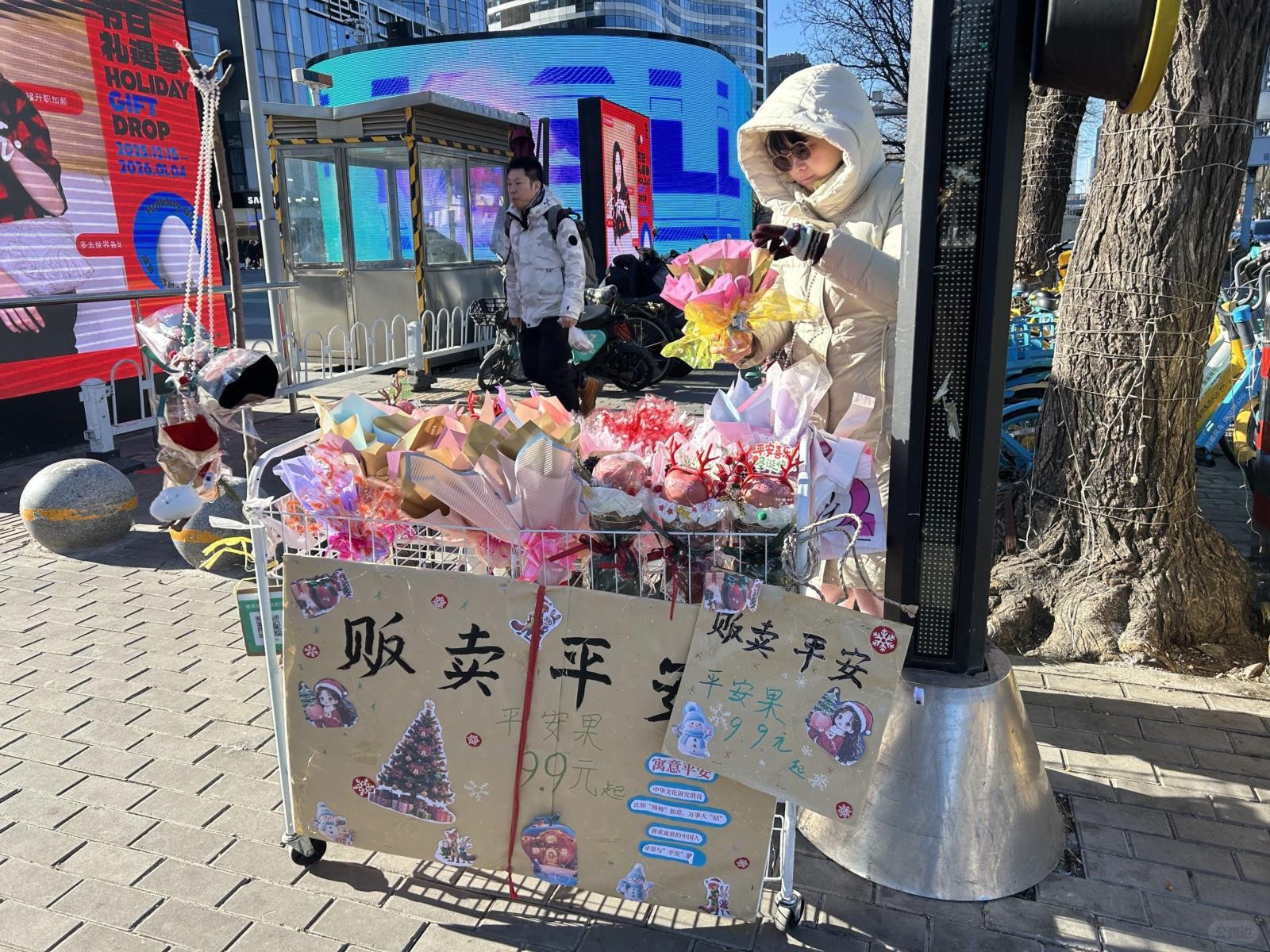
Xiao Liu, who runs a pastry business, sets up a stall to sell Ping An Guo beside the crossroads in Sanlitun, Beijing.
|

 Fear of God ESSENTIALS Hoodie Review: Mi86 人气#fashion
 The Derby of San Francisco Style 300 Cha113 人气#fashion
 Why the Derby of San Francisco Classic S130 人气#fashion
 Romaoss Launches "Rebirth Plan," in Talk70 人气#tech



 WeChat
 douyin