The capital market has shown immense enthusiasm for China's domestic GPU industry. As the "first domestic GPU stock", Moore Threads has seen its market value surpass 300 billion yuan since its listing. However, to sustain this high valuation, it must demonstrate a momentum of continuous growth. Behind the valuation fluctuations, what the market cares most about is obviously its future development direction.
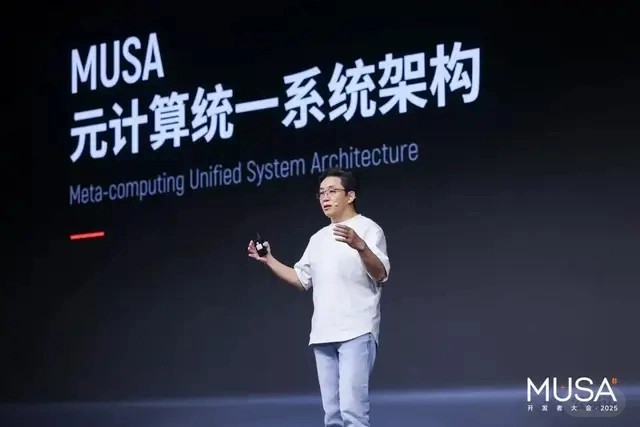
On December 20th, just 15 days after landing on the STAR Market, Moore Threads held its first "MUSA Developer Conference", and almost "radically" released the company's new GPU architecture as well as a series of technological and product progress, covering high-performance computing, 10,000-card clusters, embodied intelligence and other fields.
Moore Threads has shown its family fortune, and at the same time, has fully placed the focus of its future narrative on the "ecosystem". It aims to build a developer ecosystem centered on its MUSA architecture, build its own moat, and boost market confidence.
Building a "Chinese Version of CUDA"
"The ecosystem is the core moat and value of the GPU industry," said Zhang Jianzhong, founder, chairman and CEO of Moore Threads, in his keynote speech.
Moore Threads listed on the STAR Market on December 5th, with a market value exceeding 280 billion yuan on the first day. In fact, it has been favored by investment institutions since its establishment, and one of the major reasons is that the founding team of Moore Threads has sufficient rich industry experience. Many key members, including founder Zhang Jianzhong, basically have long-term work backgrounds at NVIDIA, which has also laid a technical and commercial foundation for the company's development.
In terms of strategic direction, Moore Threads has also chosen a route similar to NVIDIA, that is, "full-featured GPU", which can integrate core capabilities such as AI computing, 3D graphics rendering, high-performance computing, and intelligent video codec on a single card.
Why choose a full-featured GPU? Zhang Jianzhong explained at the developer conference, "Computing power is national power". Looking back at the innovation history of full-featured GPUs, it can be said to be an evolutionary history of computing power. The "full-featured" capability is crucial for supporting increasingly complex AI models and diverse application scenarios.
A domestic full-featured GPU can empower numerous application scenarios in thousands of industries, which means Moore Threads may have a broad market space, making it an extremely scarce presence in the capital market. After all, even globally, the number of enterprises capable of mass-producing full-featured GPUs is very limited.
Moore Threads has chosen the most difficult path. Among the current mainstream technical routes of AI chips, full-featured GPUs have the highest technical threshold and higher difficulty in ecosystem construction. Moore Threads has independently developed the MUSA unified architecture, which is compatible with mainstream ecosystems.
In the AI chip industry, NVIDIA has spent 20 years building the CUDA platform and the huge ecosystem derived from it, covering 5 million developers and a vast number of applications, which constitutes its core competitiveness. For domestic GPUs, the key to breaking through the ecological barriers is to first achieve compatibility with the mainstream system, then gradually build an independent toolchain and resource library, and provide developers with a smooth environment for landing applications on the domestic ecosystem.
Therefore, Moore Threads' first conference after listing was mainly targeted at developers, with the narrative focus entirely on the "ecosystem".
Moore Threads' self-developed MUSA architecture has undergone a full-stack upgrade. Zhang Jianzhong stated that the upgraded MUSA 5.0 not only supports internationally universal CPU systems, but also supports domestic CPU operating systems and domestic development environments. The unified software stack can cover all series of Moore Threads' "cloud-edge-end" products, "supporting all ecosystems of full-featured GPUs".
In the competition in the GPU industry, the ecosystem is the key. Moore Threads has revealed its ambition to build the MUSA ecosystem into a "Chinese version of CUDA".
New Architecture and Chip Roadmap Unveiled
Centering on the upgraded MUSA system, Moore Threads has further expanded this ecological story.
"This is the first time in the company's 5-year history that we have systematically reported our core research results to the outside world," said Zhang Jianzhong. Moore Threads attempts to comprehensively present the imagination of full-featured GPUs to the outside world to boost the confidence of ecological partners and developers.
Similar to NVIDIA, Moore Threads also pre-releases the architecture of its next-generation products. After mass-producing the first-generation architecture "Suti" in 2022, Moore Threads has basically maintained an iteration cycle of one architecture per year. At the event site, Moore Threads unveiled the new-generation full-featured GPU architecture "Huagang", and stated that the architecture is based on a new-generation instruction set, with a 50% increase in computing density, significantly optimized energy efficiency, and support for the expansion of intelligent computing clusters with a scale of more than 100,000 cards.
Based on the "Huagang" architecture, Moore Threads announced the technical routes of two chips to be released in the future: the AI training and inference integrated chip "Huashan", and the chip "Lushan" dedicated to high-performance graphics rendering.
Large models are moving towards the era of trillion parameters, and the cluster scale supported by AI intelligent computing boards is also increasing. Moore Threads also released the "Kua'e 10,000-card Intelligent Computing Cluster", demonstrating its engineering capabilities and reliability in supporting the training of trillion-parameter models. Zhang Jianzhong said that Moore Threads launched the first-generation 1,000-card cluster in 2024, reached 10,000 cards this year, and will next build 100,000-card, 500,000-card, and 1 million-card clusters. In addition, Zhang Jianzhong also shared the MTT C256 super node architecture plan for the next-generation ultra-large-scale intelligent computing center.
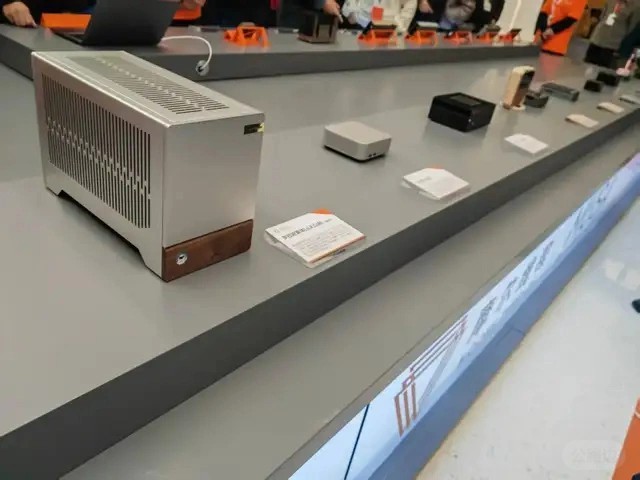
In addition to showcasing the full-stack technology from architecture to clusters, Moore Threads also launched the AI computing notebook MTT AIBOOK, which is equipped with Moore Threads' intelligent SoC chip "Yangtze River", providing 50TOPS of edge-side AI computing power and achieving full-stack integration from chips and drivers to development environments.
Launching hardware products for the consumer market, Moore Threads aims to create an entrance for a large number of AI developers to access the MUSA ecosystem.
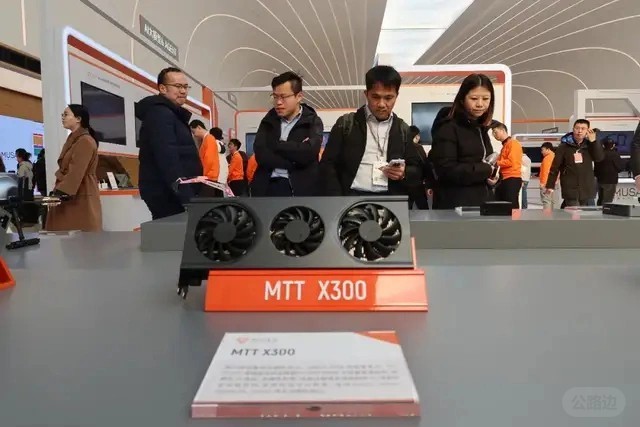
In the exhibition area at the event site, Moore Threads also displayed landing cases in industries such as smart agriculture, industrial manufacturing, and embodied intelligence to prove the breadth of the application boundaries of domestic GPUs. Moore Threads attempts to tell the vision of "full-featured computing power" through an all-round layout.
Moore Threads, founded 5 years ago, is still a very young company. Its revenue in the first three quarters of this year was 785 million yuan, and the expected full-year revenue is less than 1.5 billion yuan. Wanting to benchmark the CUDA ecosystem, its strength is still slightly weak. After listing, to boost the confidence of investors and developers in it, this display is necessary for Moore Threads: to clarify the infrastructure built through full-featured GPUs and the covered scenarios, and stimulate market imagination.
"The power of a single company is always limited," said Zhang Yubo, CTO of Moore Threads. But through open source and cooperation, an ecological circle has the possibility of continuous expansion. "In the future, for each generation of our GPUs, from the architecture to each layer of software above, we will adhere to the open source route," Zhang Yubo said.
|

 Fear of God ESSENTIALS Hoodie Review: Mi86 人气#fashion
 The Derby of San Francisco Style 300 Cha114 人气#fashion
 Why the Derby of San Francisco Classic S131 人气#fashion
 Romaoss Launches "Rebirth Plan," in Talk70 人气#tech



 WeChat
 douyin