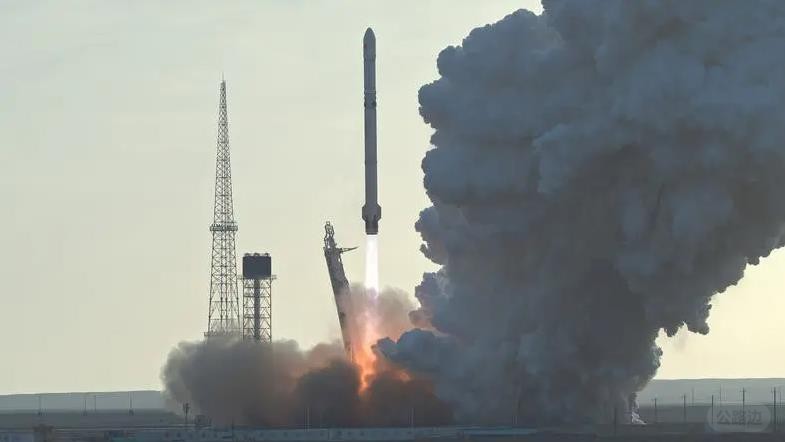
At 10:00 on December 23rd, the Long March 12A (CZ-12A) reusable launch vehicle made its maiden flight at the Jiuquan Dongfeng Commercial Aerospace Innovation Test Zone. At the moment of ignition, the roar echoed over the Gobi Desert, and the rocket soared skyward trailing a bright blue-purple exhaust plume.、
Two Failed First Flight Recoveries: Is the "Rocket Explosion" Tuition Fee Unavoidable?
The Long March 12A is a liquid oxygen-methane launch vehicle centered on achieving "first-stage reusability," developed under the overall responsibility of the Eighth Academy of China Aerospace Science and Technology Corporation (CASC). It is also China's second launch vehicle to attempt reusable technology verification on its maiden flight.
Amid widespread anticipation, the second stage of the Long March 12A successfully entered the predetermined orbit, marking a basic success for the flight test mission, but the first-stage recovery was declared a failure.[1]
In a multi-stage launch vehicle, the first stage ignites first, responsible for lifting the rocket from the ground and accelerating it to high altitude before separating once fuel is exhausted; the second stage ignites after first-stage separation, continuing acceleration to deliver the payload into the predetermined orbit.
Shortly before, on December 3rd, the "Zhuque-3" Y1 launch vehicle developed by Chinese commercial aerospace firm LandSpace successfully launched and entered orbit, but an abnormal combustion occurred during the first-stage recovery verification, failing to achieve a soft landing at the recovery site, resulting in another unsuccessful recovery test.[2]
This means that to date, the United States remains the only country to have successfully recovered a rocket's first stage. On November 13th, 2025, American company Blue Origin launched its "New Glenn" launch vehicle and successfully recovered its first stage, becoming the second commercial aerospace enterprise after SpaceX to achieve orbital rocket launch and recovery.
The journey to rocket recovery and reuse is fraught with challenges. The initial recovery tests of both New Glenn and SpaceX's Falcon 9 ended in failure, with costly lessons learned along the way. So why is rocket recovery so difficult? How should we interpret the significance of these failures?
Recovering Rockets Like Beverage Bottles
Traditional multi-stage launch vehicles are designed for single use. After completing their launch mission, each stage separates from the rocket body and subsequently crashes into uninhabited land areas or remote ocean waters, unable to be reused. This model results in massive resource waste and economic costs—particularly the first stage, which integrates the core propulsion system and typically accounts for the highest proportion of the rocket's total cost.
Driven by cost considerations, the concept of reusable rockets has existed for a long time.
In his 1963 publication Introduction to Interstellar Navigation, Qian Xuesen discussed launch vehicle recovery: "Propellant, which constitutes the vast majority of the takeoff weight, is relatively inexpensive... yet the costly empty rocket is discarded outright. In today's initial testing phase of interstellar navigation, with few flights, this is acceptable, but continuing this practice in the future would be wasteful. Therefore, we must find ways to recover empty launch vehicles for multiple uses."[3]
In 1993, McDonnell Douglas' DC-X test rocket completed the first vertical takeoff and landing demonstration of a rocket, verifying the feasibility of vertical recovery technology. However, it was not until 2011, when Elon Musk's SpaceX announced its reusable launch vehicle program, that rocket reuse technology began to mature rapidly and move toward engineering implementation.
On December 22nd, 2015, SpaceX successfully launched the Falcon 9 and achieved a soft landing of its first stage, pioneering the history of direct vertical rocket recovery from space.
After more than two years of experiments, the recovery and landing success rate of the Falcon 9 improved significantly, with subsequent mastery of fairing recovery and reuse capabilities. To date, the Falcon 9 has successfully completed over 500 first-stage booster recoveries.
According to a 2018 assessment report by Harry Jones, a researcher at NASA's Ames Research Center, based on the publicly quoted prices of the Falcon 9 at the time, commercial launch vehicles had reduced the unit launch cost to low Earth orbit to approximately one-twentieth of that during the Space Shuttle era.[4]
Commercial aerospace refers to aerospace activities with commercial profit models. Rocket transportation can be analogized to the "highway" to space. The rapidly growing satellite industry—particularly the demand for large-scale constellation deployment—has directly driven the development of commercial aerospace.
Rocket reusability can significantly reduce the marginal cost per launch, and large-lift rockets with reusable capabilities and reliable mass production capacity will take the lead in establishing advantages in competition.
According to People's Daily Online, the Zhuque-3 is designed for no fewer than 20 reuse cycles, with the goal of reducing launch costs to 20,000 yuan per kilogram.[5]
Zhang Liang, Associate Professor at the School of Aeronautics and Astronautics, Sun Yat-sen University, told The Intellectual that the R&D investment for a single rocket model starts at least 1 billion yuan, excluding auxiliary supporting facilities (such as launch site construction and measurement and control network support). For commercial rocket companies, this represents a huge investment—without substantial launch demand, it may take 5 to 10 years or more to recoup the initial investment.
"Therefore, to reduce costs, commercial rocket companies must either adopt reusable technology or carry out rocket design through industrial chain integration, based on civilian products or products suitable for mass production," Zhang Liang said.
Why Is It So Difficult?
Rocket launch and recovery is a high-risk, high-investment, and high-tech field. Zhang Liang explained that this process involves multiple key technologies, including overall rocket design, navigation, guidance and control, avionics system integration, structural additive manufacturing, launch site support, propellant loading, engine design and manufacturing, and landing buffering.
"As a newly emerging technological form, rocket recovery technology is being explored globally, with little existing technology available for direct reference. The Falcon 9 failed many times in its early stages, and Starship has undergone 11 test flights, half of which ended in failure. Without abundant capital and patience, commercial companies cannot achieve success," Zhang Liang noted.
Before the Falcon 9 successfully achieved its first first-stage recovery, it experienced numerous failures and attempts, including four major failed sea or land recovery tests and multiple suborbital recovery tests. In January 2015, the Falcon 9 crashed into a barge during its first attempted sea recovery; in June 2015, the rocket exploded and disintegrated just two minutes after launch.
In January 2025, Blue Origin also failed in its first orbital recovery test of the New Glenn rocket, not achieving the first successful sea recovery of the rocket's first stage until November of the same year.
Starship is a fully reusable heavy-lift launch vehicle developed by SpaceX, capable of carrying over 100 tons of payload. To date, Starship has completed 11 test flights, experiencing multiple explosions and disintegrations, and only successfully achieved a key controlled splashdown in its 11th test flight in October 2025.
Zhang Liang stated that specifically, the current challenges in achieving rocket "reusability" include: high-precision navigation, guidance and control technology to ensure the precise achievement of soft landing targets with multiple constraints; highly reliable, lightweight, and foldable landing buffering devices to enable vertical rocket recovery at the predetermined landing site; engine control technology with wide-range precise thrust adjustment, capable of adjusting thrust between 30% and 110% and supporting multiple ignition starts; and efficient aerodynamic control surfaces that can effectively control rocket attitude while ensuring lightweight design.
However, recovery does not equate to reusability. Zhang Liang pointed out that efficient and rapid rocket body structural health detection technology is also required to quickly evaluate and inspect the recovered rocket body to ensure it meets the requirements for reuse.
"Blowing Up Rockets" as Tuition Fees
Zhang Liang said that aerospace engineering remains a high-risk industry to this day, involving the integration of numerous key technologies. A loose screw, a misconnected wire, a tiny crack, or a structural strength failure of a component can all lead to rocket launch failure. At the same time, a single rocket model involves the collaboration of thousands of people, and human errors in information transmission or work handover can also cause launch failures.
"The development of launch vehicles involves improving relevant designs through repeated failures, thereby driving technological iteration and progress—this is consistent with the development concepts in fields such as civil aviation aircraft, new energy vehicles, and robots," Zhang Liang said. To avoid launch failures, it is necessary to strengthen design margin control during the design phase, reduce human errors, achieve standardized design and processes, and analyze data from each launch to improve relevant designs. Once the technology matures, launch failures can be avoided.
Employees of multiple commercial rocket companies told The Intellectual that China's commercial aerospace has entered a critical phase, with orbit entry success also being an important goal, and the Zhuque-3 recovery test has come close to success.
Dai Zheng, Chief Commander of the Zhuque-3 launch vehicle, reviewed the mission in an interview with CCTV News, stating that the rocket's aerodynamic control performed well during the supersonic glide phase from an altitude of approximately 40 kilometers down to 3 kilometers above the ground, but the real difficulty lay in the landing ignition phase at 3 kilometers, which placed extremely high demands on flight control. Due to the failure of final deceleration, the rocket failed to achieve effective "braking" and ultimately crashed approximately 40 meters from the landing center point.[6]
"Only through failure can we gain trial-and-error experience, enabling the company's technological iteration to go further. If we never take that step, we may never acquire such experience and will be unable to move closer to success," Dai Zheng said.
Following the maiden flight of the Long March 12A, CASC also stated that although the mission failed to achieve the predetermined rocket first-stage recovery target, it obtained key engineering data under the rocket's actual flight conditions, laying an important foundation for subsequent launches and reliable stage recovery.
The Future of China's Commercial Aerospace
December 2025 marks a critical period for the concentrated maiden flights of China's reusable rockets. Following the Zhuque-3 and Long March 12A, the "Tianlong-3" reusable rocket developed by Beijing i-Space Technology Co., Ltd. (i-Space) is also expected to make its maiden flight, but this flight will mainly verify some key capabilities and data, without involving complete recovery.
Currently, domestically designed reusable rocket models also include the Long March 12B, "Zhishenxing-1," "Yuanxingzhe-1," "Xingyun-1," "Lijian-2," and "Shuangquxian-3."
Regarding the design of reusable rockets, Zhang Liang believes it mainly depends on mission requirements. The Falcon 9's design is primarily oriented toward the rapid launch and deployment of Starlink satellites, so it was designed from the outset with the goals of mass production, large payload capacity, and multiple reuses.
"If the launched payloads are not satellites of the same model and orbit, this design may not be appropriate," Zhang Liang pointed out. Additionally, if future technologies can reduce the manufacturing cost of rocket bodies and engines to below the million-yuan level, rockets will not need to be mandatorily designed for reusability.
In practical terms, Zhang Liang believes that while higher payload capacity and reuse cycles mean better rocket performance, they also correspond to higher manufacturing costs and reliability requirements. Therefore, payload capacity is not simply "the higher the better." The overall design of reusable rockets should be planned based on future launch payload demands.
Currently, rockets such as the Zhuque-3, Tianlong-3, Lijian-2, Shuangquxian-3, and Yinli-2 developed by China's commercial rocket companies have a takeoff mass of approximately 500 tons and a payload capacity of 10 to 18 tons, primarily targeting the deployment of low-Earth orbit internet constellations for national network satellites and Yuanxin satellites.
"Once these constellations are completed and such large payload capacity is no longer needed, the relevant rocket designs will need to be updated. Furthermore, if future lunar base construction or Mars development is involved, the demand for rocket payload capacity will change."
Zhang Liang concluded by stating that technological iteration will undoubtedly drive the vigorous development of the aerospace industry. In the future, people will be able to experience space tourism, lunar tourism, or space station tourism at low cost, making such experiences accessible to ordinary people.
References
[1]https://mp.weixin.qq.com/s/mJ2JoPMm5WgUjgWZqdZMzA
[2]https://mp.weixin.qq.com/s/l0HitsBfMN1Fm1uXBBCcoA
[3]Qian Xuesen, Introduction to Interstellar Navigation
[4]https://ntrs.nasa.gov/api/citations/20200001093/downloads/20200001093.pdf
[5]http://politics.people.com.cn/n1/2025/0628/c1001-40510625.html
[6]https://baijiahao.baidu.com/s?id=1851504960554320739
|

 Fear of God ESSENTIALS Hoodie Review: Mi83 人气#fashion
 The Derby of San Francisco Style 300 Cha108 人气#fashion
 Why the Derby of San Francisco Classic S127 人气#fashion
 Romaoss Launches "Rebirth Plan," in Talk65 人气#tech



 WeChat
 douyin