On the Pest side near the Liberty Bridge in Budapest lies one of my favorite corners. Beside a small square, slender old buildings stand tall and close together. From the roadside, one can see the graceful arc of the Liberty Bridge stretching toward you, the tram tracks suspended mid-air, and across the Danube, the staggered silhouette of Castle Hill in Buda.
The Velvet Prison Theorem: the populace is anesthetized by material comfort, yet everything collapses once the economy can no longer sustain it.
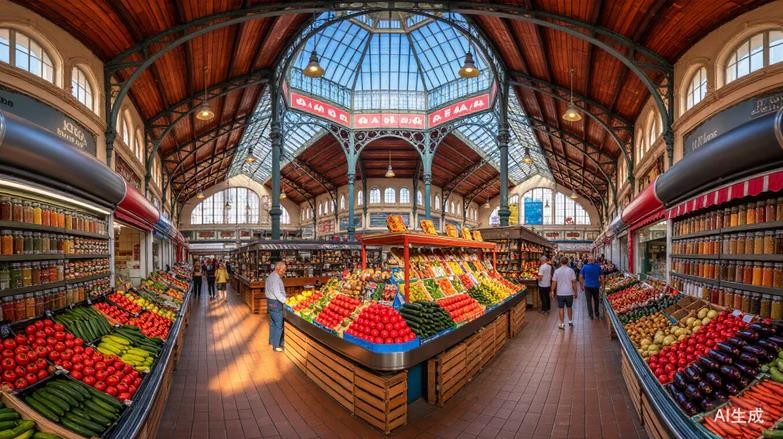
Budapest Central Market ▲
I recall many years ago sitting by the floor-to-ceiling window of my hotel room, gazing at the Danube shimmering under city lights. At that moment, it was hard to imagine that such a beautiful city had once been a vast prison. How tragic that was—and yet how fortunate, for it finally tore down its cages.
In that great prison, confinement was once everywhere. The 1956 Hungarian Uprising remains a permanent scar on Budapest. My gaze crosses the Danube toward the Parliament Building on the opposite bank. A tourist boat glides across the wide river; surely everyone aboard marvels at the grand architecture before them, unaware of the turbulent history it has witnessed. In 1956, as Hungarian citizens took to the streets in protest, the reformist politician Imre Nagy stood before Parliament and promised the people democracy. But everything came to an abrupt end under Soviet military suppression. After a series of bloody crackdowns, Nagy was arrested and executed by hanging—a brutal and cruel death.
At that time, Miklós Haraszti—born in Jerusalem but raised in Budapest—was only eleven years old. He belonged squarely to the post–World War II generation, having been born in 1945, the year the war ended. Returning to Budapest with his parents, he encountered a strange and oppressive world. His only recourse was “samizdat”—underground literature. He became editor of Hungary’s most important underground journal, Beszél? (The Speaker), and was among the founders of Hungary’s democratic and free publishing movement in the 1970s.
Naturally, Haraszti did not experience the events of 1956 with the same visceral immediacy as older figures like Márai. Yet perhaps this emotional distance was not a disadvantage—stepping back from tragedy might allow one to see beyond bloodshed to the mechanisms beneath. For resisters, the pain inflicted by violence and terror may fuel resistance, but it can also degenerate into mere vengeance. Without understanding how totalitarianism operates, one cannot know how to resist effectively; without grasping its essence, one risks falling into new traps.
Haraszti’s book The Velvet Prison targets a crucial—even indispensable—component of totalitarian rule: cultural censorship. After the 1956 uprising, János Kádár rose to power. To stabilize society, he adopted relatively relaxed economic and cultural policies, replacing the old slogan “Whoever is not with us is against us” with “Whoever is not against us is with us.”
Compared to other Eastern Bloc countries, Hungarians enjoyed greater creative freedom; even critics referred to Hungary at the time as “the happiest barracks.” But even the happiest barracks remain barracks. When censorship becomes institutionalized—when publication depends not on artistic merit but on state approval—writers have already lost their freedom. As Haraszti wrote: “The English poet John Milton na?vely believed that total censorship was neither desirable nor achievable… In the struggle for truth, falsehood is destined to lose. Censorship is a ‘vain and defective’ weapon whose use inevitably promotes precisely what it seeks to suppress. This eloquent and long-popular argument has long since been swept away by the avalanche of twentieth-century totalitarianism.”
If Haraszti’s work were merely another denunciation or angry condemnation of censorship, I would have read too many already—but Haraszti is unique. He reveals how, after an initial phase of crude repression, cultural censorship in Eastern Europe evolved. It no longer simply silenced dissenters; instead, it sought to co-opt intellectuals—even opponents—making them serve the regime and produce harmonized voices (occasionally allowing slight dissonance to simulate pluralism). Some resisters failed to recognize this reality, clinging to the belief that censorship was futile—that prohibition bred rebellion, that banned works became more popular. While this dynamic existed in certain periods or domains, it was not universal. By the 1970s, when Haraszti wrote this book, censorship itself had “upgraded.” The great prison had become a “velvet prison,” where control was no longer overtly brutal but sought “win-win cooperation” with intellectuals.
In Haraszti’s view, this new form of censorship was subtler and thus more dangerous: “Traditional censorship assumed creators and censors were natural enemies; the new censorship actively dissolved this antagonism. Artists and censors, as twin pillars of official culture, now worked hand-in-hand, cheerfully tending the state’s garden of art.”
Power-driven collusion manifests in countless forms; censorship is just one example. Such collusion is deeply ironic—“censors never dreamed they could legitimize their repression by boasting about fighting for cultural freedom.”
Haraszti aimed to expose the cultural context behind censorship—not just state intervention, but all the ways complicity erodes the foundation of authentic artistic autonomy. “Velvet” is a fitting metaphor: warm, comfortable, and reassuring—but still a prison. Ultimately, “we lie together on velvet, telling lies without blushing or hesitation, performing happily in unison. These lies become the new glue, reinforcing a prison already fragile at its core.”
Walking through Pest, I often marvel at its elegant resilience—the square by the Liberty Bridge epitomizes this spirit. Even during the Cold War, Hungary stood out as a relatively pleasant corner of the Eastern Bloc. Precisely because of the brutality of the 1956 uprising, the regime implemented extensive compensatory measures, hoping economic prosperity would mask the suffocation of totalitarianism and that improved incomes would help people forget past traumas. In a sense, they succeeded.
Pest’s Central Market is world-famous and a must-visit for tourists. This magnificent two-story market is one of Europe’s largest and Budapest’s favorite. Today it brims with goods—meat, fish, vegetables, fruits—all abundantly available. Even visitors rarely leave empty-handed, often buying renowned Hungarian delicacies like foie gras paté, paprika, and Tokaji wine, or enjoying lángos (crispy fried dough topped with sour cream and cheese) on the second floor.
As Budapest’s largest and oldest indoor market, its origins trace back to Károly Kamermayer, mayor of Budapest in the late 19th century. Upon retiring in 1896, he attended the market’s grand opening on February 15, 1897.
As early as the 1860s, proposals emerged to build a large market to improve Budapest’s agricultural supply, including ideas for standardized management and wholesale distribution networks. By the 1890s, construction was officially underway.
Designed by architect Samu Pecz, the Central Market features a neo-Gothic entrance, a steel-frame interior, a high vaulted roof adorned with colorful ceramic tiles, and numerous glass windows for natural light—creating stunning interplay between sunlight and tile hues. Severely damaged during World War II, it was restored afterward. Legend has it that even during the planned economy era, even amid Eastern Europe’s most turbulent times, the Central Market still offered ample material choices. This seems symbolic: totalitarian regimes anesthetize the populace with materialism to quell dissent. And when the economy falters and material abundance vanishes, everything collapses.
I even believe Budapest’s beauty itself is metaphorical—it was once a great prison, but a beautiful velvet prison, with censorship as one of its key mechanisms.
Haraszti, who first linked “velvet” with “prison,” was already distinctive; more valuable still was his revelation of a deeper layer: intellectuals internalize constraints, turning their own minds into velvet prisons.
In other words, censorship gradually transforms into self-censorship. Once people grow accustomed to censoring themselves, artistic standards recede, yielding to “political correctness.” At that point, intellectuals are no longer confined by totalitarian rulers—they imprison themselves. When creating, they preemptively avoid topics that might provoke authorities, sometimes even glorifying this as “indirect resistance.”
Self-censorship is even more insidious. As the Yugoslav writer Danilo Ki? put it: “Self-censorship means reading your own words through someone else’s eyes. You become your own judge—stricter and more suspicious than anyone else, because as the author, you know what the censor cannot detect: your most secret, unspoken thoughts, which you feel you can still read between the lines.”
Under such conditions, intellectuals often denounce censorship while habitually practicing self-inspection and self-mutilation. They see themselves as victims, yet simultaneously benefit from the system. They resent censorship’s restrictions but eagerly fill out forms to apply for state-funded projects and awards. Once their interests align with the regime, they become “kept” intellectuals—enjoying privileges, transforming overnight from marginal figures into power elites.
People even proactively prevent anything that might disrupt the censorship order. Haraszti recounts how, in the 1970s, Hungarian authorities briefly considered cultural reforms that would relegate “non-educational” popular art to the market—but intellectuals fiercely opposed it. To them, marketization threatened their state-guaranteed elite status and jeopardized their privileged position within the system.
This fear of marketization was typical among Eastern Bloc vested interests—they clearly preferred the “big pot” of state allocation. The Central Market itself faced a marketization crisis: in 1991, swept up in post-communist reforms, it went bankrupt and only reopened years later after restoration. Yet marketization proved the right path: in 1999, its outstanding renovation earned it the FIABCI Prix d’Excellence, and with its blend of commerce and history, it gradually became one of Budapest’s premier attractions.
For Hungarians, society—like the Central Market—has long since been reborn. Intellectuals who compromised or collaborated under censorship, and citizens content with relaxed economic policies, all need reflection. This reflection must extend beyond condemning tyranny to examining past self-censorship—to ask whether, in those years, they overlooked a simple truth: art has never been bound by freedom alone.
Without such reflection, history could repeat itself—and recent backsliding serves as a warning.
|

 Fear of God ESSENTIALS Hoodie Review: Mi83 人气#fashion
 The Derby of San Francisco Style 300 Cha108 人气#fashion
 Why the Derby of San Francisco Classic S127 人气#fashion
 Romaoss Launches "Rebirth Plan," in Talk65 人气#tech



 WeChat
 douyin