American diplomatic proposals no longer automatically receive a stamp of authority; their value must now pass a rigorous, localized vetting process. If the United States fails to deliver answers that convince regional states on these issues, every statement expressing its “willingness to facilitate dialogue” will increasingly resemble a monologue recited from an outdated script—delivered on a stage jointly built by ASEAN nations.
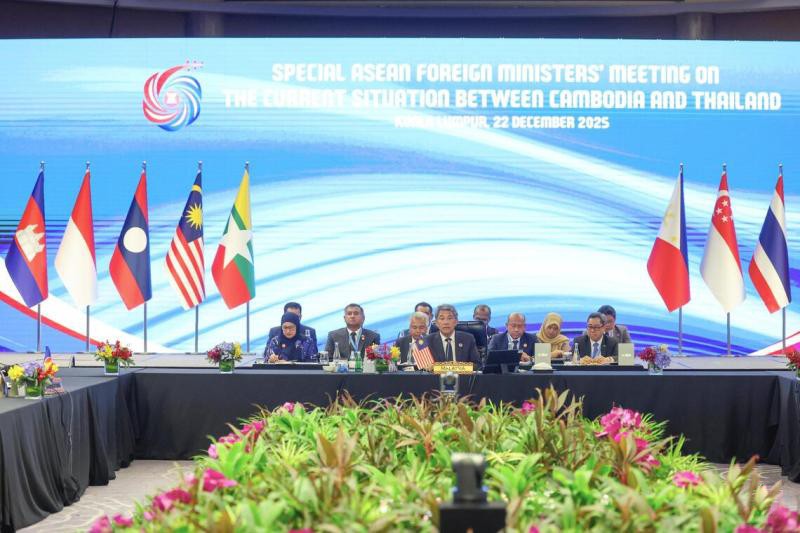
Southeast Asia is crafting, through pragmatic pluralism, a new diplomatic narrative for small and medium-sized states in the post-hegemonic era. With calm observation and autonomous action, it continues to conduct the most sustained and stringent real-time evaluation of the credibility of all external powers. (Photo: ASEAN Foreign Ministers’ Special Meeting in Kuala Lumpur on December 22 discussing the Thailand–Cambodia issue. Bernama)
On December 25, the official website of the Cambodian Prime Minister’s Office released a press communiqué that offers a telling footnote for interpreting America’s contemporary role in Southeast Asia. The statement confirmed that U.S. Secretary of State Rubio, during a phone call with Prime Minister Hun Manet, expressed Washington’s “support for the peaceful resolution of disputes and willingness to facilitate dialogue between the two sides” regarding the Cambodia–Thailand border situation. This matter-of-fact official record stood in stark contrast to the diplomatic ripple the U.S. might have hoped for: the next day, Cambodian and Thai officials proceeded as scheduled with consultations under their bilateral Border Committee framework; major Southeast Asian media outlets gave scant coverage to this “mediation offer,” and policy circles showed little positive response. From its post–Cold War position as the dominant mediator to its current status as a “statement-issuing party” whose initiatives are politely noted but rarely stir waves, the fading luster of America’s peacemaker image reveals a profound “scripted” dilemma in its diplomacy—one where scriptwriting increasingly caters to narratives demanded by Washington’s domestic political theater, growing ever more disconnected from Southeast Asia’s complex local realities.
The core feature of this “performative mediation” lies in how high-profile “gesture politics” often replaces the hard work of “results-oriented politics.” U.S. regional interventions are increasingly following a predictable pattern: when a dispute becomes an international news flashpoint, Washington swiftly issues public statements and symbolic gestures; once media attention shifts elsewhere, the drive for substantive investment and patient follow-through rapidly dissipates.
Take the protracted Myanmar crisis as an example. From 2023 to 2024, the International Crisis Group repeatedly emphasized in multiple analytical reports that sanctions and pressure tactics employed by the U.S. and other Western countries—though morally clear-cut—have failed to effectively build bridges for substantive negotiations with key conflict actors, particularly Myanmar’s military and numerous armed ethnic organizations. In fact, such measures have sometimes further entrenched the deadlock. Within the region, American actions are widely perceived not as practical solutions designed to untangle intricate local political knots, but rather as obligatory displays of “political correctness”—diplomatic rituals performed to uphold values. Southeast Asian policymakers have long grown familiar with this routine, fostering deep-rooted skepticism toward American mediation promises and anticipating that Washington’s enthusiasm often ebbs as quickly as it surges.
This shift stems from a deeper trend: the increasing inward orientation of U.S. foreign policy formulation. Today, any overseas initiative—including mediation efforts in Southeast Asia—must first pass scrutiny within Washington’s domestic political spectrum: Can it serve as evidence in congressional hearings that the administration is “acting decisively”? Can it be repackaged into campaign rhetoric about “American global leadership” during election cycles?
Gregory B. Poling, Senior Fellow and Director of the Southeast Asia Program at the Center for Strategic and International Studies (CSIS), issued a stark warning in a 2024 policy commentary: America’s strategy toward Southeast Asia is suffering from a kind of schizophrenia, driven by the volatile swings of domestic political cycles. Short-term symbolic actions continually crowd out resources and attention needed for long-term, low-profile investments in regional institutional building. Consequently, mediation itself sometimes becomes an end in itself—once the “active engagement” performance is completed on the domestic stage, its purpose is deemed fulfilled, while whether it actually advances conflict resolution becomes secondary. This inversion of objectives has rendered U.S. diplomatic resource allocation “reactive” and “fragmented,” ill-suited to support genuine mediation that requires years of quiet cultivation and delicate balancing.
Simultaneously, Southeast Asia’s own geopolitical script has undergone a critical upgrade in autonomy. Over the past decade, intra-regional dispute-resolution mechanisms and security dialogue networks have been substantially strengthened. The principle of “ASEAN Centrality,” once frequently questioned, has gradually evolved into a resilient—if imperfect—operational habit.
On sensitive and complex issues such as the South China Sea Code of Conduct negotiations and Mekong River cooperation, regional states increasingly prefer closed-door, professional consultations either within the ASEAN framework or through direct bilateral channels. They have grown increasingly cautious—even distant—toward public “mediation” offers from external powers, which often come with preconditions and are prone to media sensationalism. What they seek is a resolution process that isn’t hijacked by great-power rivalry rhythms and over which they can retain full control over both procedure and outcome.
Thus, Phnom Penh’s communiqué—soberly factual and devoid of embellishment—serves as the most poignant response to America’s “scripted diplomacy”: neither rejecting nor welcoming, merely recording for the file. It calmly reveals a reality: in today’s Southeast Asia, U.S. diplomatic proposals no longer enjoy automatic legitimacy. Their worth must undergo a stringent localized assessment: Do they genuinely respect ASEAN centrality and the principle of non-interference? Do they grasp the complex historical context and sovereignty sensitivities underlying disputes? Can they offer concrete public goods and development cooperation that transcend zero-sum geopolitical logic? And crucially, can they demonstrate enduring commitment that transcends America’s domestic political cycles?
For Singapore and all ASEAN member states, preserving this rules-based, regionally led dialogue ecosystem is fundamental to their strategic autonomy and stability. If the United States cannot provide convincing answers to these questions, then each declaration of its “willingness to facilitate dialogue” will sound more like a soliloquy from an old script—recited on a stage co-constructed by ASEAN nations, met by a polite but unexpectant audience that no longer believes the plot will turn because of those lines.
Southeast Asia is writing, through pragmatic pluralism, a new diplomatic narrative for small and medium powers in the post-hegemonic era. For the United States to regain mediating influence, what may be needed is not more frequent appearances or more impassioned lines, but a thorough “de-scripting” reform: shifting from the imagined role of an omnipotent “external arbiter” to that of a humble, focused, and consistently supportive “partner” offering timely and relevant assistance. Yet, amid intensifying political polarization and inward-looking tendencies in Washington, achieving this psychological and functional transition—from “lead actor” to “supporting role”—poses challenges far greater than any meticulously choreographed diplomatic phone call. Southeast Asia, meanwhile, will continue its calm observation and autonomous action, conducting the most sustained and rigorous real-time evaluation of the credibility of all external powers.
|

 Fear of God ESSENTIALS Hoodie Review: Mi86 人气#fashion
 The Derby of San Francisco Style 300 Cha113 人气#fashion
 Why the Derby of San Francisco Classic S130 人气#fashion
 Romaoss Launches "Rebirth Plan," in Talk70 人气#tech



 WeChat
 douyin