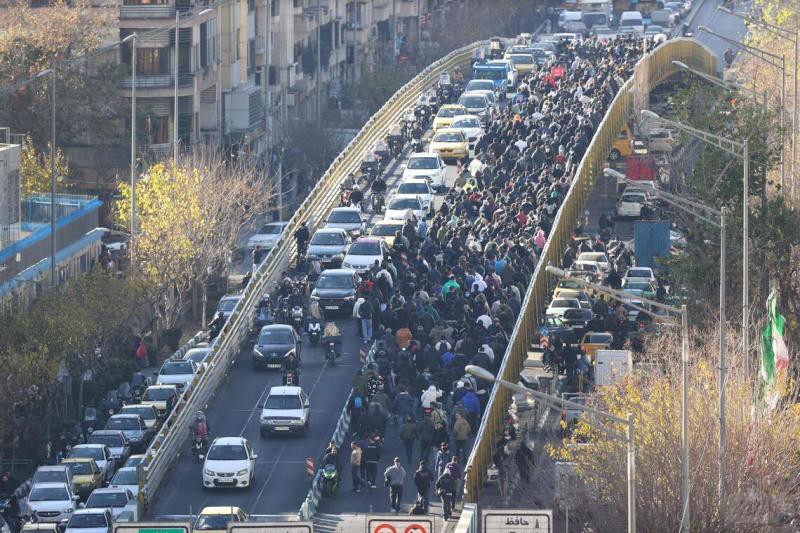
On December 29, many Iranian merchants took to the streets to protest economic hardship and the depreciation of Iran's currency.
Following days of protests by Iranian business owners over economic difficulties, President Masoud Pezeshkian urged the government to listen to the protesters' "legitimate demands."
Citing Iranian state media, AFP reported that Pezeshkian said on Tuesday (December 30): "I have instructed the Interior Minister to engage in dialogue with representatives of the protesters, listen to their legitimate demands, and enable the government to do everything possible to resolve the issue and take responsible action."
On Monday (December 29), merchants in the capital kept their shops closed for the second consecutive day as the Iranian rial hit a new low in the unofficial market.
According to price-monitoring websites, on Sunday (December 28), the exchange rate stood at approximately 1.42 million rials per U.S. dollar, compared to about 820,000 rials a year earlier. The euro was trading near 1.7 million rials.
Iran’s official currency is the rial, but in daily transactions Iranians commonly use the "toman" (1 toman equals 10 rials). In the free market, the dollar exchanges for roughly 142,000 tomans, equivalent to 1.42 million rials.
According to the pro-labor news agency ILNA on Monday, protesters “demanded immediate government intervention to curb exchange rate volatility and formulate a clear economic strategy.” Citing demonstrators, ILNA reported: “It’s become impossible to continue doing business under these conditions.”
AFP correspondents noted that price fluctuations have caused a standstill in sales of certain imported goods, with both buyers and sellers preferring to delay transactions until market prospects become clearer.
Photos published by the conservative Fars News Agency showed demonstrators occupying a major thoroughfare in central Tehran known for its concentration of shops. Local police used tear gas to disperse the protesters.
The report added that minor physical clashes occurred between some protesters and security forces, warning that such gatherings could lead to broader unrest.
According to Mizan, the judicial news agency, Iran’s Chief Justice Gholamhossein Mohseni-Ejei called for “swift punishment of those responsible for the currency fluctuations.”
Presidential spokesperson Tabatabai announced on social media: “Pursuant to the president’s decision, Abdolnasser Hemmati will be appointed as the new Central Bank governor.”
Hemmati previously served as Minister of Economic Affairs and Finance but was dismissed by parliament in March due to the sharp depreciation of the rial.
Last Sunday, Pezeshkian submitted next year’s budget proposal to parliament, pledging to curb inflation and high living costs.
Official data shows that Iran’s annual inflation rate reached 52% in December last year. However, this figure significantly understates the actual price increases for many goods, particularly essential household items.
Iran’s economy has been severely damaged by decades of Western sanctions, and the situation worsened further in late September when the United Nations reinstated international sanctions related to Iran’s nuclear program.
Western countries and Israel accuse Iran of seeking nuclear weapons—a charge Tehran denies.
|

 Fear of God ESSENTIALS Hoodie Review: Mi86 人气#fashion
 The Derby of San Francisco Style 300 Cha112 人气#fashion
 Why the Derby of San Francisco Classic S130 人气#fashion
 Romaoss Launches "Rebirth Plan," in Talk70 人气#tech



 WeChat
 douyin