In recent years, the Steam platform has become both a testing ground and showcase for creative game projects. Fueled by indie development and gameplay innovation, a wave of titles that skillfully blend popular mechanics while introducing fresh twists continues to emerge—delivering rich, novel experiences to players and reflecting a significant trend in contemporary game design: recombining and reinventing established gameplay systems to create surprising new “species” of games.
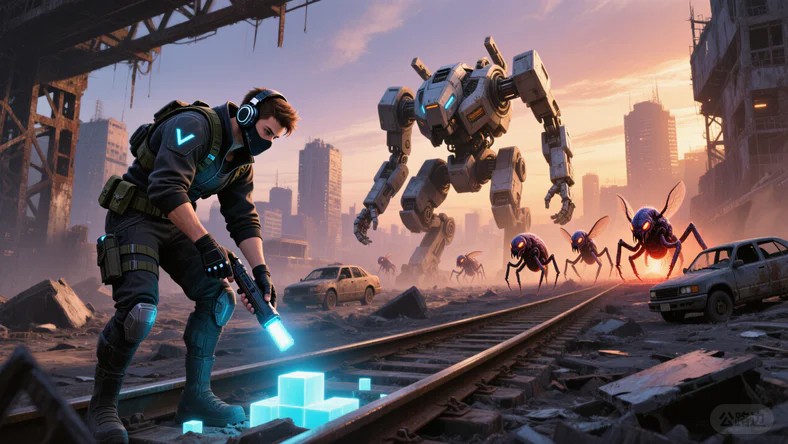
Recently, Rosky discovered on Steam a title that exemplifies this fusion-driven approach: Monsters are Coming! Rock & Road. By weaving together multiple popular mechanics and elements, it delivers an easy-to-learn yet refreshingly unique experience.
When Survivors Meet Tower Defense: Dual-Front Combat on a Moving City
Monsters are Coming! Rock & Road positions itself as a tower defense survival game with light roguelike elements. Set in a post-apocalyptic world, players represent humanity’s last hope, tasked with gathering resources to fortify a constantly moving city—the latest iteration of the ever-popular mobile metropolis trope. Here, tower defense, survival mechanics, and action-oriented light roguelike gameplay converge seamlessly atop rolling wheels, as endless waves of dark forces relentlessly assault from all sides.
Before each run, players can select a city and a map. Each city possesses distinct traits that subtly alter gameplay dynamics, while each map features unique environments, visual styles, and slight variations in resource types.
Once inside a level, two core components quickly become apparent: the city and the player character. The city automatically and continuously moves downward, while enemies spawn from above, creating a palpable sense of urgency akin to fleeing for survival. Smaller enemy groups also periodically appear from the bottom and sides, adding unexpected bursts of tension. Visually, enemies are mostly black, amorphous figures with glowing red eyes—hinting at subtle Lovecraftian influences.
The player’s role is to explore around the moving city. Upon approaching enemies, the character automatically attacks; near resources like wood, food, or gold ore, they automatically gather them. Defeated enemies drop experience gems, which the character collects simply by proximity. Resource collection yields not only experience but also “resource packs,” which follow the character once picked up—but with a strict carrying limit. Crucially, neither experience nor resources become usable until the character returns them to the city.
Occasionally, treasure chests or altars appear on the map. Breaking a chest grants a chance to enhance weapons—either acquiring a new one or upgrading an existing one. Altars require the player to stand within their activation zone continuously until fully charged, after which they also offer an equipment upgrade opportunity.
Overall, movement, combat, resource gathering, and weapon upgrades fall squarely within the familiar “Survivor-like” genre.
Resources, Buildings, and “Inventory Space”: Building Defenses Under High Pressure
The city operates under a survival-tower-defense framework. As previously mentioned, while the city advances automatically, enemies swarm from all directions, and the player must simultaneously scavenge resources nearby—necessitating robust self-defense capabilities. Although the city starts with a basic bow-based turret, this quickly proves inadequate beyond the early game. Thus, players must construct defensive structures to fend off attackers and ultimately reach the Ark to win.
When the character delivers experience and resources near the city, they’re automatically absorbed. Accumulated experience allows the city to level up, and each level-up presents a roguelike-style three-choice selection: a new building type. These include resource generators, combat structures, and buff-enhancing buildings. Each new building increases the city’s physical footprint. Identical defensive buildings can be stacked to upgrade firepower, while adjacent identical production or buff buildings boost output or effect strength. However, the city has a strict size limit, making spatial planning—a form of “architectural strategy”—a key tactical challenge.
Along the route, several “safe havens” appear, offering brief respites. When the city approaches one, enemy spawns pause, and the haven provides fixed rewards: gold, an equipment chest, and a building shop where players can purchase structures with gold. These safe zones clearly segment the game into alternating phases of “pressure” and “breathing room.” The map alternates between high-intensity danger zones and these calm refuges—where players gain precious time to plan, build, and make strategic decisions.
Additionally, each safe haven features two side challenges: activating an altar within a time limit grants rewards. Players must choose one of the two, with rewards typically including gold, wood, equipment, or stone. This forces meaningful trade-offs based on current needs.
After leaving the final safe haven, players face a boss battle. Bosses boast high HP, strong attacks, and often unique mechanics that pose severe threats to the city. Defeating the boss brings the Ark—and victory—within reach.
At the end of each run, players earn Compass Points as rewards, which can permanently upgrade character and city attributes such as health, attack power, and movement speed. Players tailor these upgrades to match their preferred playstyle or build path.
Constant Trade-offs: The Essence of Strategy—and a Double-Edged Experience
After initially learning the mechanics—getting repeatedly obliterated by bosses without understanding why—and eventually clearing several maps on normal difficulty, I gained a solid grasp of the game.
As noted earlier, Monsters are Coming! Rock & Road merges survivor and tower defense mechanics in parallel, without separating them into distinct phases. This results in one persistent phenomenon throughout the entire game: constant trade-offs.
First, there’s tension between the two core gameplay loops. Traditional survivor games emphasize character progression, with all resources funneled into personal development. But in this title, character progression is extremely limited—players can carry at most four weapons per run (one of which is default). Weapon upgrades focus only on damage, attack speed, and range, with no synergies between weapons, capping the character’s potential. Consequently, players inevitably shift focus to the city as the true center of power, prioritizing its combat capabilities.
Within each level, resource gathering and city defense are simultaneous demands. Every resource type matters for city construction, yet the city’s base defenses are weak—struggling against large enemy waves. When overwhelmed, players instinctively rush back to defend, abandoning resource collection. This creates a relentless cycle: just as you gather a bit of wood, enemies surge; after fending them off, you scramble back out to collect more. The result? Nonstop busyness—exhausting, unceasing activity.
Moreover, both experience gems and resource packs require manual pickup and delivery to the city to become usable. So: gather or defend? Make frequent short trips or risk one overloaded return?
City-building introduces further dilemmas: prioritize resource production early and combat later? Or go all-in on a “war machine” city and rely entirely on manual scavenging? Some players even advocate a “health-sacrifice” strategy—ignoring early enemies during low-pressure phases to maximize resource collection and accelerate city development.
At safe havens, the binary side challenges force another layer of choice: weapon vs. gold, gold vs. stone, gold vs. wood. Should you boost your character or your city? Build new structures or repair damaged ones? Enhance existing buildings or gamble on new ones?
Building rerolls cost gold, and each subsequent reroll becomes progressively more expensive. This forces high-stakes decisions: settle for suboptimal options or spend heavily chasing a pivotal structure? This is trade-off design at its most intense.
Such relentless decision-making keeps the experience perpetually tense. Compounded by the randomness of building drops—and escalating reroll costs—players may finish a run without ever accessing their desired build. This means the early-game stress, urgency, and fatigue often fail to culminate in the satisfying payoff of a fully realized late-game strategy, leading to strong negative feedback.
Build Potential vs. Current Limitations: Brimming with Ideas, Awaiting Balance
From the in-game collection screen, it’s clear that every building in Monsters are Coming! Rock & Road carries specific tags, and buildings sharing tags can trigger synergies. For example, all “Gold”-tagged buildings revolve around gold generation or scale effects based on total gold held.
However, due to progression constraints, only a few viable strategies have emerged so far. “Mirror City” appears particularly beginner-friendly and fast to scale—especially when paired with the “Minion Build.” Mirror City duplicates every building constructed on the left side onto the right, effectively doubling output. Landing a few key structures can rapidly snowball into overwhelming strength.
The Minion (or Summoner) Build focuses on summoning units, enhanced by buff buildings that increase minion damage or grant bonuses based on minion count. Minions automatically seek and engage enemies while also blocking their advance. In boss fights—assuming no enrage or invulnerability mechanics—this build can sometimes instantly delete the boss, making it currently the most accessible and reliable strategy.
Between Innovation and Playability: An Ongoing Experiment
Monsters are Coming! Rock & Road is undeniably bold in its fusion ambitions. It weaves multiple popular genres into a continuous escape scenario, crafting a uniquely tense strategic loop. Players must constantly make immediate, mutually exclusive choices between “building” and “exploring,” “immediate survival” and “long-term growth.” This high-density decision-making forms the game’s core tension—and its most pronounced experiential signature.
Yet this design is a double-edged sword. Excessive randomness—particularly in critical building availability—can ruthlessly undermine carefully laid plans. Early-game resource juggling and high-pressure defense may not reliably translate into late-game satisfaction, causing the experience to occasionally tip from challenging strategy into frustrating luck dependency.
Nevertheless, the game’s foundation—a rich, clearly tagged building system with evident synergy potential—already offers fertile ground for diverse builds. With future balance adjustments and content expansions, more compelling strategies could emerge. For players who relish hybrid strategy, thrive under pressure, and enjoy high-stakes risk management, this game delivers a refreshingly inventive mental challenge. But for those seeking predictable progression and reliable rewards, the current version may require patience—waiting for updates to refine this promising concept into a more harmonious and balanced experience.
|

 Fear of God ESSENTIALS Hoodie Review: Mi83 人气#fashion
 The Derby of San Francisco Style 300 Cha108 人气#fashion
 Why the Derby of San Francisco Classic S127 人气#fashion
 Romaoss Launches "Rebirth Plan," in Talk65 人气#tech



 WeChat
 douyin