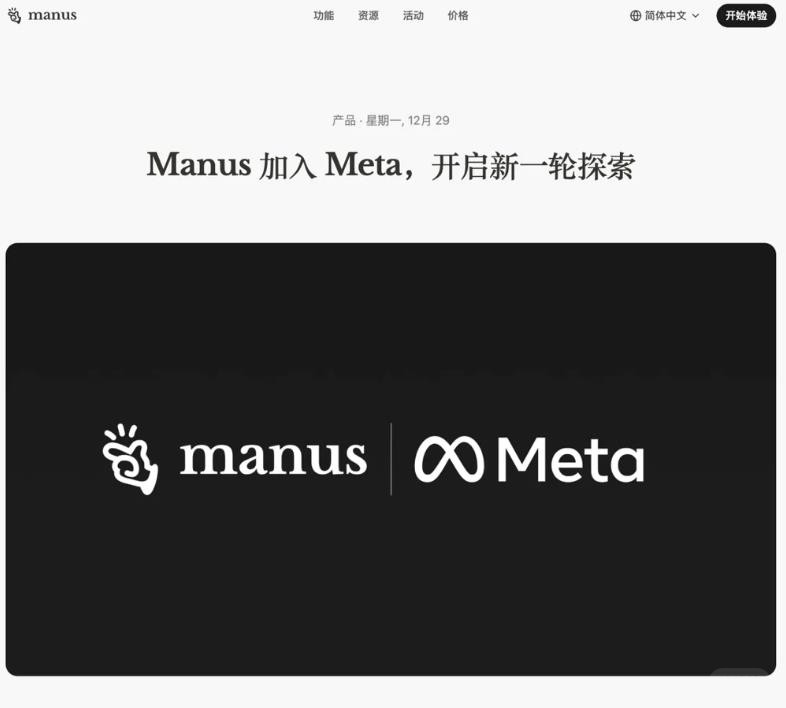
On December 30, 2025, the tech industry was shaken by major news: Meta, the social media and metaverse giant, announced it had acquired Butterfly Effect, a Chinese AI startup, for several billion dollars. Butterfly Effect’s flagship product is Manus, a general-purpose AI agent that debuted just nine months earlier in March 2025.
According to ZhenFund, an early investor in Manus, this marks Meta’s third-largest acquisition since its founding—surpassed only by WhatsApp and Scale AI—and catapults a 90s-born entrepreneur from Wuhan, China, onto the global tech stage.
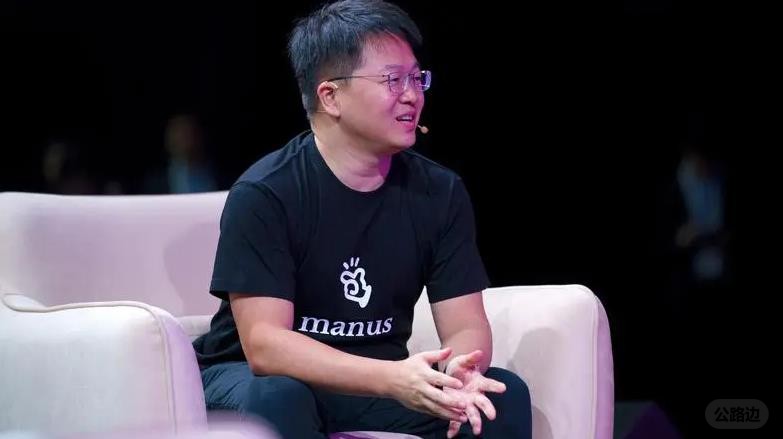
Following the acquisition, Butterfly Effect founder Xiao Hong (widely known as Red) will become a Meta vice president. His team will remain independently operated while being deeply integrated into Meta’s product ecosystem. Just nine months ago, however, this story began amid uncertainty, trial-and-error, and the bittersweet chaos following an overnight sensation.
From Launch to Rocket Ship in Just Nine Months
Rewind to early March 2025. Xiao Hong and his team likely hadn’t anticipated igniting global excitement in the AI community. On March 6, they officially launched Manus, billing it as “the world’s first general-purpose AI agent.”
Unlike mainstream chatbots at the time, Manus was designed as an autonomous “hands-and-mind” agent (its name derived from the Latin “Mens et Manus”) capable of understanding complex instructions, autonomously breaking down tasks, invoking various tools, and directly delivering complete outputs—such as travel itineraries, data analysis reports, or filtered résumés.
The market response was explosive. Within 48 hours of its invite-only launch, Manus invitation codes were being resold on secondary markets for thousands of dollars each. Traffic instantly overwhelmed servers built only for demo-scale usage, forcing the exhausted yet exhilarated team into emergency scaling. Manus co-founder Zhang Tao (hidecloud) candidly admitted at the time that what users saw was still “a newborn infant,” with significant room for improvement regarding hallucinations and processing speed.
But the trajectory suddenly shot upward.
After its viral debut, Manus’ growth resembled a rocket, clearly charting the globalization path of a Chinese star startup:
April 2025: U.S. Silicon Valley veteran VC Benchmark Capital led a 75millionSeriesBround,valuingthecompanyatnearly500 million—a fivefold increase in just a few months.
May 2025: The product opened to all users, surpassing one million sign-ups on day one. Concurrently, the company completed a capital increase through its affiliated entity, with Xiao Hong formally appointed legal representative.
June 2025: A major strategic shift occurred—the company relocated its headquarters from China to Singapore. Of its 120-person team, about 40 core engineers moved with it, while others received generous severance packages. Notably, its Singapore entity had been registered as early as August 2023.
Most recently, after months of quiet but intense iteration, Manus announced its annual recurring revenue (ARR) had surpassed $100 million—reaching this milestone in just nine months, believed to be a global record. By then, it had processed over 147 trillion tokens and created more than 80 million virtual computers.
This explosive growth and clear profitability caught the attention of Meta and CEO Mark Zuckerberg, who is aggressively betting on AI. According to Liu Yuan, a partner at ZhenFund and an angel investor in Manus, the acquisition talks moved “incredibly fast”—“barely more than ten days”—leaving the team momentarily wondering if it was even real. The speed stemmed partly from the fact that Zuckerberg and multiple Meta executives were already devoted Manus users; the deal represented not just a financial transaction but a strategic alignment of visions.
As this underdog-to-global-success story unfolded, observers began tracing the investors who backed Manus.
ZhenFund emerged as the biggest winner. Prior to the Meta acquisition, it had invested in Xiao Hong and his ventures across at least five funding rounds. After meeting Xiao at a hackathon in 2016, ZhenFund partner Liu Yuan swiftly decided to invest. In 2022, when Xiao launched a new AI venture, ZhenFund reinvested all returns from his previous project as seed capital. When Xiao pivoted toward building Monica’s predecessor, ZhenFund continued its support and eventually invested in Monica.IM.
By the time of the acquisition, Manus’ cap table included Sequoia China, Tencent, and Wang Huiwen, co-founder of Meituan.
Microsoft and Meta Line Up for Meetings—Are “Rebranded” Accusations Still Valid?
Manus’ success was initially controversial. Some compared it to DeepSeek, noting that unlike DeepSeek’s research focus, Manus lacked deep technical DNA. Yet it’s now clear that Manus’ core strength lay in a unique product philosophy and precise timing.
Throughout its nine-month lifespan, despite ongoing debates, no true competitor emerged to match Manus.
Manus adopted a “general-first, specialized-later” strategy: while most rivals focused on vertical use cases early on, Manus deliberately aimed to build a universal task-processing “platform” first, then refine high-frequency scenarios using user behavior data—an approach likened to the evolution of search engines, from directory-style portals (like Hao123) to powerful general-purpose search (like Baidu), thereby creating a wider moat.
Moreover, the team believed users paid not just to see what AI “could do,” but for the reliability and emotional value of having an agent that truly “understood them and could keep getting things done.” Manus’ ability to deliver finished results directly hit this pain point.
This approach was inseparable from founder Xiao Hong’s background. His early entrepreneurial journey wasn’t smooth—he attempted multiple ventures during college and later founded “Nightingale Tech,” which nearly failed. However, his experience developing and successfully selling two WeChat ecosystem tools, “Yiban” and “Weiban,” gave him crucial product and commercialization expertise. In 2022, he seized the AIGC wave to found Butterfly Effect, launching Monica—an AI browser extension targeting overseas users—which achieved profitability and laid the technical and financial groundwork for Manus.
This mindset resonated widely in startup circles. Multiple AI founders interviewed by Phoenix Tech praised Xiao’s capabilities. “Even if your model isn’t cutting-edge, you can still create unique value by using existing models exceptionally well,” one remarked.
From the outset, going global was almost part of Manus’ script. Its initial launch targeted international users, and even its demo video was in English.
According to an aiwatch.ai report in July 2025, Manus’ top five traffic sources were Brazil (12.52%), the U.S. (10.81%), China (9.56%), India (7.29%), and Egypt (4.55%).
Over recent months, Xiao Hong, co-founder Zhang Tao, and Ji Yichao (co-founder and Chief Scientist) appeared frequently overseas. Phoenix Tech learned that the Manus team toured the U.S., France, Singapore, Japan, and South Korea, running extensive offline ads on highways, subways, and bus stops abroad. In mid-2025, Xiao even posted a photo on social media showing him and Zhang posing with Microsoft CEO Satya Nadella.
Around the same time, Manus announced a partnership with Microsoft Azure AI Foundry.
Why Not a Chinese Giant?
The sky-high acquisition of Manus stunned China’s tech community.
On one hand, it was hailed as a triumphant victory for a new generation of entrepreneurs. Dai Yusen, a partner at ZhenFund, remarked that this team “didn’t rely on connections or seniority—they competed openly on the global stage and achieved what our previous generation couldn’t even imagine.”
On the other hand, a sharp question emerged: Is this merely an individual Chinese founder’s success—why didn’t a Chinese tech giant acquire Manus?
Domestically, Alibaba’s Tongyi Qianwen was the only officially announced partner. Phoenix Tech learned that Alibaba Group CEO Eddie Wu personally pushed the collaboration, aiming to co-develop a Chinese version of Manus. Previously, Chinese users visiting Manus saw a message: “Chinese version under development.” Now, the website simply states: “Manus is not available in your region,” seemingly signaling the end of that partnership.
As early as 2024, a major Chinese tech firm reportedly offered tens of millions of dollars to acquire the then-early-stage Manus—two orders of magnitude lower than Meta’s final bid. Some noted that Zhang Yiming had once offered $30 million to acquire Xiao Hong’s team, but the offer was deemed too low and ultimately rejected.
Alexandr Wang (Wang Tao), head of Meta’s Superintelligence Lab (MSL), reposted the acquisition news with the comment that the Manus team leads the world in exploring today’s “capability surplus” problem in large models.
Thus, for big model companies, Manus was undeniably valuable—but precisely because it was so important, Chinese giants preferred to build their own.
Tencent, for instance, recruited Yao Shunyu, a former OpenAI researcher, whose focus is AI agents. Tencent also emphasized engineering prowess. At the time of an internal reorganization, Tencent stated: “AI large model research is tightly linked to engineering. This architectural upgrade strengthens our engineering advantages while enhancing large model research capabilities, aligning with our AI strategy and improving R&D efficiency.”
ByteDance, after Manus went viral, quickly built its own “ByteDance-style Manus.” According to insiders, “ByteDance doesn’t view Manus’ capabilities as scarce.”
But for Meta, that capability was exactly what it needed.
In 2025, amid rapid technological iteration, tech giants are acquiring firms to ensure their “relevance” in the future landscape—using M&A as the most efficient way to secure talent and fill gaps.
Meta’s approach has been particularly aggressive, executing major acquisitions targeting both the data layer (Scale AI) and application layer (Manus) to rapidly compensate for weaknesses and alleviate AI-related anxiety.
Behind this urgency lies Meta’s stalled flagship model Behemoth and the lukewarm reception of its Llama series, while rivals like OpenAI, Google, and DeepSeek iterate quickly.
Internal skepticism and talent attrition—including the departure of key Llama team members—have intensified this crisis. Zuckerberg, unwilling to repeat the mobile era’s OS “chokehold,” is determined to seize control in the AI age at any cost.
By acquiring Manus—now generating over $125 million in annual revenue—Meta not only gains market-proven AI agent technology and rapidly growing cash flow but, more critically, secures a core entry point for the next human-computer interaction paradigm.
Earlier, Meta spent approximately $14.9 billion to acquire a 49% stake in top-tier AI data company Scale AI and brought its 28-year-old founder, Alexandr Wang, on board to lead its “superintelligence” initiative.
This reflects Meta’s consistent strategy: when internal R&D lags, use capital as leverage to directly acquire cutting-edge technology, validated commercialization capabilities, and the rarest top-tier talent—rapidly closing gaps across the entire chain from data and algorithms to applications.
For Manus, joining Meta represents a pivotal leap. Meta offers:
Access to billions of global users,
Computational and engineering resources far beyond a startup’s reach,
A commitment to independent operation,
And ample financial backing.
In December 2025, Xiao Hong posted on social media: “Join Manus and compete in the NBA of the global arena.” This metaphor is apt. The “butterfly” that flew out of Wuhan has found favor across the Pacific, embodying a new model of globalization for Chinese tech startups. Others may celebrate—but that’s all they can do, because this is merely one choice, not an inevitability.
|

 Fear of God ESSENTIALS Hoodie Review: Mi83 人气#fashion
 The Derby of San Francisco Style 300 Cha108 人气#fashion
 Why the Derby of San Francisco Classic S127 人气#fashion
 Romaoss Launches "Rebirth Plan," in Talk65 人气#tech



 WeChat
 douyin