I have no intention of discussing the truthfulness of Lao A’s livestream content—whether it’s true or not simply doesn’t concern me.
However, I can state very confidently that the person who wrote this complaint letter likely has little understanding of U.S. law. Moreover, the letter is steeped in a mindset that reads like: “I’m appealing directly to the central government—please send down the imperial sword to punish you!” and “Whichever agency sounds most powerful, I’ll go bang the drum at their office to file my grievance.”

First, HHS-OIG (the U.S. Department of Health and Human Services Office of Inspector General) has no jurisdiction over him.
Federal Register / Vol. 83, No. 215 /
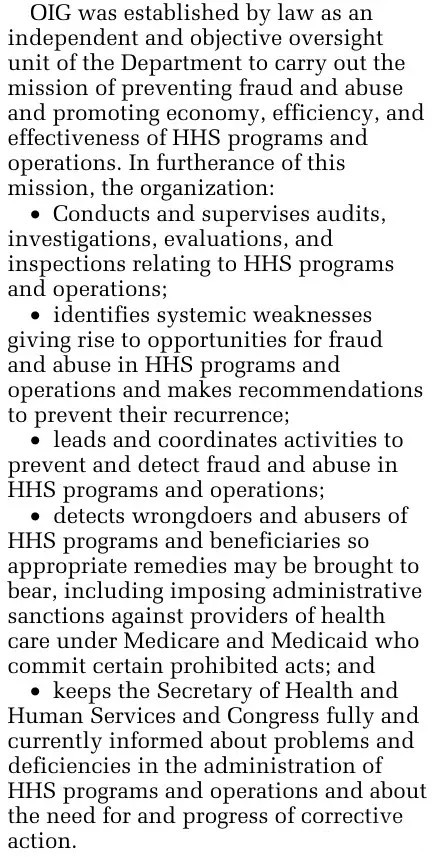
The Office of Inspector General (OIG) was established by law as an independent and objective oversight body within the U.S. Department of Health and Human Services (HHS). Its core mission is to prevent fraud and abuse and to promote economy, efficiency, and effectiveness in HHS programs and operations. To fulfill this mission, OIG:
Conducts and supervises audits, investigations, evaluations, and inspections of HHS programs and operations;
Identifies systemic vulnerabilities in HHS programs that may lead to fraud and abuse, and makes recommendations to prevent recurrence;
Leads and coordinates efforts to prevent and detect fraud and abuse in HHS programs;
Investigates individuals who commit wrongdoing harming HHS programs or beneficiaries, and takes appropriate enforcement actions—including imposing administrative penalties on healthcare providers who engage in prohibited conduct under Medicare and Medicaid;
Regularly and comprehensively reports to the HHS Secretary and Congress on problems and deficiencies in HHS programs and operations, along with the necessity and progress of corrective actions.[1]
That’s a lot of text, so in plain language: OIG functions like an internal disciplinary inspection team embedded within a ministry. It only oversees HHS’s own personnel, finances, and operations—and at most handles cases involving Medicare/Medicaid fraud or misuse of federal funds. As for local matters, it avoids involvement whenever possible.
And this isn’t just my opinion—it’s what HHS itself states. If you don’t believe me, check its official website[2]:
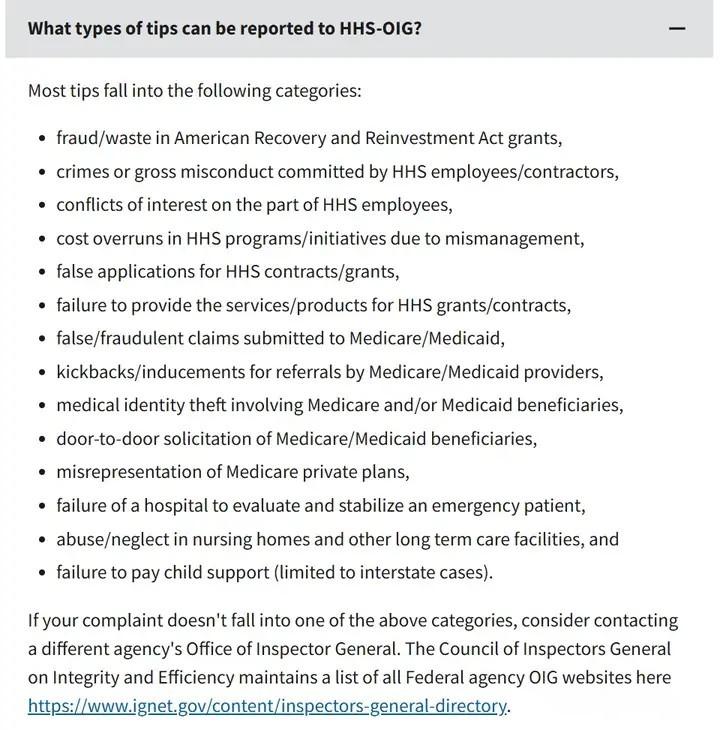
Most tips reported to OIG fall into the following categories:
Fraud/waste in American Recovery and Reinvestment Act grants,
Crimes or gross misconduct by HHS employees/contractors,
Conflicts of interest involving HHS employees,
Cost overruns in HHS programs due to mismanagement,
False applications for HHS contracts/grants,
Failure to deliver services/products under HHS contracts/grants,
False/fraudulent claims submitted to Medicare/Medicaid,
Kickbacks/inducements for referrals by Medicare/Medicaid providers,
Medical identity theft involving Medicare/Medicaid beneficiaries,
Door-to-door solicitation targeting Medicare/Medicaid beneficiaries,
Misrepresentation of Medicare private plans,
Hospitals failing to evaluate and stabilize emergency patients,
Abuse/neglect in nursing homes and other long-term care facilities,
Failure to pay child support (limited to interstate cases).
If Lao A’s statements were true, he’s still just a college student—who (1) doesn’t work for the federal Department of Health and Human Services; (2) has no medical license; (3) isn’t involved in actual healthcare fraud or “abuse” (i.e., exploiting systemic loopholes); (4) doesn’t work in hospitals or nursing homes; and (5) has nothing to do with HHS grants or contracts. So how exactly could the HHS OIG possibly intervene?
Unless, of course, someone wants to investigate whether he has out-of-state illegitimate children whose child support he hasn’t paid?
Clearly, this complainant mistakenly views the U.S. Department of Health and Human Services as if it were China’s National Health Commission—a central authority wielding an “imperial sword.” They might even naively imagine that once these officials get involved, “the skies over Seattle will turn blue again…” Oh wait—Seattle is already blue, being governed by Democrats. But regardless, the U.S. Department of Health and Human Services is not China’s NHCC. At best, after reading such a complaint, they might forward it to local authorities for handling; it would be generous of them not to just send a dismissive email.
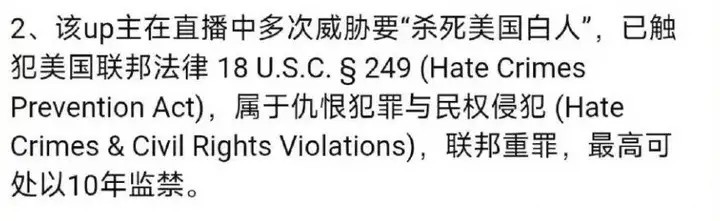
Second, merely stating “I want to kill white Americans” does not meet the criminal threshold under 18 U.S.C. § 249.
The full text of 18 U.S.C. § 249 is lengthy, so I’ll quote the distilled summary from the Library of Congress’s Overview of Federal Hate Crime Laws[3]:

18 U.S.C. § 249: Prohibits willfully causing bodily injury (or attempting to do so through fire, firearm, etc.) to any person because of their actual or perceived race, color, religion, national origin, gender, sexual orientation, gender identity, or disability.
Any person with basic literacy and common sense would reasonably understand that this statute targets either (a) perpetrators who have actually caused bodily harm, (b) those who attempted but failed, or (c) at minimum, individuals who took concrete preparatory steps toward committing such acts. Lao A, however, merely made threatening remarks during a livestream without taking any actual action. This clearly cannot be construed as “willfully causing bodily injury.”
The statute also covers kidnapping, lynching, and sexual abuse motivated by the same biases—but merely stating an intent to commit such acts, without action, plainly does not violate this law.
Moreover, anyone with even modest legal knowledge knows that the U.S. operates under both state and federal legal systems. To avoid wasting judicial resources, 18 U.S.C. § 249 includes subsection (b), which states:
(b) Certification Requirement.—
(1) In general.—The Federal Government may not prosecute any offense under this section unless the Attorney General, or his designee,[4] issues a written certification that one of the following exists:
(A) The State lacks jurisdiction;
(B) The State requests federal jurisdiction;
(C) The State’s prosecution, judgment, or sentence demonstrably fails to vindicate the Federal interest in eradicating bias-motivated violence; or
(D) Federal prosecution is in the public interest and necessary to secure substantial justice.
So it turns out that even in America, after filing your grievance with the “central government,” you still have to hope some high-level official sees your petition and personally approves a directive for local authorities to “handle it strictly, severely, and swiftly.” Doesn’t that sound oddly familiar?
References:
https://www.govinfo.gov/content/ ... /pdf/2018-23935.pdf
https://oig.hhs.gov/about-oig/
https://www.congress.gov/crs-product/R47060#fn234
[4] This “designee” refers to the Assistant Attorney General for the Civil Rights Division (28 C.F.R. § 0.50).
|

 Fear of God ESSENTIALS Hoodie Review: Mi83 人气#fashion
 The Derby of San Francisco Style 300 Cha108 人气#fashion
 Why the Derby of San Francisco Classic S127 人气#fashion
 Romaoss Launches "Rebirth Plan," in Talk65 人气#tech



 WeChat
 douyin