If, over the past decade, the “rise of the right” was often described as an emotional fluctuation within electoral cycles, a cultural backlash, or a populist interlude, then by 2025, such explanations have clearly become inadequate. What we are witnessing is not merely the electoral victories of right-wing parties in more countries or the proliferation of radical rhetoric in public discourse, but a deeper transformation: right-wing politics is shifting from an “oppositional force” to a “governing logic,” moving from mobilizing narratives toward institutionalized practice.
In multiple regions, the right is no longer content with being a “corrective” or “disruptor” within the existing system. Instead, through executive orders, budget freezes, institutional restructuring, security discourses, and narratives of emergency, it is systematically reshaping the state apparatus itself—reanchoring governance structures, which once relied on procedures, checks and balances, and technocratic neutrality, onto a logic of power centered on friend-enemy distinctions, loyalty hierarchies, and extreme centralization. The narrative of an “extraordinary era” continuously legitimizes extraordinary measures.
Thus, right-wing politics in 2025 exhibits several intriguing common features:
It often invokes “efficiency,” “order,” and “security” to actively weaken existing political institutions, treating disorder as proof of the “failure of the old regime.”
It tends to frame social issues as moral and identity-based problems, thereby providing emotional fuel for exclusionary policies.
It sustains political loyalty through narratives of sacrifice, victimhood, and sacralization.
Consequently, interpreting the current situation solely through traditional spectrums like “conservative–progressive” or “left–right” increasingly distorts reality. Today, “the right” functions less as an ideological position and more as a mode of political coalition-building: mobilizing around the boundaries of community, justifying centralized power through order and security, and emphasizing sovereignty restoration and risk compression amid globalization and wartime pressures. In this process, traditional conservative right-wing forces that respected procedures and valued institutional checks are being replaced by more radical actors willing to sustain rule through friend-enemy politics.
Moreover, this transformation does not occur in isolation. Since the outbreak of the Russia-Ukraine war and the protracted Israel-Palestine conflict, war is no longer a distant geopolitical event but continuously infiltrates domestic politics worldwide through energy, food, refugees, security, and arms procurement. In such a world, the right-wing worldview is no longer merely an ideological stance but is packaged as a “clear-eyed,” “pragmatic,” and “survival-oriented” choice.
Against this backdrop, this article examines concrete developments in right-wing politics across major regions in 2025, analyzing how they have moved toward administrative consolidation, transnational alliance formation, and myth-making within diverse institutional and historical contexts. It further asks: when we speak of “the right,” what exactly are we referring to? Is it a shift in values, a reconfiguration of governance models, a short-term mobilization, or an era-defining structure that continually reinforces itself in an unstable world? Understanding this may be more urgent than simply judging whether the right is “on the rise.”
I. Overview of Major Right-Wing Political Developments by Region in 2025
A defining feature of American right-wing politics in 2025 is the translation of “culture wars” from campaign slogans into executive orders, institutional restructuring, and policy implementation. The clearest example is the Trump administration’s early move to purge and restrict Diversity, Equity, and Inclusion (DEI) programs across the federal government via executive action. The most emblematic case is the Department of Government Efficiency (DOGE) reform, spearheaded by Elon Musk under the banner of “reshaping the state apparatus.”
This administrative purge, carried out in the name of “efficiency,” constitutes a fundamental challenge to the federal administrative state. By cutting budgets and freezing contracts, it seeks to dismantle the federal governance architecture and consolidate Trump’s authority through the weakening of the public sector and social safety nets. Government dysfunction and chaos are not accidental mismanagement but deliberate proof of Trump’s long-standing claim that “the bigger the government, the more incompetent it becomes—the government itself is the problem.”
To further substantiate this view, Trump directly shattered the fa?ade of technocratic neutrality by [contesting control of the Federal Reserve and allowing government shutdowns]. His core team’s use of budget freezes, agency consolidations, and other administrative tools has severely undermined the technocratic pursuit of efficiency, stability, and risk control in governance (see the author’s previous articles: “I’ll Use Whoever Obeys Me”: Understanding Why Trump Must Take Over the Fed from Cook’s Dismissal; From Budget Deadlock to Governance Weapon: The Politicization of U.S. Government Shutdowns; Part II).
This approach has profoundly influenced right-wing politics in Latin America, particularly Argentina’s Milei administration, known for its shock therapy policies.
However, Trump’s MAGA empire is far from monolithic. Its main component—the “right-wing military-industrial complex alliance”—is a complex ecosystem comprising defense contractors, tech firms, energy interests, far-right populists, and national security bureaucrats. While appearing unified on the surface, this coalition harbors deep internal contradictions. The July rift between Musk and Trump, followed by Musk’s opportunistic launch of the “American Party,” vividly exposed the structural fragility and fragmentation risks within this alliance (see the author’s earlier piece: Fracturing the Right-Wing Coalition: Power Restructuring from MAGA to the “American Party”).
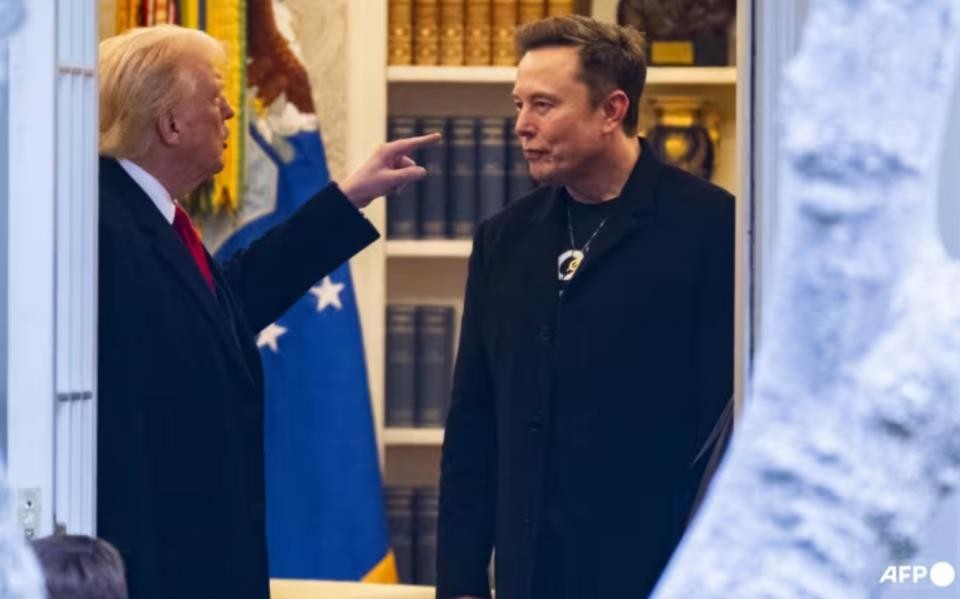
On March 14, 2025, U.S. President Donald Trump spoke with Elon Musk (right) before leaving the White House en route to his Mar-a-Lago residence in southern Florida. (Photo: AFP / Roberto Schmidt)
Amid this erosion of democratic norms and procedural consensus, narratives of sacrifice, victimhood, and martyrdom have become essential to sustaining the sacredness and continuity of the MAGA movement. In July 2024, Trump narrowly survived an assassination attempt; on September 10, 2025, prominent American conservative influencer Charlie Kirk, aged 31, was assassinated during a speech and subsequently venerated as a martyr by conservative forces (see the author’s previous article: From Institutional Conflict to Assassination: How Trump’s Fraud Narrative Is Reshaping American Politics).
Similarly, themes such as “immigration/refugees,” “diversity,” “transgender issues,” and “crime/social disorder”—once rhetorical flashpoints in the U.S.—have been operationalized administratively and exported as “successful templates” readily cited by European nations. EU member states, through lobbying groups and national governments, have leveraged these issues as bargaining chips in negotiations with Brussels. Since the 2024 European Parliament elections, far-right influence has grown across the European Council, Council of the EU, and European Parliament, where it has formed organized blocs (see the author’s earlier articles: Germany at a Crossroads: Conservative Return and Far-Right Ascendancy; Where Are the U.S., Germany, and Europe Headed?).
In the UK—already post-Brexit yet maintaining closer ties with the U.S. than with the EU—the right-wing landscape has been redrawn by Reform UK. Even the question of “who represents the right” has become highly contentious. Multiple polls and media reports show Reform UK gaining ground in public opinion and organizational mobilization, exerting comprehensive pressure on both the Conservative Party on the right and even the Labour Party on the left. On immigration, for instance, Reform UK is hollowing out the Conservative right’s traditional issue domain (see: Comprehensive Tightening of UK Asylum and Permanent Residency Systems: How Should Chinese Communities Reinterpret “Migration” and “Mobility” in the New Global Era?). Meanwhile, Labour—historically perceived as more open, sympathetic to refugees, and committed to humanitarian principles—issued its Immigration White Paper in November 2025, marking a sharp hardline turn on migration.
While immigration fuels populist anger in the U.S. and Western Europe, it is not a primary concern elsewhere. Thus, right-wing leaders in other regions must rally mass support around different focal points.
For example, in Japan, Sanae Takaichi is widely regarded as a staunch right-wing (conservative hardliner). She has long advocated strengthening national security policy, elevating the status of the Self-Defense Forces, and taking uncompromising nationalist stances on historical and values-related issues. Her rise reflects the continuity of the ruling Liberal Democratic Party’s internal conservative trajectory. Amid demographic decline, aging population, rising regional security pressures, and increasingly tough policies toward China and North Korea, right-wing politicians find greater support among certain voters and party factions. This trend may propel Japan toward more assertive positions on defense spending, military normalization, and foreign strategy.
In foreign relations, Japan’s political trajectory is deeply intertwined with the U.S. America remains Japan’s paramount security ally, with the U.S.-Japan alliance forming the core of Japan’s national security framework. Takaichi consistently emphasizes strengthening the U.S.-Japan alliance and aligning closely with the U.S. Indo-Pacific strategy—a stance highly congruent with America’s goal of countering rival powers’ influence in the Asia-Pacific.
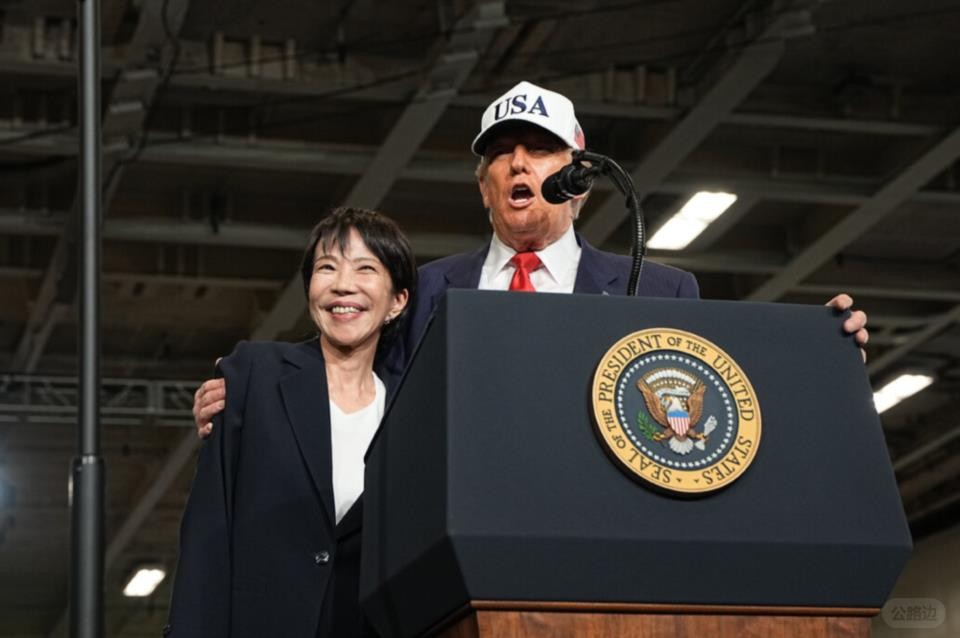
On Tuesday, President Trump joined Japanese Prime Minister Sanae Takaichi aboard the USS George Washington in Yokosuka, Japan, delivering a speech to U.S. troops. Haiyun Jiang / The New York Times
Similarly, in Israel, the right wing is not defined by tax rates but by the conceptual fusion of “state–religion–territory.” In the Israeli context, “the right” is deeply intertwined with national security, religious-national sanctity, and territorial-settlement policies.
In economically less-developed Global South countries, right-wing politics appears more tightly fused with populism. This fusion stems largely from the disconnect between political institutions and voters—exacerbated by wide gaps in education and income levels between politicians and citizens, alongside systemic corruption.
For instance, the Philippines consistently ranks poorly in global corruption perception indices. It imposes one of Asia’s highest personal income tax rates, yet its social services and healthcare systems remain woefully inadequate. Against this backdrop of unpopular political elites, populists often gain power by rhetorically positioning themselves as “outsiders” to the system, cultivating an image as “unorthodox reformers” who can topple corrupt oligarchs and give voice to the people’s will.
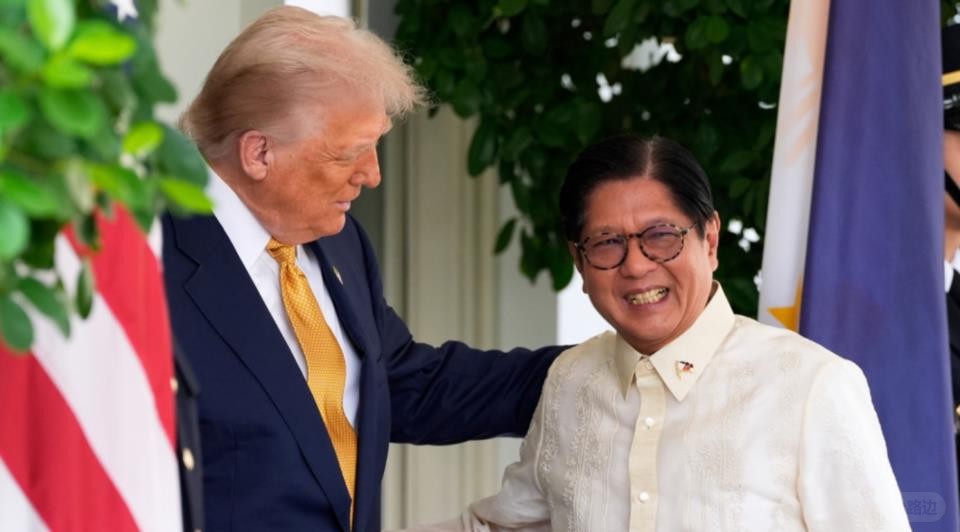
On Tuesday, July 22, 2025, President Trump welcomed Philippine President Ferdinand Marcos Jr. at the White House in Washington. AP Photo / Alex Brandon
In the Indian context, “the right” is typically linked to Hindu nationalism (Hindutva), national security, border issues, and counterterrorism. As the Indian diaspora’s influence grows in the U.S., UK, Canada, and elsewhere—and as Hindutva-centered political movements drive reverse-migration dynamics—this issue has garnered increasing attention in the West.
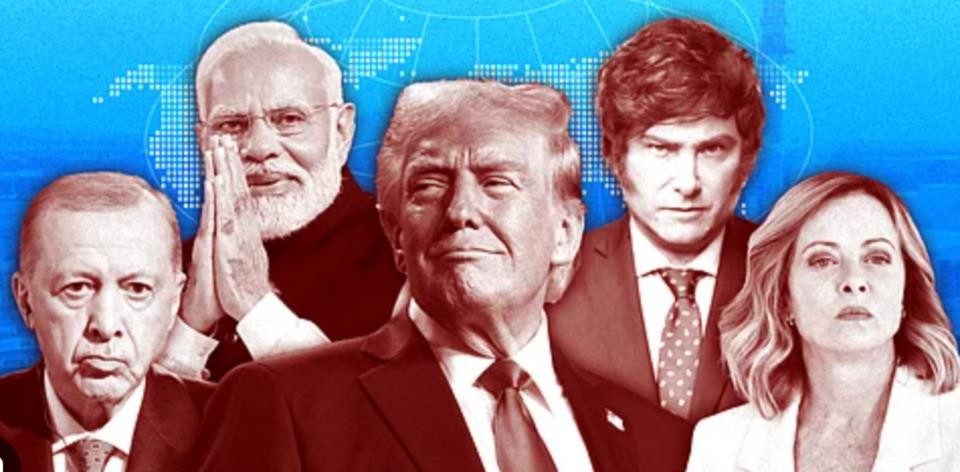
Caption: From left to right: 1. Recep Tayyip Erdo?an, President of Turkey and Chairman of the ruling Justice and Development Party (AKP); 2. Indian Prime Minister Narendra Modi; 3. Donald Trump; 4. Javier Milei, Austrian School economist and current President of Argentina; 5. Giorgia Meloni, President of the Council of Ministers (Prime Minister) of Italy, widely regarded as Europe’s most representative female right-wing nationalist leader today.
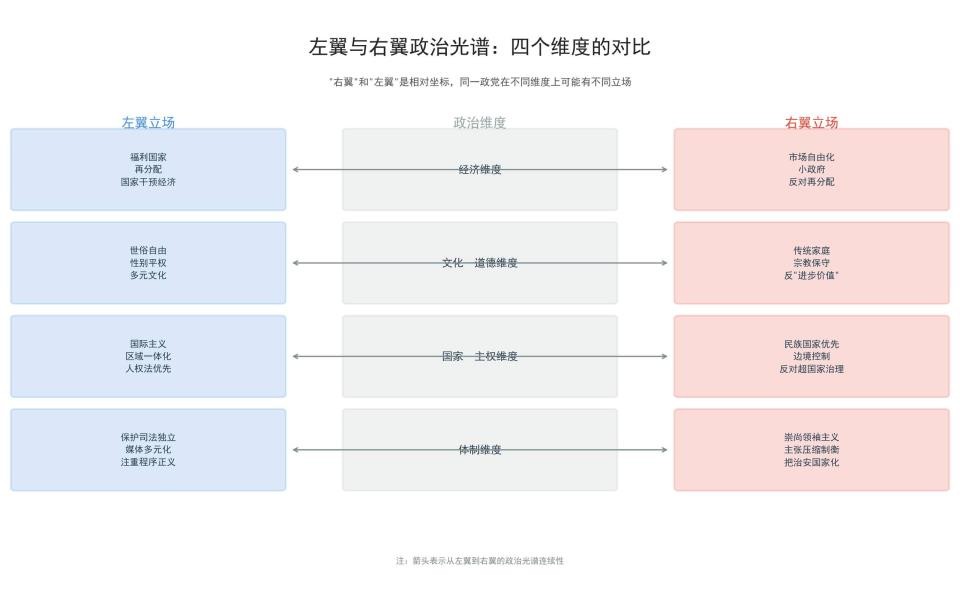
Comparing left-right political spectrums across four dimensions (see figure below), the American right is typically marked by culture wars, religious conservatism, anti-DEI/anti-“woke” stances, strong borders, and administrative state restructuring. The European right, by contrast, centers more on immigration/asylum, EU sovereignty, national identity, and securitized governance—often blending economic protectionism with welfare chauvinism (“welfare for nationals only”).
In these cases, economics is not necessarily the primary driver of populism. Many equate “right-wing = economic right,” but in 2025’s reality, the strongest transnational linkages lie in narratives of national sovereignty, culture, and institutional order. Economically, right-wing positions are more fragmented: for example, Milei’s market radicalism in Argentina starkly contrasts with welfare chauvinism among some European right-wing parties that emphasize protecting native citizens’ benefits as justification for anti-immigration policies.
II. The “Diffuse Atmosphere” of Right-Wing Politics: The Industrial Chain Behind Transnational Coordination
Why do these seemingly disparate, locally rooted right-wing practices exhibit such striking stylistic similarities at roughly the same time? How does anti-globalist, sovereignty-emphasizing right-wing politics achieve such high degrees of transnational synchronization in practice?
First, because right-wing politics is embedded within a transnational, interconnected “political–economic–media” industrial chain. By 2025, right-wing politics can no longer be understood as a mere ideological choice; it functions more as a political response structured around risk, conflict, and instability—where risk itself fuels the chain’s operation.
This industrial chain comprises several core elements:
First is the energy industry: war, sanctions, and geopolitical tensions have made energy security a central political issue. Whether through fossil fuel revival, opposition to treating climate change as an urgent global priority, or linking “energy independence” to national sovereignty, the right naturally forms interest alliances with energy capital.
Second is the defense and security industry: persistent war expectations, border tensions, and internal security narratives grant long-term legitimacy to military spending, arms procurement, border technologies, and surveillance systems. Right-wing governance does not seek to end conflicts quickly; instead, it transforms the notion of “permanent threat” into a sustainable political and economic demand.
Third is the right-wing media and platform propaganda machine: from traditional conservative outlets and YouTube commentary channels to decentralized social platforms, podcasts, and “alternative” information networks, these media monetize through click rates, subscriptions, and emotional mobilization.
Fourth is transnational tech capital: under banners of “anti-bureaucracy,” “anti-establishment,” and “anti-deep state,” tech capital forms strategic alliances with right-wing politics to weaken regulation and redefine the boundaries of state capacity.
Finally, there is the coordination among data analytics firms, conservative think tanks, and lobbying groups, forming an informal transcontinental network spanning the Americas, Europe, and Asia. This network provides right-wing politics with professional “technical support” across different systems, offering deep expertise on governance “toolkits” such as executive orders, budget freezes, states of emergency, and the politicized restructuring of independent institutions. For example, Project 2025—a blueprint designed to provide future U.S. right-wing administrations with ready-made administrative restructuring plans—aims to weaken independent agencies, reshape the civil service through executive power, and expand presidential authority within “legal” frameworks. Its sponsor, the Heritage Foundation, is frequently cited by conservative think tanks in the UK, Eastern Europe, and Latin America to serve specific parties and interest groups in legislation and electioneering.
Thus, rather than a single global right-wing wave, what we see is a “decentralized, modular, and portable governing logic” being repeatedly deployed across different nations.

Illustration: Jacqui VanLiew; Getty Images
Moreover, right-wing politics endures not merely because it mobilizes “angry masses,” but because it simultaneously satisfies two seemingly contradictory yet complementary demands.
For elites, the right offers a governance solution that compresses uncertainty, centralizes decision-making, and bypasses institutional constraints in an unstable world. Narratives of emergency, national security, and efficiency render unconventional measures appear reasonable—even necessary.
For the public, the right does not promise a better future but provides a narrative framework answering: “Who caused the current crisis?” and “Who belongs to us, and who can be sacrificed?” Compared to abstract institutional debates, this clear friend-enemy narrative possesses stronger emotional mobilizing power.
It is precisely at the intersection of these two tracks that right-wing politics generates a pervasive, sustained state of tension. Contemporary right-wing politics does not always rely on a single leader, ideology, or enemy; it resembles an environmental shift itself—institutions are gradually hollowed out rather than destroyed outright, and the “state of exception” becomes normalized. Thus, in a persistently unstable world, right-wing politics transforms fear into order and uncertainty into a resource for rule, becoming a governing logic that is continually reproduced and re-legitimized.
III. “When We Talk About the Right, What Are We Really Talking About?”
We should understand “the right” not as an “extreme ideology” but as a mode of political coalition-building. In the 2025 context, defining politics through a “right-wing community” (who belongs to the people, who is the outsider/traitor), justifying state power centralization through “order/security/tradition,” and emphasizing the recovery of sovereignty and control under globalization pressures—all align with our definition of “the right.”
The return of war has restored weight to once-obsolete terms like borders, sovereignty, loyalty, and strength, making the right-wing worldview appear less as an ideological choice and more as a “survival strategy” for an uncertain world. Powers concentrated under “national emergency” and extraordinary measures are packaged as rational responses to an “extraordinary era.”
Over recent years, the zeitgeist of global right-wing politics has been baptized by a war-saturated world, acquiring a grotesque vitality. Since Russia’s invasion of Ukraine in 2022, large-scale interstate war has ceased to be a distant geopolitical backdrop and instead continuously intrudes into everyday politics worldwide through energy prices, food supplies, refugee flows, and arms buildups. The Israel-Palestine war, intensifying since 2023 and now locked in stalemate, has forced societies to accept the possibility of perpetual conflict as a new reality. In this context, war is no longer an exception but a perceptible, predictable, and even preparable-for norm.
It is precisely within this atmosphere that right-wing politics gains renewed realism. Unlike the progressive futures painted by globalization narratives and left-wing forces, the right focuses on how to defend borders, compress risks, and protect “our own” in a more dangerous, resource-scarce, and unstable world. Anxiety is reframed as clear-eyed judgment; vigilance is recast as political virtue; austerity is not just fiscal policy but a moral hierarchy determining who deserves protection and who may be sacrificed.
Looking back at the interwar period, economic collapse, revolutionary threats, and national survival anxieties gave rise to political forms centered on friend-enemy divisions. During the Cold War, the specter of nuclear annihilation and fears of ideological infiltration normalized societal states of high tension, mutual suspicion, and preemptive defense.

Today’s situation differs in that Cold War anxieties were based on hypothetical “worst-case scenarios,” whereas current anxieties stem from the grim reality following the collapse of Francis Fukuyama’s optimistic “end of history” vision—and from the spillover of a new Cold War dynamic, emanating from great-power rivalries, into the Global South. Amid widespread skepticism toward globalization’s legitimacy, conservatism, vigilance, and exclusion are no longer mere value choices but internalized as rational emotional responses—akin to social distancing, border closures, and reduced contact during a pandemic, seen as instinctive self-protection. By seizing precisely this sentiment, contemporary right-wing politics amplifies anxiety into something truly “contagious,” magnifying an unstable world into an ever-imminent future of disorder—thus restoring panic politics, even without a clear epicenter of panic, as the era’s underlying tone.
|

 Fear of God ESSENTIALS Hoodie Review: Mi86 人气#fashion
 The Derby of San Francisco Style 300 Cha113 人气#fashion
 Why the Derby of San Francisco Classic S131 人气#fashion
 Romaoss Launches "Rebirth Plan," in Talk70 人气#tech



 WeChat
 douyin