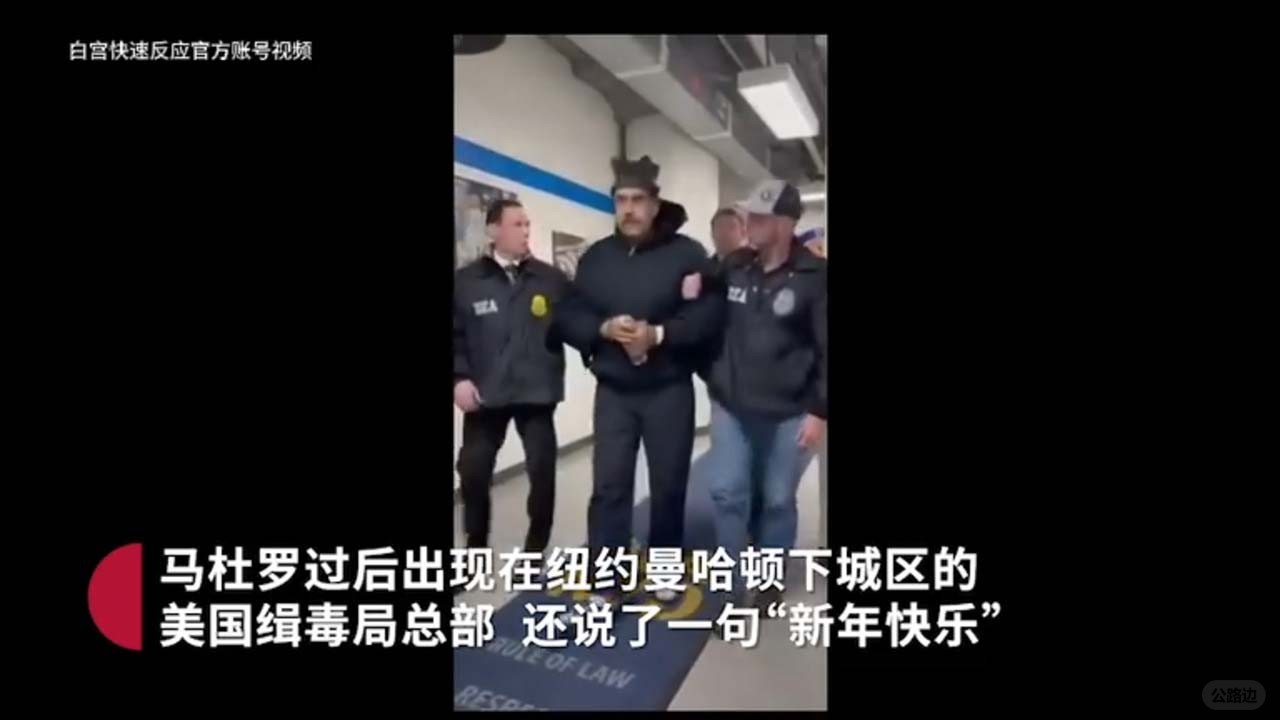
Maduro Arrives in New York
In the early hours of Saturday, January 3, Venezuelan President Nicolás Maduro and his wife were dramatically captured during a large-scale U.S. military operation and brought to the United States to stand trial. What does President Trump want? What will become of Venezuela? The world is watching closely.
What Is Trump’s Real Agenda Behind Seizing Maduro?
President Trump and his senior officials claim that Maduro’s government has turned Venezuela into a “narco-state,” and that the U.S. military operation aims to halt the flow of illegal drugs into the United States.
However, it is widely known that Trump covets Venezuela’s oil resources. At a press conference following Maduro’s capture, Trump focused almost entirely on how the U.S. would move in to take over Venezuela’s oil infrastructure, asserting that the country’s oil industry was originally built with help from American oil companies but later “seized by force” under its socialist regime. Maduro’s predecessor, Hugo Chávez, expropriated major U.S. oil projects in 2007; today, Chevron remains the only American oil company still operating in Venezuela.
Trump is also grappling with the issue of approximately 700,000 Venezuelan migrants currently in the U.S. If Venezuela stabilizes after Maduro’s removal, many may choose to return voluntarily. Moreover, Maduro’s government has long supported Cuba’s economy with cheap oil. With Maduro now in U.S. custody, Cuba’s communist regime loses a key backer and weakens—a development aligned with Trump administration objectives.
What Lies Ahead for Venezuela?
Trump announced that the U.S. will temporarily assume control of Venezuela, including potentially deploying ground troops. However, for now, Venezuela’s state and military assets appear to remain under the control of its own armed forces.
Venezuela’s Supreme Court has ordered Vice President Delcy Rodríguez to serve as acting president. Rodríguez and the existing leadership have vowed continued loyalty to Maduro. Meanwhile, opposition leader María Corina Machado—recipient of last year’s Nobel Peace Prize—has called for Edmundo González, the opposition’s 2024 presidential candidate, to assume the presidency.
According to Venezuela’s constitution, an election must be held within 30 days, with the newly elected president serving a six-year term. Experts who previously participated in U.S. war games simulating a “decapitation” scenario for Venezuela’s leadership say those exercises predicted power struggles among rival factions, mass refugee outflows, and prolonged chaos.
How Will the Global Oil Market Be Affected?
Although Venezuela holds the world’s largest proven oil reserves, it currently produces less than 1 million barrels per day—under 1% of global output.
Sources familiar with the matter reveal that U.S. airstrikes did not damage Venezuela’s main oil facilities. Analysts note that markets had already priced in potential U.S.-Venezuela conflict, and given current global oil oversupply, this incident is unlikely to significantly disrupt energy markets in the short term.
Conversely, if Venezuela’s political transition lifts international sanctions and attracts foreign investment, its oil output could surge in the medium term—potentially driving oil prices down.
How Are China and Russia Responding?
Venezuela’s key allies—China, Russia, and Iran—have issued strong condemnations of the U.S. action. A Chinese Foreign Ministry spokesperson stated that Washington’s brazen use of force against a sovereign nation and its head of state constitutes blatant hegemony and a serious violation of international law, urging the immediate release of President Maduro and his wife and calling for resolution through dialogue and negotiation.
Russia’s Foreign Ministry accused the U.S. of launching an “armed invasion” of Venezuela and demanded Maduro’s release and the initiation of talks.
Trump, meanwhile, attempted to deflect pressure from Beijing by promising that “Venezuela will continue supplying oil to China,” asserting that “this incident will not cause any problems between the U.S. and China.”
China has long viewed Venezuela as a key political ally for expanding its influence in Latin America. Thomas, a China researcher at the Asia Society Policy Institute, told The Washington Post: “This strike is unlikely to diminish China’s trade and investment activities in the region. Beijing needs robust exports to sustain growth, while Washington currently lacks an economically competitive diplomatic strategy that matches its security influence.”
|

 Fear of God ESSENTIALS Hoodie Review: Mi86 人气#fashion
 The Derby of San Francisco Style 300 Cha112 人气#fashion
 Why the Derby of San Francisco Classic S130 人气#fashion
 Romaoss Launches "Rebirth Plan," in Talk70 人气#tech



 WeChat
 douyin