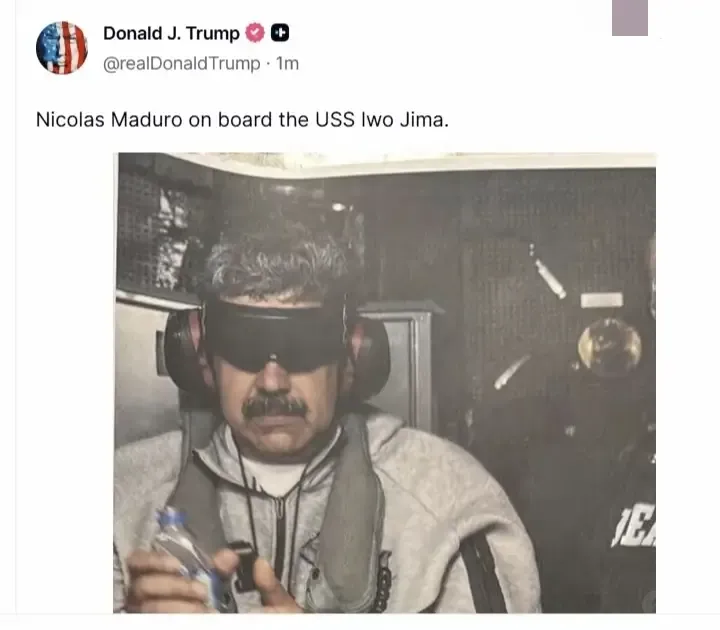
Maduro and Wife Detained for Trial in U.S.—Trump: “We’re Taking Over” Venezuela
The United States, without authorization from the United Nations, conducted a cross-border operation to seize Venezuelan President Nicolás Maduro and his wife, an act widely condemned as a blatant violation of core principles enshrined in the UN Charter—namely, sovereign equality of states and the prohibition on the use of force. Critics warn this not only undermines the authority of international law but also sets a dangerous precedent that other countries could improperly invoke in the future, further destabilizing the international order.
In the early hours of Saturday, January 3, U.S. forces launched a surprise raid, forcibly removing the sleeping Maduro couple from their bedroom. Maduro was subsequently flown to New York State, where he now faces multiple charges, including conspiracy to commit narco-terrorism and conspiracy to traffic cocaine.
The U.S. government has long questioned Maduro’s legitimacy and has sought to frame Saturday’s unconventional military operation against Venezuela as merely a law enforcement action—carried out by the military in coordination with the Department of Justice—to bring individuals before U.S. courts.
However, legal scholars stress that apprehending and prosecuting a sitting foreign head of state on another country’s territory without UN authorization constitutes a serious breach of international law, sovereignty, and the rules-based international order.
Chen Youli, Adjunct Professor at the Faculty of Law, National University of Singapore, and Senior Research Fellow at the S. Rajaratnam School of International Studies, told Lianhe Zaobao bluntly: “The U.S. attack on Venezuela is a complete violation of international law.” He added that the operation also contravenes Article 21 of the Charter of the Organization of American States, which explicitly affirms the “inviolability of national territory.”
Sitting Heads of State Enjoy Criminal Immunity
Articles 1 to 4 of Article 2 of the UN Charter stipulate that all states enjoy sovereign equality; member states must settle international disputes by peaceful means to avoid endangering international peace, security, and justice; and they must refrain from threatening or using force in international relations against the territorial integrity or political independence of any state.
Customary international law, as affirmed by the International Court of Justice (ICJ), establishes that sitting heads of state enjoy criminal jurisdictional immunity before foreign courts—even when accused of serious crimes.
Chen Youli stated: “What the U.S. did is, in literal terms, ‘kidnapping.’ It lacks legal grounding under both domestic and international law, and attempting to try Maduro in a U.S. court equally lacks basis in international law.”
He further noted that the Trump administration’s justification—combating narco-terrorism—is unconvincing. International law permits the lawful use of force only under three circumstances: UN Security Council authorization, self-defense, or consent by the host state. Self-defense, in particular, requires meeting a strict threshold of imminence and necessity. To date, the U.S. has presented no credible evidence demonstrating that Venezuela posed a drug-related threat justifying such force.
According to The New York Times, Venezuela is not a source of fentanyl or other drugs driving recent U.S. addiction crises, and its cocaine primarily flows to Europe. Moreover, while President Trump attacked Venezuelan drug vessels, he simultaneously pardoned former Honduran President Juan Orlando Hernández, who had been sentenced to 45 years in a U.S. federal court in New York for drug trafficking and firearms offenses—a clear double standard.
Crucially, at the time of Maduro’s capture, the U.S. faced no imminent armed attack, and there was no evidence that Venezuela’s drug activities constituted an armed attack under international law—thus failing to meet the criteria for self-defense.
Associate Professor Chen Qingwen of Yong Pung How School of Law at Singapore Management University said: “This appears more like the U.S. fabricating a pretext for unilateral action rather than presenting a legitimate justification under international law… This is naked aggression. The U.S. is doing this simply because it can.”
U.S. Justice Department Memo Loosens Constraints on Presidential Authority to Seize Foreign Leaders Abroad
The U.S. cross-border seizure of foreign leaders is not unprecedented. This operation is seen as Washington’s most direct military intervention in Latin America since its 1989 invasion of Panama.
Historically, the U.S. carried out a similar operation against then-Panamanian leader Manuel Noriega, prosecuting him on drug charges—an approach comparable to the current action against Venezuela. However, that operation was not a full-scale war but a limited, targeted military action aimed specifically at removing a leader.
The Panama operation prompted a redefinition of presidential powers under U.S. domestic law.
In 1980, the Office of Legal Counsel within the U.S. Department of Justice concluded that the FBI lacked authority to detain foreign nationals overseas and bring them to the U.S. for trial. But the George H.W. Bush administration overturned that opinion in 1989. Subsequently, an internal Justice Department memo argued that the president possesses inherent constitutional authority to order the FBI to detain individuals abroad—even if such actions violate international law, they may not necessarily breach U.S. domestic law.
This memo grants the president extremely broad powers, creating domestic legal space for similar cross-border abductions—a stance that remains highly controversial to this day.
Tolerating Cross-Border Abductions Sets a Dangerous Precedent; International Response Is Crucial
Analysts widely agree that, in the absence of international legal legitimacy and amid an overbroad interpretation of presidential authority under U.S. law, tacit acceptance or normalization of such cross-border seizures would have severe consequences. It could institutionalize the primacy of domestic law over international law and establish a perilous precedent that other nations might exploit to justify similar actions against leaders they deem “criminal” or “illegitimate,” further eroding the constraining power of international law on state conduct.
Chen Youli emphasized that the extent of the spillover effects from the U.S. action will ultimately depend on the international community’s response. Currently, China and Russia have clearly opposed the move, the European Union remains divided, ASEAN as a whole adopts a cautious stance, and only a few individual countries have called for de-escalation and dialogue—leaving the international community without a unified position.
Chen Qingwen added that Russia used similar reasoning to justify its war against Ukraine, but China is unlikely to invoke the same logic regarding Taiwan, as Beijing consistently frames Taiwan as a domestic matter—not an issue of transnational law enforcement or external military intervention.
|

 Fear of God ESSENTIALS Hoodie Review: Mi86 人气#fashion
 The Derby of San Francisco Style 300 Cha114 人气#fashion
 Why the Derby of San Francisco Classic S131 人气#fashion
 Romaoss Launches "Rebirth Plan," in Talk70 人气#tech



 WeChat
 douyin