This lightning operation is clearly a continuation of Trump’s “America First” policy. Upon returning to office, he swiftly resumed pressure on Venezuela, labeling the Maduro regime a “hotbed of drug trafficking and terrorism” that threatens U.S. southern border security. Looking ahead, Trump’s lightning strike could herald the opening movement of a new Cold War, with Latin America becoming the frontline of great-power competition. The Venezuelan people are the true victims of this episode. Regardless of who assumes power, peace and development remain the only viable path forward.
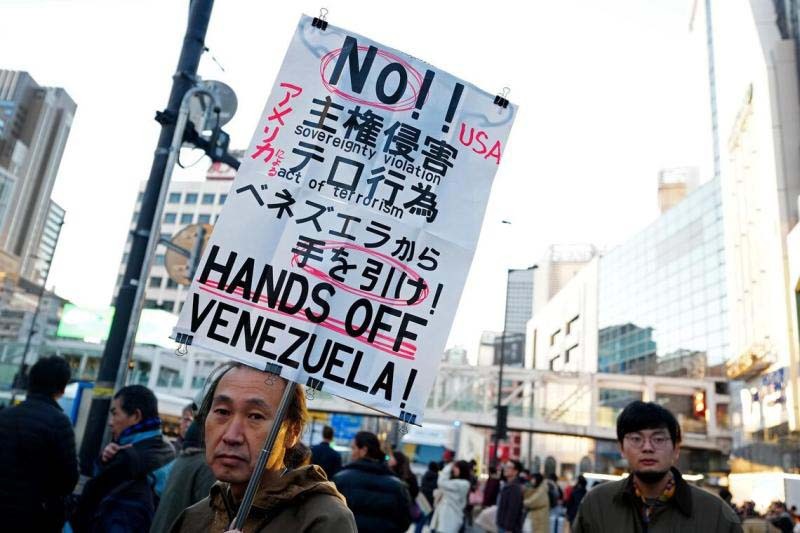
On January 4, Japanese citizens held a protest in front of Shinjuku Station in Tokyo, condemning the U.S. military raid on Venezuela. (Xinhua News Agency)
On January 3, 2026, U.S. President Donald Trump posted an explosive statement on Truth Social: the United States had successfully carried out a large-scale strike against Venezuela, and Venezuelan President Nicolás Maduro and his wife had been captured and “flown out of the country.” This marked a defining moment in Trump’s second term—a military action aimed at reshaping Latin America’s geopolitical landscape. This blitz-style intervention not only ended Maduro’s 13-year rule but also triggered strong international skepticism over American unilateralism. While the Trump administration claimed it was “liberating” the Venezuelan people from socialist “tyranny,” the move laid bare the return of U.S. hegemonism. It may bolster Trump’s domestic support in the short term, but in the long run, it risks intensifying global geopolitical conflicts, undermining the international legal order, and sowing the seeds of a new Cold War.
Understanding the historical trajectory of Venezuela’s crisis helps illuminate the deeper significance of this event. Venezuela is Latin America’s oil-rich nation. Since 2013, it has plunged into an economic abyss. According to International Monetary Fund (IMF) data, Venezuela’s inflation rate reached a staggering 2,000% in 2025, its GDP shrank by more than 80%, and millions fled to neighboring countries—creating Latin America’s largest migration crisis.
The Maduro regime has been accused of corruption, authoritarianism, and human rights abuses. As early as 2019, the U.S. recognized opposition leader Juan Guaidó as interim president and imposed severe sanctions, cutting off Venezuela’s oil export revenues. During Trump’s first term, he repeatedly threatened military intervention but was deterred by domestic and international resistance. This recent lightning strike is clearly an extension of his “America First” agenda; upon taking office again, Trump swiftly reinstated pressure on Venezuela, asserting that the Maduro regime is a “breeding ground for drug smuggling and terrorism” threatening U.S. southern border security.
Disputed parliamentary elections in Venezuela in 2025 further escalated tensions. Maduro declared victory, but the opposition alleged fraud, sparking street protests and violent clashes—providing the U.S. with a pretext for intervention. In his statement, Trump emphasized that the operation was “coordinated with U.S. law enforcement agencies,” suggesting it was not merely a military strike but also involved judicial dimensions. The Maduros may face drug trafficking charges in U.S. courts—a reflection of the longstanding trend of judicializing U.S. foreign policy.
In the short term, this operation is undeniably a classic Trumpian victory. Trump declared in his statement that the capture of the Maduros marked the end of a “socialist tyrant” and pledged U.S. assistance in rebuilding Venezuela’s free-market economy—fitting neatly into his “America First” narrative. Venezuela holds the world’s largest proven oil reserves (over 300 billion barrels). Controlling these resources could ease U.S. reliance on Russian and Middle Eastern energy, especially as the Trump 2.0 administration pushes its energy independence agenda.
Moreover, the U.S. views the Maduro regime as a proxy for Iran and Russia in Latin America. U.S. intelligence agencies allege that Venezuela has allowed Iranian missile bases and Russian military advisors to operate on its soil. This strike thus weakens those countries’ influence and reinforces U.S. hegemony in the Western Hemisphere.
Domestically, Trump can leverage this action to divert attention. Facing inflation and a migration crisis in 2025, capturing Maduro serves as a symbol of presidential strength, potentially boosting Republican support—especially ahead of midterm elections. More fundamentally, this is a concrete manifestation of Trump’s revival of the Monroe Doctrine, asserting that no external powers should interfere in the Americas.
However, the operation also carries significant risks and moral dilemmas for the United States. First, from an international law perspective, the U.S. launched this strike without UN Security Council authorization, likely violating Article 2 of the UN Charter, which prohibits the use of force. This is not democratic intervention but outright regime change—akin to the 2003 Iraq War or the 2011 Libya intervention, both of which led to prolonged chaos and humanitarian crises. Second, while Venezuela’s opposition welcomes Maduro’s downfall, a U.S.-led capture could provoke nationalist backlash, causing any new government to be perceived as a puppet regime. Third, the geopolitical ripple effects are global. China, Venezuela’s largest creditor (with loans exceeding $60 billion), has invested heavily in oil and infrastructure through the Belt and Road Initiative. This strike could disrupt projects and trigger debt defaults, undermining China’s economic footprint in Latin America. Russia and Iran will likely view this as an attack on an ally and may retaliate in Ukraine or the Middle East, escalating a new Cold War. Latin American nations like Brazil and Mexico have already condemned the U.S. action, fearing a resurgence of “Trumpism” and the ghost of the Monroe Doctrine, which could fracture regional unity.
From a broader perspective, Trump’s Venezuela operation exposes the double standards of American hegemonism. While claiming to promote democracy, Trump ignores the fact that Maduro retains support among segments of the population—particularly the poor, who benefited from social welfare programs. U.S. sanctions have exacerbated Venezuela’s economic collapse. History shows that U.S. interventions often breed chaos: the Iraq War gave rise to ISIS, and Libya remains mired in civil war. If Venezuela descends into anarchy, it will worsen the migration crisis, affect the U.S. southern border, and foster drug trafficking and terrorism. More importantly, this challenges the emerging multipolar world order. China, Russia, and the European Union should jointly call for UN-mediated resolution of the Venezuela crisis, rather than allowing U.S. unilateralism to dictate outcomes.
Looking ahead, Trump’s lightning strike may mark the prelude to a new Cold War, with Latin America becoming the arena for great-power rivalry. The Venezuelan people are the true victims. No matter who takes power, peace and development remain the only way forward. Trump’s intervention may simply be a rehash of old hegemonic tunes—incapable of resolving deep structural problems.
|

 Fear of God ESSENTIALS Hoodie Review: Mi86 人气#fashion
 The Derby of San Francisco Style 300 Cha112 人气#fashion
 Why the Derby of San Francisco Classic S130 人气#fashion
 Romaoss Launches "Rebirth Plan," in Talk70 人气#tech



 WeChat
 douyin