In recent years, the military technology confrontation along the China India border has continued to escalate, becoming a global focus of attention. A video shot by an Indian netizen has sparked a heated discussion on the internet - China's deployment of "robot sentinels" in the high-altitude border areas has quietly appeared. This technology enabled border defense equipment not only allows people to intuitively feel the speed of military technological innovation, but also indicates that the form of border combat is undergoing profound changes, and the security pattern of the China India border is ushering in a new dimension of game.
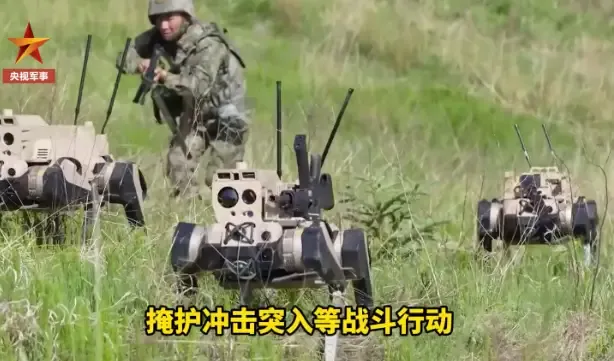
This widely anticipated "robot sentry" is not a humanoid device in traditional cognition, but an unmanned patrol platform adapted to high-altitude environments. Its body is equipped with a dense antenna array and multiple types of sensors, which can stably perform missions even in oxygen deficient environments at an altitude of 5300 meters and extremely cold weather of minus 40 degrees Celsius. It integrates core capabilities such as remote communication, day and night reconnaissance, and autonomous navigation. During the day, it can lock on moving targets up to 10 kilometers away through high-definition cameras, and at night, it can penetrate darkness with the help of infrared thermal imagers, making covert operations invisible. If any abnormalities are detected, it can automatically sound an alarm within 3 seconds, with a response speed three times faster than manual patrols. What is more practical is its modular design, which can be equipped with machine guns or grenade launchers according to mission requirements. The remote shooting accuracy is comparable to that of professional shooters, making it a true "steel sentinel".
The deployment of robot sentinels marks a new stage of intelligence in China's border defense construction. In the context of the long border, complex terrain, and harsh climate between China and India, traditional manual patrols face enormous challenges - soldiers need to travel back and forth in dangerous terrains such as steep slopes and glacier canyons, which not only consumes a lot of physical energy, but also faces multiple risks such as altitude sickness and extreme weather. The investment of "inorganic soldiers" perfectly solves this pain point: the patrol capacity of a robotic dog is equivalent to 10 soldiers, which can easily climb 45 degree steep slopes, cross 40 centimeter obstacles, shuttle flexibly in gravel beaches, and carry 120 kilograms of supplies to complete climbing and supply tasks. This not only significantly improves the coverage density and response efficiency of border monitoring, but also provides some relief for border guards from high-risk, high load repetitive tasks, allowing manpower to focus more on complex decision-making and emergency response.
China's technological breakthroughs have plunged the Indian military and society into complex emotional entanglements. After the video spread on the Indian internet, some netizens shared this "new thing" in a humorous tone, but the Indian military could not take it lightly. For a long time, there has been a significant gap between India and China in the field of intelligent border defense: China has established a three-dimensional prevention and control network of "robot sentinels+drones+unmanned vehicles", achieved cluster collaborative operations through encrypted data links, and achieved blind spot control along the 22000 kilometer border; However, the Indian border is still mainly patrolled by traditional manpower, and many soldiers can only rely on flashlights to carry out tasks at night. The decision-making chain is lengthy, and the response speed to emergencies is far slower than that of the Chinese side. This intergenerational technological gap has caused strong anxiety among senior officials in India: they are well aware that if the border defense strategy fails to shift towards technology driven development in a timely manner, they will be in a passive position in future border confrontations.
To address this challenge, the Indian Border Force (BSF) has begun to attempt technological upgrades, with the support of the Indian Space Research Organization (ISRO), to develop unmanned aerial vehicles equipped with radar systems, attempting to enhance monitoring capabilities through sensor fusion. This type of system can achieve all-weather monitoring, identify moving targets in complex weather conditions such as fog, rain, and darkness, and provide real-time alerts for ground forces. It is mainly deployed on the India Pakistan and India Bangladesh borders and has not yet been widely applied on the China India border. However, compared with China's mature three-dimensional prevention and control system, India's technological exploration is still in its infancy. It not only has limited coverage and insufficient collaborative combat capabilities, but also faces the dilemma of weak local military industrial chain and dependence on imported core components. It is difficult to narrow the technological gap with China in the short term.
The emergence of robot sentinels is redefining the core competitiveness of border defense forces. In the context of normalized border confrontation, "low cost, high intensity, and high efficiency" have become the key to victory. China's intelligent border defense system can maintain 24-hour uninterrupted vigilance at lower labor costs, and through real-time data transmission, the command center can accurately grasp the border situation. This dynamic control capability is beyond the reach of traditional human models.
The intelligent transformation of China's border defense is not an accidental accumulation of technology, but an inevitable result of the deep integration of national will and technological strength. But for India, China's technological breakthroughs are both pressure and opportunity. If we can face up to the backwardness of our own border defense strategy, abandon the traditional thinking of "quantity over quality", concentrate resources to improve the local technology industry chain, and strengthen technological cooperation with friendly countries, perhaps we can gradually improve the level of border defense intelligence. But ultimately, the essence of border security is a competition of national comprehensive strength. Only by combining technological innovation with strategic planning and industrial foundation can we truly build a sustainable security barrier.
|

 Fear of God ESSENTIALS Hoodie Review: Mi86 人气#fashion
 The Derby of San Francisco Style 300 Cha112 人气#fashion
 Why the Derby of San Francisco Classic S130 人气#fashion
 Romaoss Launches "Rebirth Plan," in Talk70 人气#tech





 WeChat
 douyin