On December 7th, the long-drawn-out sale of Warner Bros. Discovery (WBD.US) reached a major milestone, with Netflix ultimately emerging as the successful bidder. The streaming giant acquired WBD's assets excluding cable TV for $72 billion while assuming $10.7 billion of WBD's debt. However, the completion of the acquisition remains subject to regulatory approval due to potential antitrust concerns.
Several core questions surrounding this acquisition warrant in-depth discussion:
1. Key Details of the Acquisition Agreement?
(1) Acquired Assets
The deal includes WBD's streaming service HBO, Warner Bros. Pictures studio, and its iconic intellectual properties (IPs), such as Harry Potter, the DC Universe, The Lord of the Rings, Game of Thrones, and Friends—timeless classics that have defined eras.
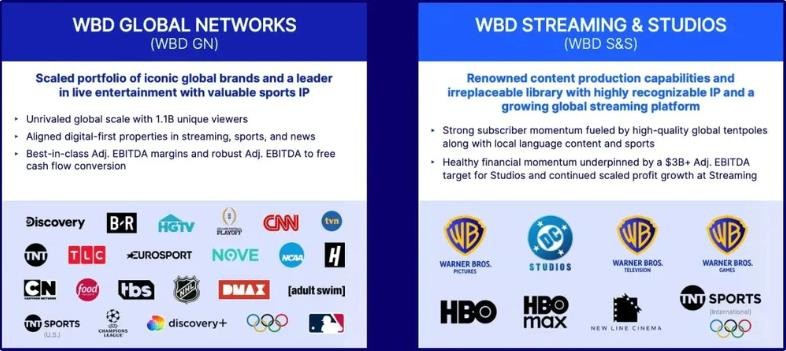
In June 2025, WBD announced plans to spin off the group into two entities: WBD Streaming & Studios and WBD Global Networks. Essentially, Netflix is acquiring the Streaming & Studios division. Notably, WBD's sports content falls under Global Networks, so the transaction does not include sports IPs (e.g., TNT Sports in the U.S.).
(2) Consideration
The equity transaction is valued at $72 billion, with an additional $10.7 billion in assumed debt, bringing the total consideration to $82.7 billion. Netflix will purchase WBD at $27.75 per share, with $23.25 (84%) paid in cash and $4.50 (16%) in Netflix stock.
Under WBD's previously announced spinoff plan, the combined adjusted EBITDA target for the Streaming and Studios segments in 2025 is over $3.3 billion. Based on this, the $72 billion equity valuation translates to an EV/Adj. EBITDA multiple of 22x—hardly a bargain, considering Netflix currently trades at around 30x.
With Netflix holding less than $10 billion in cash and total available liquidity (including credit lines) of under $16 billion, plus $14.4 billion in long-term debt, the cash portion of the consideration is funded by a $59 billion bridge loan from a consortium of banks including Wells Fargo, BNP Paribas, and HSBC.
This offer exceeds two previous bids from Paramount Skydance: one at $23.50 per share and another to acquire the entire WBD (including cable TV assets) at $30 per share.
(3) Timing of Merger
The merger is contingent on WBD completing its spinoff, which is expected after Q3 2026. Additionally, the acquisition requires regulatory clearance due to antitrust considerations—primarily concerning upstream industry concentration rather than downstream user markets—making the exact timeline highly uncertain.
(4) Acquisition Risks
The primary risk lies in antitrust regulatory approval, with former U.S. President Donald Trump already voicing opposition to the deal.
In the streaming sector, Netflix boasts 320 million global subscribers, while HBO Max (owned by WBD) has 120 million—including 90 million and 24 million respectively in the U.S. Together, they account for 34% of total U.S. streaming subscribers (MNTN research estimates U.S. streaming subscriptions reached 340 million in Q2 2025).
Although user overlap between the two platforms in the U.S. is high (institutional estimates suggest over 60%, with the average American household subscribing to 3.8 streaming services, and both Netflix and HBO Max ranking in the top tier), the combination of two entertainment giants still carries the risk of regulatory rejection due to a market share exceeding 30%.
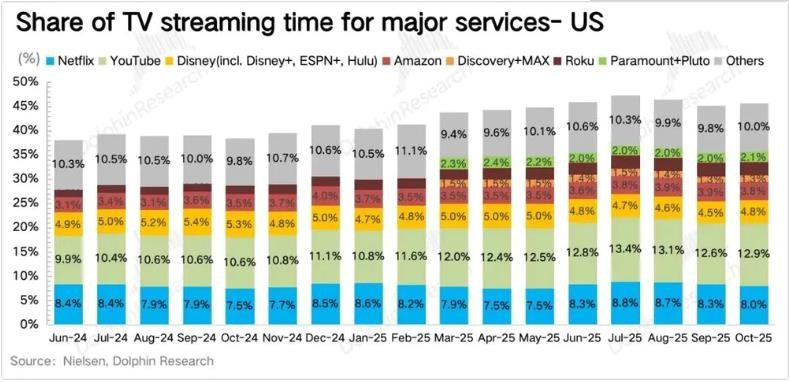
Netflix may seek to mitigate this risk by expanding the definition of the streaming video industry to include YouTube. By this broader measure, Netflix + HBO Max's viewership share would drop to approximately 20% (=9.3%/45.7%), falling below antitrust thresholds.
Paramount Skydance—with its favorable ties to Trump—might have secured regulatory approval more easily. However, WBD opted for Netflix not only for its stronger business footprint and platform advantages but also because Netflix offered a $5.8 billion breakup fee if the acquisition fails to close.
Beyond antitrust risks on the user side, backlash from upstream content creators is also significant. Consolidation among leading downstream platforms would severely weaken content producers' bargaining power for copyright premiums.
2. Why Did Netflix Abandon Its "Be More Builders Than Buyers" Strategy?
This is likely the market's most pressing question. Dolphin Research summarizes the key drivers: growth anxiety as the core motivation, tariffs as a catalyst, and a shift in management style following the leadership transition as the final push.
(1) Growth Anxiety – Rising Costs of Building New IPs
By the end of 2025, Netflix is approaching the tail end of its current content cycle. While its content lineup remains compelling, innovation has been limited—with only a handful of S-tier original IPs (e.g., Squid Game, Wednesday) emerging in the past three years. Most major hits have been sequels to existing franchises, such as Stranger Things, You, Bridgerton, and Money Heist.
With over 300 million subscribers and increasingly high user expectations, maintaining 20% revenue growth and 30%+ profit growth to justify a 30–40x PE multiple has become increasingly challenging. The crackdown on password sharing provided only a one-time boost, and advertising revenue remains modest. Fundamentally, growth still depends on high-quality content catering to diverse audiences and exploring new monetization avenues, such as gaming and IP-themed parks.
International expansion has been critical to user growth, with hits like Squid Game, Money Heist, and Lupin demonstrating Netflix's success in global markets. However, the Trump administration's proposed 100% tariff on "foreign-produced films/television content"—a policy that would impact Netflix, as approximately 50% of its original content budget is allocated to international productions—threatens to constrain its global strategy.
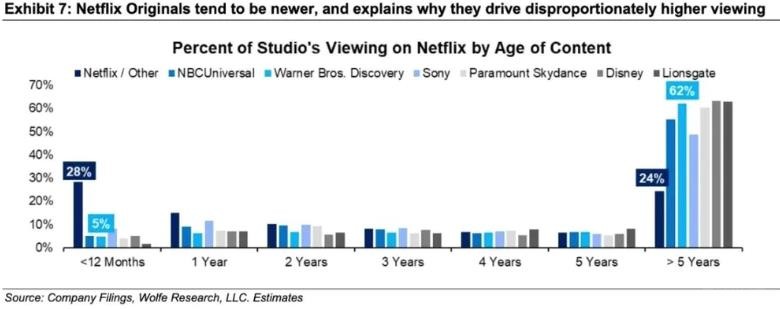
This adds further pressure on content innovation, but licensing external IPs is not a panacea. Currently, most licensed content in Netflix's library consists of older titles (released over five years ago), as studios are reluctant to license newly produced original content.
For IP monetization beyond traditional media, acquiring established, irreplaceable top-tier IPs has become a viable strategy for Netflix. These IPs not only enrich its content library but also enable the development of non-film/television entertainment products for additional revenue streams.
WBD has already achieved notable success in IP derivatives—outperforming Netflix in this area. For example, the recent blockbuster video game Hogwarts Legacy has sold over 30 million copies worldwide, with a sequel currently in development.
(2) Shift in Management Style – From Conservative Idealism to Rational Realism
Rumors of Netflix's interest in acquiring WBD surfaced prior to its Q3 earnings report, but most market participants remained skeptical, given the company's long-standing "build, don't buy" philosophy championed by its founders.
Over the past five years, the entertainment industry has seen numerous mergers and acquisitions, but Netflix's management consistently showed little interest in M&A. Even during the Q3 earnings call in mid-November, when analysts directly asked about the possibility of acquiring WBD, management remained noncommittal—reiterating their preference for original content and lack of interest in traditional media.
While the earnings call may have been a smokescreen, a key turning point emerged in early December when co-founder Reed Hastings sold a significant portion of his Netflix shares. A staunch advocate of in-house content production, Hastings—who already held less than 0.5% of the company (eliminating any voting rights constraints)—sold an additional 370,000 shares worth over $40 million on December 1. He had previously sold shares valued at over $40 million during the critical phase of acquisition negotiations in late October.
Hastings' stock sales indirectly signal a divergence between the company's current strategic direction and his personal beliefs. The current leadership team—appointed after Hastings stepped down as CEO in 2023—consists of two co-CEOs: one with a background in content creation (having navigated Hollywood) and the other in product technology (focused on monetization). Both are more "calmly realistic" compared to the founder's "idealism."
3. How to Evaluate This Acquisition?
Frankly, Netflix's move has exceeded our expectations. Despite persistent rumors, in our Q3 earnings review in mid-November, Dolphin Research still believed Netflix would either stick to its principles or abandon the deal due to the high price tag.
Investor opinions on Netflix's decision are divided. Regardless of regulatory approval, Netflix faces the risk of losing the $5.8 billion breakup fee if the deal falls through. Even if approved, while the merged entity would have an expanded footprint and stronger competitive barriers, the short-term financial and cash flow pressure on Netflix will be significant before synergies materialize.
As noted earlier, user overlap between HBO Max and Netflix is substantial, meaning the acquisition will not bring many net new subscribers. Netflix estimates the merger will save the company $2–3 billion annually in content costs (likely from licensing fees previously paid to WBD for its content).
However, the $59 billion bridge loan from the bank consortium will eventually be refinanced through $25 billion in corporate bonds, $20 billion in delayed-draw term loans, and $5 billion in revolving credit facilities. Assuming an interest rate of 6%–9% for a high-quality company's bridge loan, annual interest expenses would amount to over $4 billion—exceeding the projected content cost savings. For the transaction to be financially viable, Netflix must deliver significant synergies.
Currently trading at 30x PE for 2026 (excluding the impact of the WBD acquisition), Netflix's valuation is approaching the attractive price range identified by Dolphin Research. However, the uncertainties and short-term cash flow pressures make this a concerning development for value investors.
Therefore, until the acquisition's final outcome is determined (a process that may be prolonged due to regulatory scrutiny), Netflix is likely to experience a period of volatility driven by "investor rotation": value investors—who previously favored Netflix for its stable streaming cash flow and monopolistic pricing power—may exit, while growth investors may wait for an opportunity to join Netflix in this $80 billion high-stakes gamble.
|

 Fear of God ESSENTIALS Hoodie Review: Mi86 人气#fashion
 The Derby of San Francisco Style 300 Cha112 人气#fashion
 Why the Derby of San Francisco Classic S130 人气#fashion
 Romaoss Launches "Rebirth Plan," in Talk70 人气#tech



 WeChat
 douyin