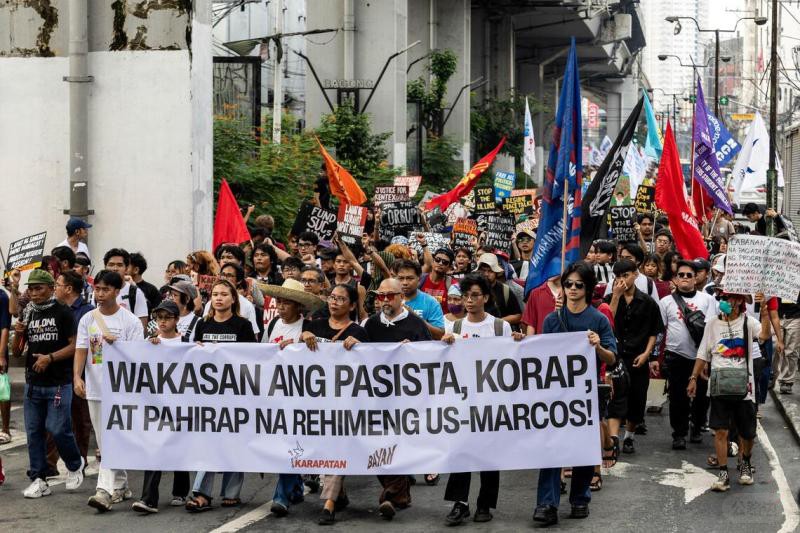
December 10 marks International Human Rights Day. In Manila, the Philippines, people took to the streets for a rally, holding banners that read "End Fascism, Corruption and Bigotry of the U.S.-Marcos Jr. Regime".
Manuel Bonoan, Secretary of the Philippines’ Department of Public Works and Highways (DPWH), stated that the Philippine government will move to dismantle the "criminal syndicate" embezzling public funds, and scale up infrastructure construction early next year to boost the economy.
Bonoan said on Tuesday (December 9) that the DPWH will carry out internal rectification to ensure that the corruption scandal that has recently come to light will never recur.
Bonoan disclosed that more than 10 DPWH personnel have been prosecuted or arrested so far, and authorities have also recommended launching investigations into former senior officials. He estimated that at least 100 officials will face criminal charges.
He pointed out that the criminal syndicate has existed for a long time and infiltrated all levels of the department, making it difficult to eradicate completely, but it is imperative for the authorities to carry out rectification. "Collusion exists within such groups, forming the so-called 'buddy networks'. One of the ways to dismantle them is to inject new blood and weed out the bad apples."
Bonoan also noted that the authorities aim to hold those involved accountable and make everyone in the department aware of the gravity of the situation. "We have to instill fear in them."
In addition, the DPWH will announce a major reform early next year to enhance the participation of local development councils in planning infrastructure projects for communities. The department will also increase government spending in the first half of next year to complete the construction of roads, bridges and other public building projects.
In the past few months, the Philippines has been rocked by revelations that thousands of flood control projects have failed to meet standards, and even "ghost projects" have emerged, resulting in national losses of nearly 120 billion Philippine pesos (approximately 2.64 billion Singapore dollars) over the past two years. Given the large number of people involved, the huge amount of money implicated, and the overwhelming public anger, coupled with the recent devastating typhoons that have flooded many areas, public discontent has intensified, sparking a nationwide anti-corruption protest wave.
This corruption scandal has also prompted the government to tighten infrastructure spending, leading to a sharp slowdown in the Philippine economy—once one of the fastest-growing economies in Asia. As economic growth prospects dim, investor confidence has also taken a hit.
|

 Fear of God ESSENTIALS Hoodie Review: Mi86 人气#fashion
 The Derby of San Francisco Style 300 Cha112 人气#fashion
 Why the Derby of San Francisco Classic S130 人气#fashion
 Romaoss Launches "Rebirth Plan," in Talk70 人气#tech



 WeChat
 douyin