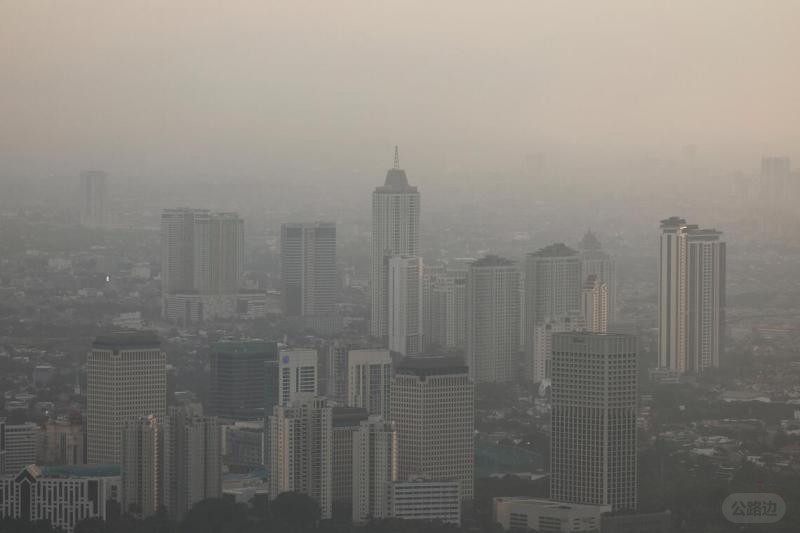
On November 4, a thick haze shrouded the sky over Jakarta, Indonesia’s capital, blanketing the city in a dull grey veil.
Nearly 2 million respiratory disease cases were reported in Jakarta in the first ten months of this year, sparking growing concerns over worsening air pollution in the city.
According to the Jakarta Health Office, as of October 2025, more than 1.9 million people in Jakarta have been diagnosed with acute respiratory infections, with children accounting for nearly 20% of the total cases.
In an interview with The Jakarta Post on Monday (December 8), Jakarta Health Office Head Dr. Ani Yudhoyono stated, “Overall, the high incidence of acute respiratory infections is triggered by a combination of factors, including climate change, air pollution, Jakarta’s high population density, strong population mobility, weakened immunity and exposure to pathogens.”
A report released by Indonesia’s Ministry of Health on November 29 showed that Jakarta ranks as the province with the third-highest incidence of respiratory diseases, trailing only West Java and Central Java.
Experts and environmentalists have long argued that Jakarta’s poor air quality is a major contributor to the city’s heightened vulnerability to environmental disasters.
In recent years, Jakarta has consistently ranked among the world’s most polluted cities. According to IQAir, a Swiss air quality monitoring firm that tracks global air conditions, the concentration of PM2.5 particulate matter in Jakarta—home to over 10 million people—reached 26 micrograms per cubic meter on the afternoon of December 7, roughly five times the safety limit set by the World Health Organization (WHO).
Fakhria, Manager of the Indonesia Center for Strategic Development Initiatives, pointed out that short-term exposure to air pollution may trigger respiratory problems, while prolonged exposure could lead to cardiovascular diseases and cognitive impairment.
Fakhria warned that long-term exposure to polluted air would impose a heavier burden on vulnerable groups including outdoor workers, children, the elderly and low-income households. He said, “These vulnerable groups are bearing the brunt of severe pollution, yet they have very limited access to mitigation measures such as air purification systems or medical services.”
Asep, Head of the Jakarta Environmental Agency, disclosed that the agency is formulating a roadmap, which aims to manage and control the capital’s air quality through integrated air quality management and climate action plans, including a target to cut emissions by 30% by 2030.
He stated, “Through this roadmap, Jakarta is committed to achieving air purification and emission reduction goals, making the city healthier and more resilient, and creating a more sustainable future for generations to come.”
|

 Fear of God ESSENTIALS Hoodie Review: Mi90 人气#fashion
 The Derby of San Francisco Style 300 Cha116 人气#fashion
 Why the Derby of San Francisco Classic S133 人气#fashion
 Romaoss Launches "Rebirth Plan," in Talk72 人气#tech



 WeChat
 douyin