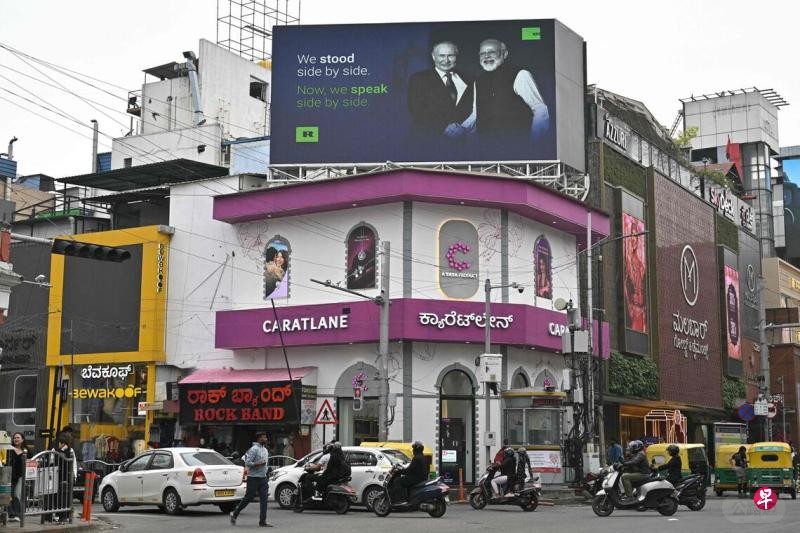
As the saying goes, *When elephants fight, it is the grass that suffers*. To become a **standing elephant** rather than **trampled grass**, India may still have a long way to go. India rolled out the red carpet for Russian President Vladimir Putin’s first visit since the outbreak of the Russia-Ukraine conflict. Despite immense pressure from the United States, it signed a host of cooperation agreements with Russia, with the extension of energy deals drawing particular attention. It has to be acknowledged that there are not many countries in the world today that can withstand U.S. pressure, and India is certainly one of them; nor are there many that can persist in conducting various trade and strategic collaborations with Russia amid the ongoing war, and India also fits the bill. So, will such an independent approach earn India the great power status it aspires to? Is the current global context an opportunity for Indians to realize their great power dream? Led by Prime Minister Narendra Modi, Indians are clearly viewing this once-in-a-lifetime opportunity with optimism. After all, the intricate web of relations among major powers is truly unprecedented in history. At the very least, India has the potential to avoid antagonizing all major powers simultaneously. The best-case scenario would be for every major power to have needs that only India can meet, thus tolerating its occasional "provocations" or "reckless moves". This is precisely the window of opportunity for India to integrate itself into the circle of major powers and become one of them. However, optimism does not guarantee success. Even though India is widely regarded as the most promising candidate to emerge as the next superpower, its great power dream is inevitably intertwined with the fates and key junctures of other major powers. It is by no means easy to truly grow into a substantial great power while navigating such a tightrope. First and foremost, India is geographically too close to China, and it faces persistent pressures from unresolved disputes. China shares similarities with India in terms of its long history, turbulent past, and late-blooming potential. The key difference, however, is that China has clearly taken a head start. As the world’s second-largest economy, China’s comprehensive national strength is now almost on par with that of the United States. India’s current development level is roughly equivalent to that of China two or three decades ago, and it follows a highly similar development path. Therefore, as long as China has not yet completed its track transformation, it will be extremely difficult for India to take over or encroach upon China’s development space. Furthermore, India and China are mired in extremely complex territorial disputes and political mistrust—a fact underscored by the recent resumption of direct flights after five years of suspension. China will never allow India to easily forge ahead on a path of continuous catch-up and encroachment. Perhaps one day, Indians will echo the sentiment of former Mexican President Porfirio Díaz: *"Poor Mexico, so far from God and so close to the United States (China)!"* Second, Russia cannot serve as a pivotal driving force for India’s rise. India-Russia relations have deep historical roots, shaped by both geopolitical considerations and major power competition. While these ties have been important in the past, they have never played a decisive role in reshaping the international order. Today, Russia is even more bogged down in the quagmire of war. Its engagement with India is increasingly motivated by the need for diplomatic breakthroughs and energy trade—essentially, it is making more transactional concessions to secure India’s strategic neutrality, or at the very least, to prevent India from fully aligning itself with the opposing camp. It is hard to see how Russia can provide significant impetus for India’s development at this juncture. The oil and gas resources it supplies can at best lower India’s development costs, but they cannot fuel a quantum leap in India’s growth. As for military equipment and technological cooperation, India is gradually reducing its dependence on Russia, and the two countries are drifting further apart. Once Russia emerges from its current predicament, it will by no means continue to let India reap such benefits at its own expense. Third, the United States is geographically distant and is currently in a phase of strategic and military retrenchment. The latest U.S. National Security Strategy, released on December 5, has been described by some media as an "extended version of the Monroe Doctrine". It broadly outlines that the U.S. strategic priority in the new era will be focused on the Americas—a direction that aligns perfectly with the U.S.’s recent string of actions, including scaling back direct aid to Ukraine, imposing a military siege on Venezuela, launching economic and trade crackdowns on its northern and southern neighbors, and conducting political encirclement against left-wing regimes across the Americas. Whether driven by declining national strength or strategic recalibration, the U.S.’s outward strategic contraction is unmistakable. India would be unwise to harbor unrealistic expectations about U.S. support, despite their shared values and certain similarities in political systems. Even if the U.S. needs to leverage countries like India and Japan to counter China’s rise, these nations must carefully weigh the costs and benefits of aligning with such a strategy. Fourth, Europe is too weak and simply lacks the capacity to concern itself with the fates of other nations. Europe is undoubtedly a major pole in the international community and, as the former colonial power of India, has exerted a profound influence on the country. However, Europe’s path toward further integration has been fraught with challenges, and it has recently been confronted with security threats stemming from the Russia-Ukraine conflict. Even if Europe were inclined to help India rise, it would be hamstrung by its own limitations. India once held high hopes for Europe, as evidenced by its aggressive procurement of European military hardware and efforts to attract high-tech European enterprises. The complementary advantages between the two sides made for a rational partnership. Unfortunately, Europe itself is grappling with bottlenecks in technological development, squeezed by both China and the United States. Meanwhile, India’s own development efficiency is not sufficient to outcompete other developing countries in a head-to-head contest. As a result, mutual support between India and Europe is unlikely to yield significant outcomes. Last but not least, India faces intense competition from a host of other aspiring nations, which will put the political wisdom of all rising powers to the test. The current global reality is that amid the once-in-a-century transformation of the world order, numerous countries are seeking to seize the opportunity to achieve national rejuvenation or rise to prominence. This includes several highly capable and ambitious nations such as Brazil, South Africa, Turkey, Egypt, Saudi Arabia, and Iran. While these countries exhibit diverse development trajectories, they share a common resolve to emerge as great powers—all of which pose competitive pressures that India must contend with. Each of these rising nations boasts its own unique comparative advantages, making it an arduous task for India to break through the pack. Meeting this challenge will not only require rationality and wisdom from the current generation of political leaders but also demand sustained prudence from leaders for generations to come, as well as the united efforts of the entire Indian nation. Only then can India ultimately realize its national aspirations. India’s great power dream is well-known to the world, and it is arguably one of the most active and enthusiastic pursuers of such a dream, with every move attracting global attention. Other countries may also face pressures stemming from the rivalry between major powers, but India seems to be more closely intertwined with them and thus bears the brunt of such pressures, necessitating greater caution and prudence. As the saying goes, *When elephants fight, it is the grass that suffers*. To become a **standing elephant** rather than **trampled grass**, India may still have a long way to go.
|

 Fear of God ESSENTIALS Hoodie Review: Mi86 人气#fashion
 The Derby of San Francisco Style 300 Cha112 人气#fashion
 Why the Derby of San Francisco Classic S130 人气#fashion
 Romaoss Launches "Rebirth Plan," in Talk70 人气#tech



 WeChat
 douyin