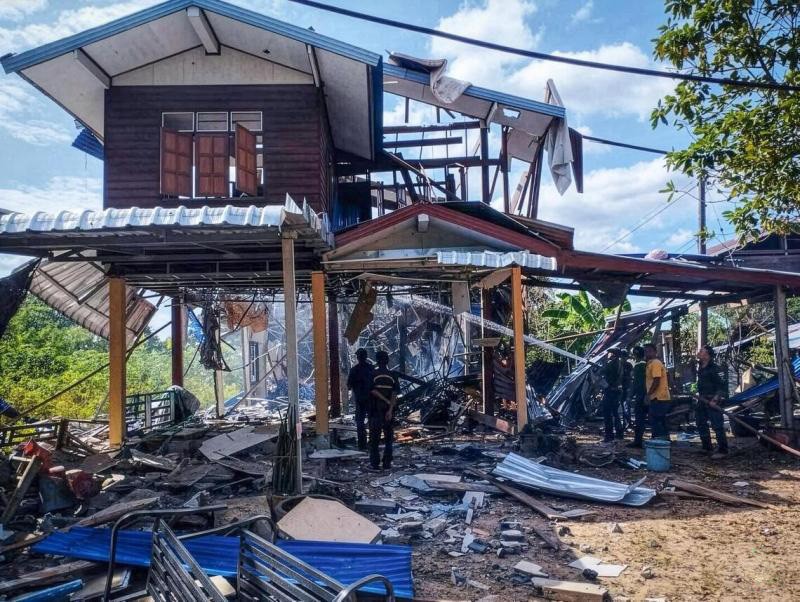
Thailand has accused Cambodia of launching BM-21 rockets at civilian areas on Sunday (December 14). The rockets hit a community center and a school in Sisaket Province, killing a 63-year-old man who was struck by shrapnel. (Photo from the Thai military's Facebook page)
(Comprehensive News from Bangkok/Phnom Penh) As the Thailand-Cambodia conflict escalates further, the Royal Thai Armed Forces have requested the Ministry of National Defence to propose to the National Security Council a blockade of the Gulf of Thailand. This measure aims to prevent Thai vessels or Thai operators from transporting fuel and military supplies to Cambodia using ships of any nationality.
According to a report by the Bangkok Post, the Royal Thai Armed Forces sent an urgent letter on Sunday (December 14), urging the Ministry of National Defence to immediately submit a proposal to the National Security Council. The proposal seeks to adopt a series of measures to restrict and weaken Cambodia's ability to threaten Thailand.
Among the proposed measures, the armed forces called for a blockade of the Gulf of Thailand. Meanwhile, they ordered the Thai Maritime Law Enforcement Command Center to intercept and stop all ships—including merchant ships and fishing boats—carrying oil and war-related supplies sailing from Thai waters to Cambodia.
Additionally, the Thai military suggested designating the waters surrounding Cambodian ports as high-risk areas.
However, the proposal has not yet been officially approved and will be discussed at a security meeting held on Monday (December 15).
The border conflict between Thailand and Cambodia has entered its second week. Despite successive mediation efforts by U.S. President Trump and Malaysian Prime Minister Anwar Ibrahim, Thailand has refused to cease fire. Heng Ratana, Director-General of the Cambodian Mine Action Centre, condemned this, stating that Thailand has ignored appeals from international organizations such as the United Nations and ASEAN. He added that the international community could clearly recognize Thailand's aggressive acts against Cambodia through this incident.
A White House spokesperson also stated that President Trump expects all parties to fulfill their commitments, noting that "he will hold all relevant parties accountable to stop the killings and ensure lasting peace."
Nevertheless, Thai Caretaker Prime Minister Anutin Charnvirakul posted on Facebook on Sunday, stating that Anwar Ibrahim had sent a message clarifying that he only proposed that both Thailand and Cambodia cease all provocative acts starting from 10 p.m. on Saturday (December 13). He did not order a ceasefire between the two countries nor claim that they had agreed to a truce.
Thai Foreign Minister Sihasak Phuangketkeow expressed disappointment over Trump's description of the incident in which several Thai soldiers were injured by Cambodian landmines as an "accident," asserting that such remarks had hurt the feelings of the Thai people.
Surasak Suwannakesorn, spokesperson for the Thai Ministry of National Defence, noted that although Cambodia has publicly expressed its willingness to stop fire, it has continued to launch attacks on Thai forces using heavy weaponry.
Specifically, Cambodian military forces have continuously attacked Thai border areas with BM-21 rockets, grenade launchers and suicide drones. The Thai military also seized several fifth-generation multi-purpose long-range precision-guided anti-tank missiles at a Cambodian military base in Ubon Ratchathani Province.
Separately, AFP reported that Thailand confirmed on Sunday the death of the first civilian in the conflict. The 63-year-old man was killed by shrapnel from a rocket launched by Cambodian forces.
To date, the conflict has resulted in at least 27 deaths, including 16 Thai soldiers and 11 Cambodian civilians. Hundreds of people have been injured, and over 500,000 have been displaced from their homes.
In the interest of public security, Thailand has imposed a curfew in parts of Trat Province, following a similar measure implemented in Sa Kaeo Province. The curfew runs from 7 p.m. to 5 a.m. the next day.
On the other hand, Cambodia accused Thailand on Sunday of continuously attacking civilian infrastructure, including the use of fighter jets and shelling of civilian areas. It further alleged that Thai troops fired toxic smoke bombs at Okroav District in Banteay Meanchey Province, posing a threat to local civilians.
However, flight services between the two countries have not been affected by the border conflict.
In terms of land transportation, Cambodia fully suspended the operation of border checkpoints with Thailand starting from Saturday. This has left approximately 7,000 Thai citizens stranded in Poipet, a Cambodian border city.
The Thai Foreign Minister accused Hun Sen, former Cambodian Prime Minister and President of the Senate, of violating international human rights law. He noted that Hun Sen had initially allowed Thai citizens to cross the border and return to Thailand between 1 p.m. and 4 p.m. on Saturday, only to suddenly announce the closure of the border checkpoints afterward.
Krisana Phongphitak, former legal advisor to the Thai Ministry of National Defence, also warned that Hun Sen must allow the stranded Thai citizens to return home. Otherwise, he may violate the Geneva Conventions by detaining civilians or carrying out illegal imprisonment.
|

 Fear of God ESSENTIALS Hoodie Review: Mi86 人气#fashion
 The Derby of San Francisco Style 300 Cha114 人气#fashion
 Why the Derby of San Francisco Classic S131 人气#fashion
 Romaoss Launches "Rebirth Plan," in Talk70 人气#tech



 WeChat
 douyin