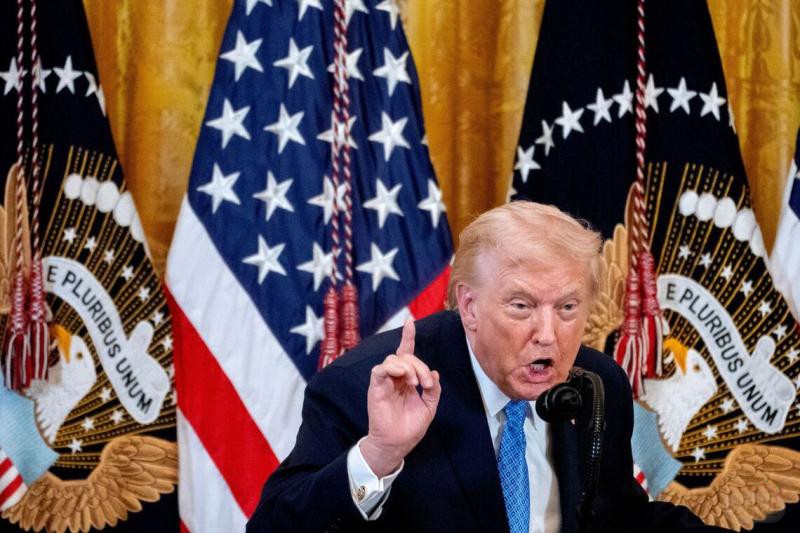
U.S. President Donald Trump ordered a full maritime blockade on sanctioned oil tankers entering and exiting Venezuela on Tuesday (December 16), directly cutting off the country's oil revenue source. This move not only drastically escalated the pressure on Venezuela but also immediately triggered a strong backlash from the Venezuelan government. The picture shows Trump attending an event at the White House on the same day.
Will the 1964 Gulf of Tonkin incident that shocked the world happen again?
The United States has recently been continuously stepping up its military deployments in the waters adjacent to Venezuela. On Tuesday (December 16) local time, Trump also posted on social media, stating that the Maduro government has been designated a "Foreign Terrorist Organization". He ordered a "complete and total blockade" on all sanctioned oil tankers entering and exiting Venezuela, targeting the lifeline of Venezuela's economy.
He also accused Venezuela of stealing U.S. oil and assets "to fund itself, drug terrorism, human trafficking, murder and abduction".
Last week, the United States seized a supposedly sanctioned oil tanker off the coast of Venezuela and claimed that the oil on board would be kept by the United States. The seizure operation was led by the U.S. Coast Guard. A video released by Attorney General Bondi on social media showed U.S. troops dramatically rappelling onto the ship from a helicopter and then moving around on the ship with guns.
Voice of America reported that the House Select Committee on the Strategic Competition Between the United States and the Chinese Communist Party stated that the seized oil tanker has a direct connection with China. On Monday (December 15), Republican Representative Moran posted on the X platform, claiming that the tanker used deceptive tracking methods "and was linked to ships managed by China". Maduro sharply criticized that the United States has ushered in a "new era of criminal piracy in the Caribbean Sea".
After Washington released the new version of the National Security Strategy Report earlier this month, which designated Latin America as part of the "U.S. core interest sphere", its military actions against Venezuela have continued to escalate. Behind this, there is also the intention to curb the growing influence of China in Latin America.
The U.S. National Security Strategy Report clearly states that it will implement Trump's version of the Monroe Doctrine to restore U.S. dominant status in the Western Hemisphere and protect national security as well as strategic channels in key regions of the Western Hemisphere.
Although the report did not name China, it indicated that it will prevent "non-Western Hemisphere competitors" from deploying military forces in the Western Hemisphere or owning and controlling strategically important assets. U.S. officials must fully monitor "harmful external influences".
Under the pretext of anti-narcotics operations, the United States has been assembling military forces in the waters surrounding Venezuela. Aircraft carriers, destroyers and F-35 fighter jets have converged in the Caribbean region, with the number of troops reaching 15,000. As reported by CBS earlier this month, the U.S. military has carried out at least 21 strike operations in the international waters of the Caribbean Sea and the eastern Pacific Ocean since the beginning of September.
It is believed that Washington's real intention is not only to oust Maduro and promote a regime change in Venezuela, but also to reshape the geopolitical landscape of Latin America, strive for the United States' full control over the Western Hemisphere, and eliminate "harmful external influences" such as China that are regarded as such by the United States.
The United States has also supported right-wing governments and candidates in elections in countries including Argentina and Honduras respectively. Trump has even stated on multiple occasions that he does not rule out seizing control of the Panama Canal through military means.
After the United States released its National Security Strategy Report, China issued its third Policy Paper on Latin America and the Caribbean on December 10, nine years after the previous one, expressing its reluctance to back down in the United States' "backyard".
In contrast to the United States' emphasis on exclusivity, China holds high the banner of the "Global South" and states that Latin America and the Caribbean, as a whole, "boast a glorious tradition of independence and self-strengthening through unity, and constitute an indispensable force in the process of world multipolarization and economic globalization". Beijing also made a pointed statement that China-Latin America relations "do not target or exclude any third party, nor are they subject to the control of any third party".
Beijing's response shows that China does not accept the United States' claim of seeking full control over the Western Hemisphere, and the geopolitical game between China and the United States in Latin America is bound to intensify.
China and Russia are Venezuela's two major partner countries. China is the largest buyer of Venezuelan oil. It is reported that Beijing has provided Venezuela with more than 60 billion US dollars in loans and credit lines secured by crude oil shipments. Venezuela, in turn, is one of the top three recipients of China's development funds. It accounted for approximately 86% of China's total arms sales to the Americas between 2010 and 2020.
Despite the close relations between China and Venezuela, there is no sign that Beijing intends to provide military support or substantial assistance to Venezuela to ease the immense pressure Maduro is facing from the United States.
It is generally believed that China will not engage in a direct confrontation with the United States over Venezuela, so as not to undermine the hard-won temporary tariff truce. Instead, Beijing may safeguard its interests in Venezuela and Latin America through diplomatic statements and economic support.
As reported by Xinhua News Agency, when Chinese Foreign Minister Wang Yi held a phone call with Venezuelan Foreign Minister Hill at the latter's request on Wednesday (December 17), he stated that China opposes all acts of unilateral bullying and supports all countries in safeguarding their national sovereignty and dignity. Venezuela has the right to independently develop mutually beneficial cooperation with other countries, and it is believed that the international community understands and supports Venezuela's position in defending its legitimate rights and interests.
Spokespersons of China's Foreign Ministry have also stated on multiple occasions that China opposes unilateral sanctions without a basis in international law or authorization from the UN Security Council, opposes external forces interfering in Venezuela's internal affairs under any pretext, and calls on the United States to lift its illegal unilateral sanctions.
Just as the Russia-Ukraine conflict has provided various lessons for the world regarding wartime conditions, the United States' Operation Southern Spear against Venezuela is believed to bring important revelations to China and other countries.
Two of the most obvious revelations are: once the United States launches a full-scale attack on Venezuela, some Latin American countries may purchase more weapons from China, similar to how European countries increased their defense budgets one after another following Russia's invasion of Ukraine.
Although Taiwan can never be compared with Venezuela—a sovereign and independent country—the modus operandi of how the United States has launched military operations, gradually exerted pressure on Maduro through military intimidation, including dispatching the Coast Guard to rappel from helicopters to seize ships and attempting to cut off Venezuela's economic lifeline, is believed to serve as a valuable reference for Beijing in formulating strategies related to maritime blockades against Taiwan.
Equally concerning is that after Trump's "new Monroe Doctrine" was first put into practice in Venezuela, will the world be divided into different spheres of influence—the Western Hemisphere under U.S. dominance and Asia under China's?
|

 Fear of God ESSENTIALS Hoodie Review: Mi86 人气#fashion
 The Derby of San Francisco Style 300 Cha114 人气#fashion
 Why the Derby of San Francisco Classic S131 人气#fashion
 Romaoss Launches "Rebirth Plan," in Talk70 人气#tech



 WeChat
 douyin