Since it was ultimately bound to keep pace with the times, why was there such strong resistance initially? The answer lies in a "collective procrastination response" driven by a combination of cultural inertia, governance anxieties, and information isolation.
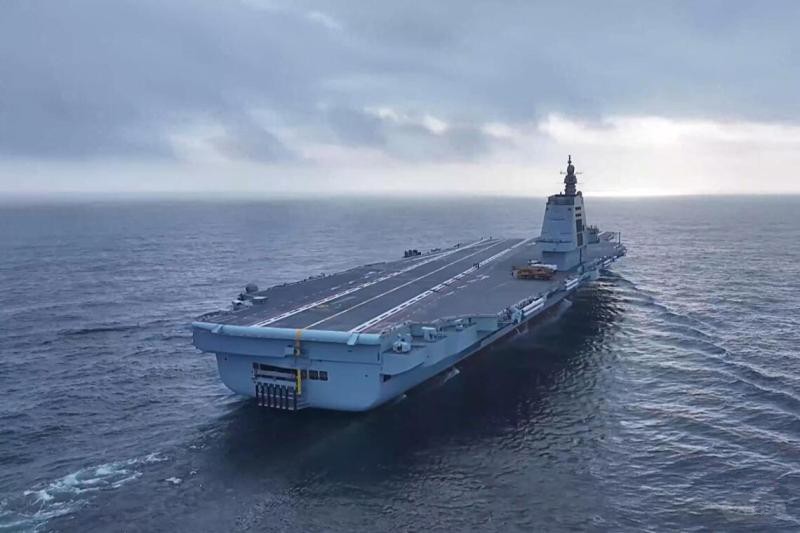
This screenshot is taken from a video filmed by the Chinese Ministry of National Defense in May 2024 and released via Agence France-Presse Television on May 11, 2024. The video shows China's third aircraft carrier, the Fujian, conducting sea trials in certain waters. According to an official media report on November 7, 2025, the Fujian was officially commissioned into the navy following a handover ceremony. (Agence France-Presse)
The year 2025, drawing to a close, has witnessed numerous highlights in the development of China's maritime and naval endeavors. Among these, the most notable is the successful sea trials and commissioning of the Fujian, China's first aircraft carrier equipped with electromagnetic catapults. This undoubtedly marks a leap forward in China's maritime consciousness and serves as a prime example of learning and catching up with advanced modern standards.
Looking back at the evolution of world civilization over the past 500 years, a recurring "Chinese imprint" emerges: at nearly every critical juncture of modernization, China has lagged behind by 200 to 300 years. After a difficult start, its modernization drive has often been a prolonged, tortuous process full of twists and turns. Yet ultimately, it has moved toward the inevitable outcome of "embracing modernization". Here, we do not delve into the economic proposition of "comparing first-mover and latecomer advantages", but rather focus on the inherent laws governing a civilization's capacity for self-adjustment, institutional flexibility, and cultural-psychological dynamics.
In the historical course of China's march toward modernization, there have been three iconic "moments of delay":
The Maritime Era: A 500-year lag from the "maritime ban" to "thriving by the sea";
Economic and Trade Globalization: A 200-year lag from the "Celestial Empire" mentality to "development through WTO accession";
The Industrial Revolution: A 250-year lag from "holding fast to the dominant agricultural position" to advancing industrialization.
From the late 15th to the early 16th century, Portugal and Spain pioneered the Age of Exploration, with the oceans gradually becoming the main artery for the flow of global power, wealth, and knowledge. Over the subsequent centuries, all truly powerful nations have been maritime powers. However, during the same historical period, China took a diametrically opposite path: the Ming Dynasty's Hongwu Emperor issued multiple maritime ban decrees; during the Shunzhi and Kangxi reigns of the Qing Dynasty, the coastal evacuation order was implemented, forcing coastal residents to move inland and severing so-called overseas ties.
This comprehensively led to the long-term weakness of China's maritime sector. It not only abandoned the construction of overseas shipping routes and trade networks, but also lost the practical motivation to expand its horizons via the oceans, build up naval capabilities, and reshape its institutions. It was not until around the year 2000 that China truly began to "thrive by the sea" on a large scale: following its accession to the World Trade Organization, total foreign trade volume grew at a rapid pace, coastal port clusters emerged as global hubs, and strategies such as the "21st-Century Maritime Silk Road" were proposed. This 500-year delay meant not only the loss of economic development opportunities, but also the stagnation of institutional and ideological transformation.
In the 18th and 19th centuries, the Industrial Revolution overlapped with colonial expansion, and a global economic and trade network took shape rapidly. Countries such as Britain gradually integrated the world into a Europe-centered global market through the free trade system and colonial system. At this juncture, China once again chose to go against the tide: it defined itself as the Celestial Empire, claiming to be abundant in all resources and self-sufficient; it repeatedly rejected foreign requests for equal trade, regarding overseas commerce as a peripheral matter or even a security threat.
It was only after suffering successive setbacks—the Opium War defeat in 1840, the loss in the First Sino-Japanese War, and the upheaval of the 1911 Revolution—that China gradually realized that isolation would mean being reshaped by the world. Even so, it was not until its accession to the World Trade Organization in 2001 that China truly achieved in-depth participation in the global trading system, completing a historic turnaround. This roughly 200-year delay exacted a heavy toll on China, including the erosion of national sovereignty, the loss of tariff autonomy, the distortion of industrial structure, and setbacks on the path of development.
In the mid-to-late 18th century, Britain launched the First Industrial Revolution. The steam engine, large-scale machine production, and the factory system drastically transformed human production methods, social organization, and political order. However, China, once enjoying the status of the "leader of agricultural civilization", became trapped in path dependence and was not eager to carry out fundamental reforms to its production methods; the soil for scientific revolution was weak, making it difficult to form a systematic experimental spirit and technological innovation system; the protection of private property rights was insufficient, market incentive mechanisms were lacking, and the institutional environment prioritized maintaining order over encouraging experimentation.
As a result, China's industrialization did not officially begin until around the 1950s, and comprehensive industrialization was concentrated in the more than 30 years following the reform and opening-up drive, during which the main industrial systems were basically established. The outcome was another delay of approximately 250 years.
Similar Paths of the Three Major Modernization Delays
Reviewing these three major delays in modernization, a highly similar evolutionary path emerges: an instinctive resistance to the wave of modernization, followed by tentative introduction and half-hearted adoption, accompanied by enormous costs, and ultimately driven to implement modernization transformation.
Behind this lie at least three underlying reasons.First, modernization was "misaligned" with traditional civilization, resulting in a lack of endogenous motivation. The core of modernization is not merely technology and material objects, but understanding the world through scientific methods, reconstructing order through contracts and the rule of law, and breaking traditional identity structures through individual rights and social mobility. The origins of these concepts are largely rooted in the modern ideological traditions of the European Renaissance and Enlightenment, which have no direct inherent connection with China's millennia-old civilization centered on patriarchal clan systems, ritual propriety, and agriculture.
Thus, when external waves such as the maritime era, the Industrial Revolution, and globalization surged in, China's initial cultural instinct was often to regard them as heresy and foreign aggression, reject them with orthodox ideological discourse, and adopt a defensive and resistant rather than open and learning-oriented mindset.
Second, the security instinct of the governance structure prioritizes stabilizing the overall situation over seizing opportunities. Any large-scale modernization transformation implies the reshaping of power structures, interest patterns, and social order. For vested interest groups and the power system, this inherently carries enormous risks: opening up the oceans and trade could lead to the rise of local forces and maritime merchant groups; introducing industrialization and foreign institutions would transform the traditional agricultural bureaucratic system; accepting the rules of external civilizations would weaken top-down absolute control.
Therefore, the governance structure tends to overestimate the risks of reform and underestimate the costs of rejection. Rather than taking risks in an unknown world, it prefers to maintain the status quo in a familiar order; rather than unleashing social energy, it opts to tighten control. This instinct for stability has meant that every step of China's modernization drive has first had to navigate a long period of doubt, negation, and suppression.
Third, there has been a long-term tug-of-war between the progressive and conservative forces. As successful experiences from the outside world accumulated alongside internal problems, insightful individuals, enlightened officials, business groups, and social elites have inevitably called strongly for reform.
This has often led to a typical dual-track situation within Chinese society: on one side are the "forward-looking visionaries" who courageously embrace the world; on the other side are conservative forces that adhere to traditional paradigms and emphasize "special national conditions". For a long time, national policies have wavered between these two forces: on the one hand, there are localized trials and limited opening-up; on the other hand, there is the constant possibility of tightening and retraction. This prolonged dual-track tug-of-war is precisely the institutional manifestation of "modernization delay"—it is neither a complete rejection nor a fundamental adoption, but rather procrastination, wait-and-see, modification and mutation, and a dilemma of advance and retreat.
The above reasons can also be summarized into three laws:
Modernization in China has often been "externally triggered" rather than "endogenously generated". Therefore, the initial response is often maladaptation, and it is only when external shocks and evidence accumulate to a certain intensity that a genuine impetus for internal reform is formed.
Every step forward in modernization is accompanied by prolonged internal games and dual-track struggles. Fierce conflicts between the reformist and conservative factions often result in delays, multiplied costs, and wasteful detours.
A national consensus on modernization will ultimately achieve irreversibility. Once the majority of people truly believe that traditional robes and jackets are no longer suited to the times, that broadswords and spears cannot stand against modern firearms, and that isolation will only lead to marginalization, the renewal of institutions and ideas will advance by leaps and bounds, which can also lead to the problem of "haste makes waste".
This gives rise to a crucial question: since it was ultimately destined to keep pace with the times, why was there such strong resistance initially? The answer lies in a "collective procrastination response" driven by a combination of cultural inertia, governance anxieties, and information isolation. Then, another key question arises: how can China shorten or even avoid new "delays in modernization"?
|

 Fear of God ESSENTIALS Hoodie Review: Mi86 人气#fashion
 The Derby of San Francisco Style 300 Cha113 人气#fashion
 Why the Derby of San Francisco Classic S130 人气#fashion
 Romaoss Launches "Rebirth Plan," in Talk70 人气#tech



 WeChat
 douyin