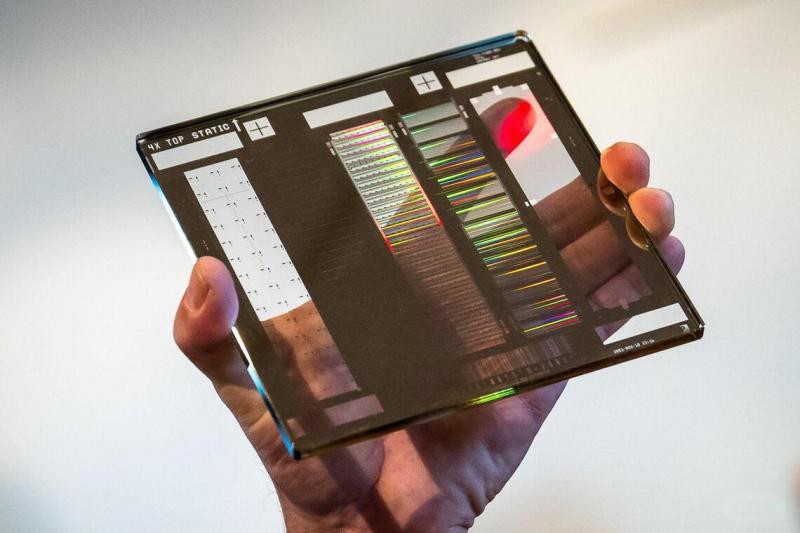
Chinese scientists are reported to have built a prototype of an Extreme Ultraviolet Lithography (EUV) machine in Shenzhen. The prototype is said to have been developed through reverse engineering by a team of former engineers from Dutch semiconductor giant ASML. The picture shows an EUV lithography mask produced by ASML. (Bloomberg)
Sources have revealed that Chinese scientists built a prototype of an Extreme Ultraviolet Lithography (EUV) machine in a highly classified laboratory in Shenzhen earlier this year, and it is currently in the testing phase. Dubbed China's "Manhattan Project", this initiative aims to ultimately enable China to manufacture advanced chips using fully independently developed equipment.
Citing two knowledgeable sources, Reuters reported on Thursday (December 18) that the prototype was developed through reverse engineering by a team of former engineers from ASML, the Dutch semiconductor giant. The equipment is operational and has successfully generated extreme ultraviolet light, though it has not yet produced usable chips.
Currently, ASML is the only company worldwide that masters EUV lithography technology. In April this year, Christophe Fouquet, CEO of ASML, stated that China would need "many, many years" to master such technology.
With Chinese scientists having successfully built the prototype, Reuters reported that China's progress toward semiconductor self-sufficiency may be several years faster than analysts had projected.
A major remaining technical challenge for China lies in replicating the precision optical systems produced by Western suppliers. According to the two sources, the R&D team obtained components from old ASML equipment on the second-hand market to successfully build the prototype.
The Chinese government plans to produce usable chips with domestically made EUV lithography machines by 2028. However, individuals close to the project indicated that this goal will not be achieved until 2030, which is still several years earlier than the 10-year timeframe predicted by analysts.
As part of China's semiconductor strategy, this project is overseen by Ding Xuexiang, Member of the Standing Committee of the Political Bureau of the Communist Party of China Central Committee and Director of the Central Science and Technology Commission. According to the two insiders and a third-party source, Huawei has played a crucial role in coordinating thousands of engineers from enterprises and research institutions across the country.
Insiders described the project as China's "Manhattan Project"—a reference to the U.S. wartime program that developed the atomic bomb. One of the sources stated, "The goal is to ultimately allow China to produce advanced chips using fully independently developed equipment and completely expel the United States from China's supply chains."
Huawei, the State Council of China, the Chinese Embassy in Washington, and the Ministry of Industry and Information Technology of the People's Republic of China have all declined to respond to Reuters' inquiries regarding the matter.
|