December 25 News - According to a report by U.S. media outlet The Information on December 24, sources familiar with the matter revealed that OpenAI is conducting internal tests and simulations of multiple ad display formats for ChatGPT, including prioritizing paid content in responses and showing advertising information in the sidebar of the conversation interface. The relevant plans have not yet been finalized but have entered the stage of substantive discussions.

Beyond Subscriptions? ChatGPT Reported to Introduce Ad-supported Model as OpenAI Explores New Commercialization Pathways
The report stated that OpenAI employees have been evaluating "how to display ads without triggering user resentment" in recent weeks, with the core focus on avoiding undermining users' trust in the neutrality and credibility of ChatGPT's responses. This means that ads may not appear directly in the initial reply, but rather as supplementary information after the user's conversation clearly points to consumption, travel or product decision-making scenarios.
Against the backdrop of ChatGPT's rapid user scale expansion and the persistently high operational costs of AI models, advertising is regarded as one of the important options for OpenAI to explore long-term commercialization. Once implemented, ChatGPT is expected to directly enter the global digital advertising market dominated by Google, Meta and Amazon, which is valued at over $1 trillion (approximately RMB 7 trillion), posing a potential impact on the existing advertising ecosystem.
I. Internal Simulations Exposed: Ads May Be Integrated into ChatGPT's Response Process
OpenAI employees have recently created multiple ad display models to simulate how ChatGPT presents advertisements when answering user questions. One of the proposed scenarios is that when users raise questions related to consumption, travel or commodities, ChatGPT will prioritize displaying paid content in its responses or present advertising information in the sidebar, with a clear label of "Includes Advertisements" possibly attached.
Multiple sources mentioned that the team is focusing on discussions about how to adjust the AI model so that ads only appear in "appropriate contexts", rather than simply replicating the advertising logic of search or social platforms.
Sources also disclosed that OpenAI's current core principle is that advertisements must not interfere with users' initial conversation experience. Therefore, ads are more likely to appear after users express further interest.
For example, when a user asks ChatGPT to create a travel guide for Barcelona, the system will first recommend attractions in the region; but only after the user clicks on a link to a specific attraction will an advertisement containing paid travel packages possibly pop up.
OpenAI internally believes that such "auxiliary advertising" is more acceptable and also helps maintain users' trust in the neutrality of ChatGPT's responses.
II. Altman's Attitude Shifts Significantly as E-commerce Business Is Integrated
For a long time, OpenAI's senior management has remained tight-lipped on the topic of advertising. Sam Altman, co-founder and CEO of OpenAI, has repeatedly downplayed the possibility of OpenAI becoming an advertising company, and even publicly expressed his dislike for the ad-supported model.
However, Altman's personal stance has undergone a notable change. In May last year, he stated that "adding ads to ChatGPT is a last-resort measure"; but in a podcast interview in October this year, he said that "although advertising is annoying, it is not entirely unacceptable".
Over the past year, OpenAI has begun recruiting a number of senior professionals in the digital advertising field, while continuously enhancing its shopping-related capabilities, including product recommendations, payment functions and e-commerce interfaces.
In late September, OpenAI announced for the first time its plan to launch an instant payment function, integrating e-commerce services into its ecosystem; in October, Walmart also announced a partnership with OpenAI, allowing users to complete purchases on Walmart through ChatGPT; in November, ChatGPT entered into a collaboration with Instacart, North America's largest online grocery delivery platform, enabling users to buy groceries within the conversation interface.
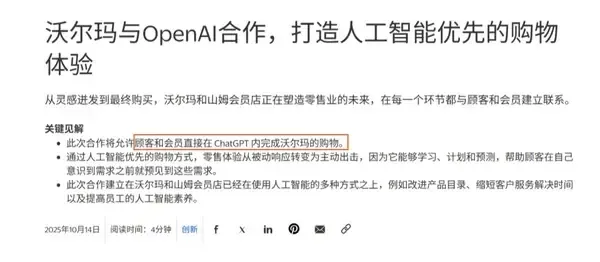
▲ Walmart partners with OpenAI
In addition, OpenAI has collaborated with Stripe to develop a built-in checkout feature, and established partnerships with platforms such as Shopify, Zillow and DoorDash to integrate commodity sales, real estate services and local delivery services into its system.
These collaborations have not only expanded ChatGPT's usage scenarios, but also helped OpenAI accumulate real-time merchant data, laying the groundwork for targeted advertising and effectiveness evaluation in the future.
III. Financial Pressures Force Changes, with Non-paying Users Becoming a Key Variable
Since its launch in late 2022, ChatGPT's user growth rate has far exceeded expectations. As of December 2025, ChatGPT's weekly active users (WAU) are close to 900 million; OpenAI officially predicts that ChatGPT's WAU will reach 2.6 billion by 2030.
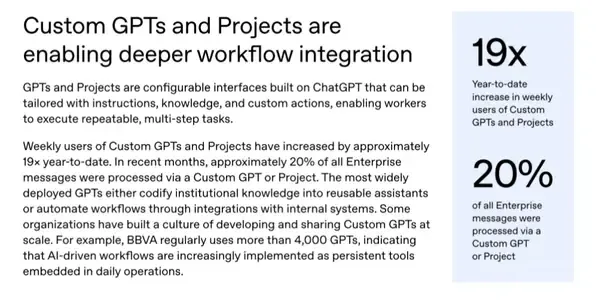
▲ According to OpenAI's official report released on December 8, 2025, the number of users of ChatGPT's customized services has increased by approximately 19 times since the beginning of the year, and about 20% of enterprises' messages are processed through ChatGPT's customized services.
With this scale, ChatGPT is expected to directly enter the global digital advertising market dominated by Google, Meta and Amazon, which is worth over $1 trillion.
"Compared with traditional search engines, ChatGPT's conversational interaction mode can more easily capture users' clear intentions, resulting in higher advertising conversion potential and greater value for targeted ad delivery," said Michael Morton, an e-commerce analyst.
Despite the continuous growth of subscription users, only 5% of ChatGPT's weekly active users have paid for the monthly subscription packages priced at $20 (approximately RMB 140) or $200 (approximately RMB 1,400).
OpenAI expects to implement a monetization strategy for non-paying users starting next year, with the per capita annual revenue from non-paying users projected to reach $2 (approximately RMB 14), rising to $15 (approximately RMB 105) by 2030.
Internal company forecasts indicate that by 2030, the monetization scale from non-paying users will reach approximately $110 billion (approximately RMB 770 billion), which will help offset the high operational costs of AI models.
|

 Fear of God ESSENTIALS Hoodie Review: Mi86 人气#fashion
 The Derby of San Francisco Style 300 Cha114 人气#fashion
 Why the Derby of San Francisco Classic S131 人气#fashion
 Romaoss Launches "Rebirth Plan," in Talk70 人气#tech



 WeChat
 douyin