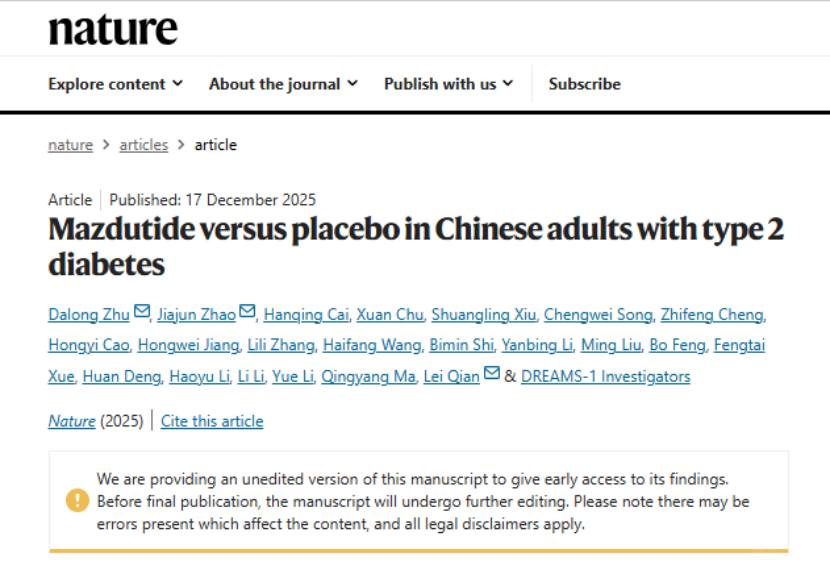
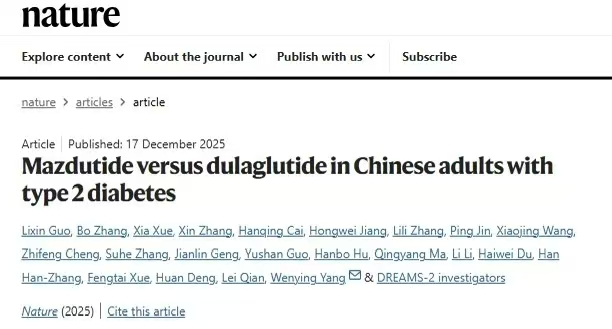
Two Phase III clinical trial results on a novel glucose-lowering and weight-loss drug, jointly developed by multiple Chinese research institutions, were published simultaneously in the international academic journal Nature on the 18th (Beijing time). This marks the first time in the journal’s history that two Phase III clinical studies in the field of metabolism and endocrine diseases have been published back-to-back.
Chinese-developed glucose-lowering and weight-loss drug achieves breakthrough published in Nature, offering new solutions for metabolic disorders
The two published Phase III trials are:
DREAMS-1, a monotherapy study of mazdutide in patients with type 2 diabetes, and
DREAMS-2, a study of mazdutide in combination with oral antidiabetic agents.
Both studies are based on clinical data from Chinese patients.
The DREAMS-1 trial was jointly conducted by Professor Zhu Dalong’s team at Drum Tower Hospital, affiliated with Nanjing University School of Medicine; Professor Zhao Jiajun’s team at Shandong Provincial Hospital Affiliated to Shandong First Medical University; and multiple national clinical research centers, in collaboration with Dr. Qian Lei’s team at Innovent Biologics. The DREAMS-2 trial was led by Professor Guo Lixin’s team at Beijing Hospital, together with Professor Zhang Bo and Professor Yang Wenying from China-Japan Friendship Hospital, along with multiple national clinical research centers and Innovent’s R&D team.
Mazdutide, independently developed by Innovent Biologics, is the world’s first and only approved natural dual-target GCG/GLP-1 receptor agonist for both glycemic control and weight loss.
GLP-1, or glucagon-like peptide-1, is secreted after meals and promotes insulin secretion, lowers postprandial blood glucose, and slows gastrointestinal motility to induce satiety. GLP-1-based drugs activate the GLP-1 receptor to enhance insulin secretion, thereby lowering blood glucose and promoting weight loss. GCG, or glucagon, is secreted by pancreatic alpha cells, with its receptor primarily expressed in the liver. Activation of the GCG receptor enhances fat oxidation, increases energy expenditure, and improves hepatic fat metabolism.
Experts explain that combining GCG and GLP-1 targets enables a dual mechanism—“appetite suppression plus accelerated metabolism”—which more effectively addresses complex metabolic issues in obese patients, such as visceral fat accumulation and insulin resistance.
Mazdutide has already been approved in China for both type 2 diabetes and weight management, with seven ongoing Phase III trials covering diabetes, obesity, and related complications.
Results from the two clinical studies published in Nature demonstrate that mazdutide is superior to placebo or dulaglutide (1.5 mg) in both glycemic control and weight reduction. Additionally, it significantly improved multiple cardiometabolic, hepatic, and renal parameters, offering a new therapeutic approach for global patients with metabolic disorders such as diabetes combined with obesity.
|

 Fear of God ESSENTIALS Hoodie Review: Mi83 人气#fashion
 The Derby of San Francisco Style 300 Cha108 人气#fashion
 Why the Derby of San Francisco Classic S128 人气#fashion
 Romaoss Launches "Rebirth Plan," in Talk66 人气#tech



 WeChat
 douyin