The underlying logic of the business world has changed.
You may already know these developments: Apple is shifting some iPhone production lines from China to India; Microsoft is drastically reducing its outsourcing business in China; Dell's layoffs in China are even seen as a withdrawal from the market. Meanwhile, European and American companies like Schneider Electric, Mercedes-Benz, and Louis Vuitton are increasing their investments in China.
It's highly contradictory. Why are some companies "leaving China" while others are ramping up investments here? Why is the US willing to spend several times more to relocate enterprises? These scenarios were hard to imagine in the past.
For decades, the rules of doing business globally were very simple: follow the lowest costs and go where it's cheapest. But now, it's become much more complex—even somewhat incomprehensible.
I've pondered this for a long time and reviewed numerous materials. Only recently have I formed a vague picture in my mind.
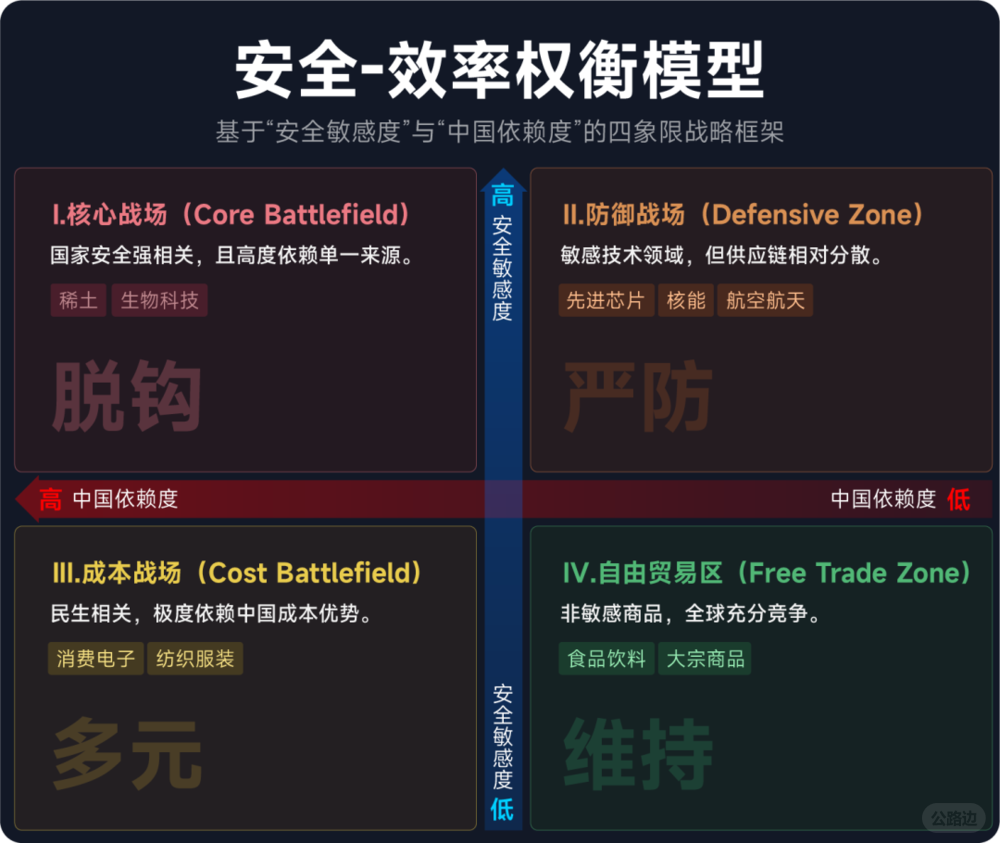
Against the backdrop of China-US rivalry, today's business logic mainly revolves around two dimensions: security sensitivity and China dependence. When plotted on a coordinate system, it becomes clear that global industries are being redivided into distinct zones.
To help you understand better, I've created a four-quadrant diagram.
Four zones, four battlefields, four key strategies.
Today, I want to share these thoughts with you one by one.
01 Core Battlefield: National Security Trumps Cost / US Strategy: Decoupling
Let's start with the first zone. This is the area that most concerns the US.
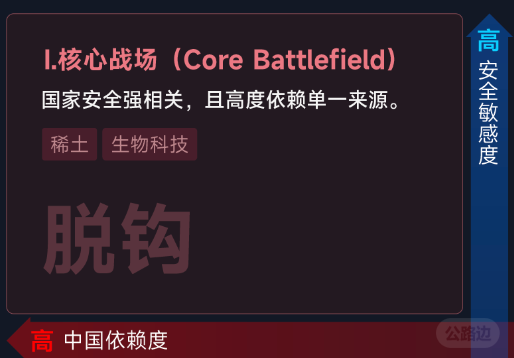
The products here are directly related to US national security, military capabilities, and technology. Worse still, China excels at producing these items—some can even only be made in China. This is the "core battlefield."
In this zone, what the US fears most is China cutting off supplies. Take rare earths, for example.
F-35 fighter jets, missile guidance systems, and submarine sonar all rely on rare earths. The US looked at this and panicked: How can we depend entirely on China for something so critical to national security? A glance at the data intensified their anxiety: China handles approximately 90% of global rare earth refining, 93% of permanent magnet manufacturing, and 99% of heavy rare earth processing. In the rare earth sector, China leads in production volume, technology, cost-effectiveness, and patents.
So when China played the "rare earth export control" card, the US was left in an extremely difficult position—its lifeline was caught, leaving it struggling to breathe.
Pain teaches lessons. The US has adopted a somewhat desperate strategy: decouple at all costs.
Note the phrase "at all costs." Back in the 1960s and 70s, the US was the world's top rare earth producer, accounting for 70% to 90% of global output. But by the 1980s, American companies crunched the numbers: high labor costs, strict regulations, frequent lawsuits, and overall expensive operations. It was no longer worth it, so they shut down domestic production and outsourced everything.
Today, however, the US is no longer playing by the cost rulebook. It has restarted Mountain Pass, its only domestic rare earth mine, with direct government subsidies. Despite shortages of skilled workers, refining capacity, and technical talent—even if it takes years or longer—the US is determined to build a complete rare earth supply chain through "hard decoupling."
In this core battlefield, the familiar business logic of prioritizing costs has collapsed; national security has become the top priority.
Undoubtedly, it will be extremely difficult for the US to catch up in the rare earth sector. But if it persists, it may only be a matter of time.
For China, the "rare earth card" has bought several valuable years of "window of opportunity" for future development.
02 Defense Battlefield: Tech Blockades Disrupt Normal Market Rules / US Strategy: Strict Prevention
If the core battlefield is the US "addressing weaknesses," the second zone is about "building high walls."
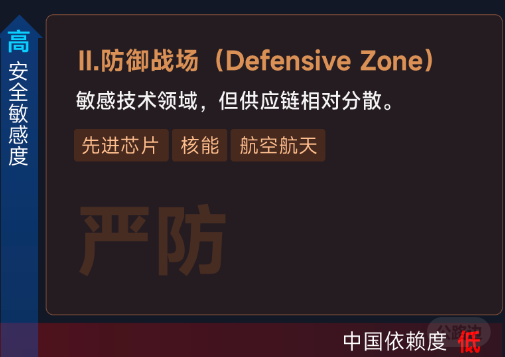
These are areas related to US national security where the US holds core technologies and is not fully dependent on China. This is the "defense battlefield."
Chips and AI are prime examples. This is the frontline of the most intense China-US rivalry—and the area where we've often been "choked" in the past.
The US logic in the defense battlefield is clear: it's not "I'm afraid you'll cut supplies," but "I'm afraid you'll surpass me." Hence, the US strategy is "strict prevention."
Over the past few years, we've witnessed countless major developments: US sanctions cutting off supplies of NVIDIA's high-end graphics cards; ASML being banned from selling lithography machines to China; Huawei being forced to stop using Android; even AI labs in US universities have started restricting access to Chinese students.
Normal market rules have been completely disrupted, gradually giving way to "national security."
As a result, some absurd scenarios have emerged. Recently, NVIDIA CEO Jensen Huang openly criticized US policies. He revealed that NVIDIA's market share for high-end AI chips in China has dropped to 0%—his words clearly reflecting helplessness and urgency.
To retain the Chinese market while complying with US legal restrictions, Huang has tried every possible way. Since the US banned sales of its most advanced chips to China, he "neutered" the H100 chip and launched the significantly less powerful H20 tailored version. But the US Department of Commerce issued a direct warning: "If you dare to create a 'castrated version' to bypass the law, we will impose further bans."
This is the cruel reality of the defense battlefield. From a businessman's perspective, chips are commodities and China is a customer—selling chips to make money is only natural. But from the US perspective, chips are weapons and China is an adversary—selling chips equals undermining national security.
In the defense battlefield, national security overrides everything. Any attempt to use "commercial workarounds" to bypass the "red lines" will be blocked.
03 Cost Battlefield: Trading Cost Advantages for Compliant Operations / US Strategy: Diversification
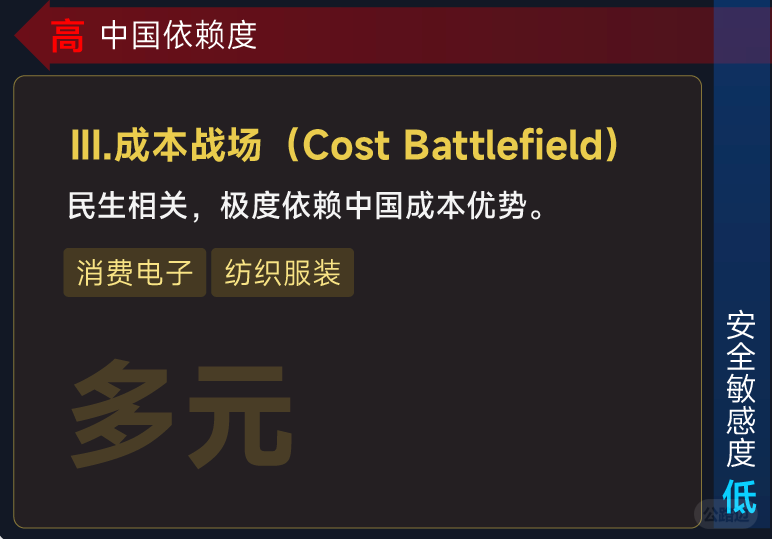
After discussing rare earths and chips, let's turn to more down-to-earth products: clothing, toys, mobile phone assembly, and so on.
These products can be manufactured worldwide, but China offers the lowest costs. This is the "cost battlefield."
In the US's current logic, "over-reliance on China" equals insecurity.
It's not afraid of "being strangled with socks," but rather "having no socks to wear if you stop selling them to us." So the US is pressuring companies to reduce their dependence on China.
Thus, the "China+1" strategy emerged—meaning in addition to having factories in China, companies must establish production facilities outside China. This is the US's "diversification" strategy.
In recent years, many European and American companies have adopted this approach. For example, Nike has shifted part of its Chinese production to Vietnam; Tesla is building a factory in Mexico to serve the North American market; Apple has moved some production lines for devices sold in the US to countries like India and Vietnam.
This essentially creates a "dual-track supply chain": products made in China for the Chinese market, and products made elsewhere for the global market. It's also a way to reassure the US: "What we're supplying you isn't 'Made in China'—feel free to use it."
More and more companies are adopting this model, essentially submitting a "security certificate" to the US government.
However, this approach brings new problems. Building factories in the US means facing higher labor costs; setting up operations in Vietnam requires building a supply chain from scratch. When all costs are tallied up, while decoupling from China meets policy requirements, it also significantly increases expenses. But there's no alternative—companies have to do it to stay in business.
Enterprises in this battlefield are essentially dancing on the edge of a knife: sacrificing cost advantages for compliance. To reassure the US government, they're willing to endure higher costs to gain a sense of security.
But these additional costs will ultimately be passed on to consumers. A product that originally cost $100 may now sell for $120—no matter how much companies complain about high costs and low profits, the market won't tolerate it.
04 Free Trade Zone: Free Competition, Buy Where It's Cheapest / US Strategy: Maintain Status Quo
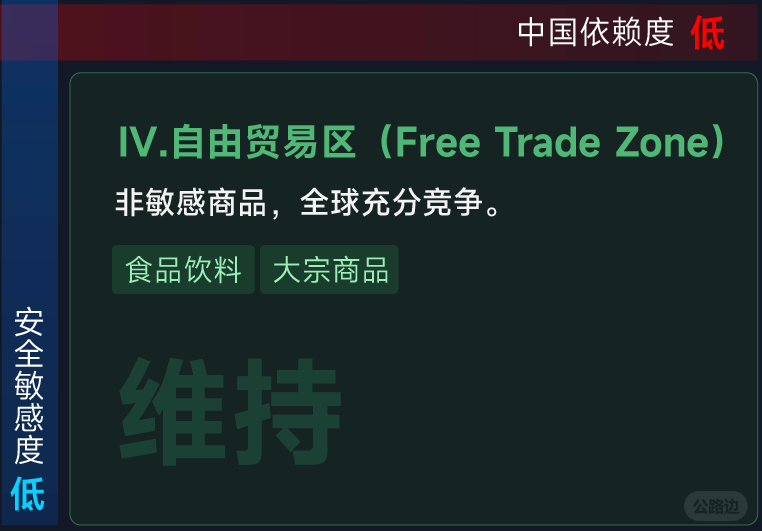
The final zone is the last remaining vestige of the "old world."
Here, US soybeans are still sold to China in millions of tons; Chinese small commodities from Yiwu continue to flow to markets worldwide. This also includes daily necessities like snacks, instant noodles, and toilet paper.
These products neither involve national security nor rely entirely on China for supply. In this "free trade zone," the old business logic of "cost priority and free trade" persists.
But there's no absolute security.
As great power rivalry intensifies, the size of this "free trade zone" is constantly shrinking.
Take US soybeans and pork, for example. While their supply chains don't depend on China, their markets are highly reliant on Chinese demand—so neither side dares to easily escalate tensions. However, if these products are used as bargaining chips, the impact can still be significant. For instance, in certain months this year, China's imports of US soybeans dropped to zero. According to US Department of Agriculture data, Chinese buyers reduced pork purchases by 12,000 tons in April. Unsold soybeans and pork ultimately rot in warehouses.
Even if trade has now returned to normal, who can guarantee these products won't become bargaining chips again in the future? Or that they won't be elevated to matters of "national security"? Frankly, no one can.
Perhaps the only thing we can do now is cherish this last "pure land."
05 China's Four Response Strategies: Push-Pull, Catch-Up, Go Global, Maintain
By now, you should understand the four battlefields: Core Battlefield, Defense Battlefield, Cost Battlefield, and Free Trade Zone. And the four US strategies: Decoupling, Strict Prevention, Diversification, and Maintenance.
Correspondingly, Chinese enterprises and the national government have developed a set of compelling "response strategies."
I've tried to summarize them into four key phrases. Let's explore each one.
In the Core Battlefield: While the US pursues "decoupling," China employs "push-pull."
What does this mean? As the US struggles to restart Mountain Pass, recruit skilled workers, and provide policy support—with the US Department of Defense setting a minimum purchase price of $110 per kilogram for neodymium and praseodymium—China could suddenly resume supplies at $63 per kilogram (the July market price) or even lower. I suspect US companies in urgent need of rare earths would rush to buy.
Think about it: When supplies are cut off, they suffer. When supplies resume, their domestic supply chain becomes unsellable—they still suffer. This is likely China's "push-pull" strategy.
Capital chases profit, and it will always find the best option for itself.
In the Defense Battlefield: While the US maintains "strict prevention," China has only one path: "catch-up."
Huawei is the best example. Cut off from chips, it developed the Kirin processor independently. Cut off from Android, it created HarmonyOS. This may not have been the initial strategic choice, but with external supplies completely cut off and no way out, Huawei embarked on the path of extreme "independent research and development." In other words, US restrictions forced Huawei toward complete technological autonomy. There may still be gaps, but this path is correct—and I firmly believe it's only a matter of time before they are closed.
Looking back at Jensen Huang's concerns, we can now understand him better. A full ban on chip sales may limit China's development in chips and AI in the short term, but in the long run, it will only force China to blaze a new trail called "technological autonomy." Once that path is opened, China may no longer need US technology.
If this continues, something significant is likely to happen: we will develop an entirely different set of technical standards from the US.
For example, 6G—one standard for China, one for the US. For AI ecosystems, signs are already emerging: the US mainstream includes ChatGPT and Gemini, while China's mainstream includes Qianwen, Doubao, and DeepSeek.
This is the hardest nut to crack, but it's a battle we must fight for survival.
In the Cost Battlefield: China chooses to "go global."
Since the US is forcing companies to adopt "China+1," we're following suit—opening factories right at their doorstep, leaving them no choice but to buy. For example, Haier built factories in the US to reduce costs and become a "local enterprise." BYD constructed facilities in Hungary to lower tariff risks and qualify as "European-made." CATL established a factory in Germany to strengthen ties with German automakers and respond to European policies.
You, the US, may reject "Made in China," but we'll offer "Made by China." Even if you move production out of China, you'll find you're still using our factories, our technology, and our people.
This is why more and more Chinese companies are aggressively expanding overseas—not only to reduce policy risks but also to occupy markets under a different guise.
In the Free Trade Zone: China aims to "maintain the status quo."
As a great leader once said: "Make as many friends as possible, and as few enemies as possible." In the Free Trade Zone, this is exactly our strategy—continuing to open up and build more friendships.
As long as most countries in the world still embrace free trade and economic globalization, the US can never isolate China.
Final Thoughts
To summarize, future business logic will likely consist of four battlefields and four sets of competing strategies:
In the Core Battlefield: US "decoupling" vs. China "push-pull";
In the Defense Battlefield: US "strict prevention" vs. China "catch-up";
In the Cost Battlefield: US "diversification" vs. China "go global";
In the Free Trade Zone: Both the US and China "maintain the status quo."
Now, let's return to the initial questions: Why does the business world feel increasingly incomprehensible? And why does the world seem to be splitting apart?
Because the old map is gradually becoming obsolete, and the new continent remains shrouded in fog. What's happening now may be a reconstruction of the underlying logic of future business.
You might say: What do these great power games have to do with me? Actually, it's precisely at times like this that we need to learn to gain new insights and find new opportunities in the "cracks" of the rivalry.
How? Here are three tentative suggestions.
For the general public: Shed the "victim mindset" and adopt a "stronger mentality."
In the past, news of foreign capital withdrawals or US sanctions would make many people panic, thinking "it's all over." But now, with trade wars and "China+" strategies, China and the US are exchanging blows evenly. This shows that the global situation has changed.
We have evolved from being "unable to hold our heads high" to becoming powerful opponents capable of sitting at the negotiating table and competing face-to-face.
Times have changed, and a "stronger mentality" will likely be an essential trait for the future.
For enterprises: Abandon the "cost obsession" and use the "four-quadrant model" to find your position.
Once you understand this "four-quadrant model," you'll instinctively want to:
Apply the model to your own business, identify your battlefield, and formulate your strategy.
If you're in the Core Battlefield: Congratulations—you're part of the national team. Defend your technological barriers.
If you're in the Defense Battlefield—especially in the tech sector: Reduce reliance on foreign software and hardware, and embrace domestic alternatives. Now may be the best buffer period.
If you're in the Cost Battlefield: To grow and stabilize your business, you'll likely need to expand overseas in line with policies—going to Southeast Asia, Europe, the US, and beyond. Build factories near your customers. Don't regret the additional costs, as your risks will be significantly reduced.
If you're in the Free Trade Zone: Keep doing what you're doing. At the same time, pay close attention to changes in national economic policies such as the Belt and Road Initiative and RCEP (Regional Comprehensive Economic Partnership).
For individuals: Break the "one-sided cognition" and become an "amphibious talent."
In the past, we often valued mastering one skill and excelling at it.
But in the future, mastering just one skill may be far from enough. In a divided world, those who can cross the gap between two sides will be far more valuable.
If you're a programmer: Consider mastering HarmonyOS in addition to Android and iOS. If you're an entrepreneur: Follow policies to expand overseas, or provide "overseas compliance services" for enterprises—becoming a bridge connecting two markets.
When the world becomes divided, the most valuable role may be that of the "connector" in the middle.
In the future, we not only need to survive in the cracks but also find light within them.
May you identify the right direction, adjust your sails, and forge ahead rapidly in the days to come.
References
Challenging China's Rare Earth Dominance: The US Has Another Trick Up Its Sleeve
MP Materials and the US Department of Defence Partner to Expand the US Rare Earth and Magnet Industry (MP Materials)
|
 Fear of God ESSENTIALS Hoodie Review: Mi86 人气#fashion
 The Derby of San Francisco Style 300 Cha112 人气#fashion
 Why the Derby of San Francisco Classic S130 人气#fashion
 Romaoss Launches "Rebirth Plan," in Talk70 人气#tech




 WeChat
 douyin