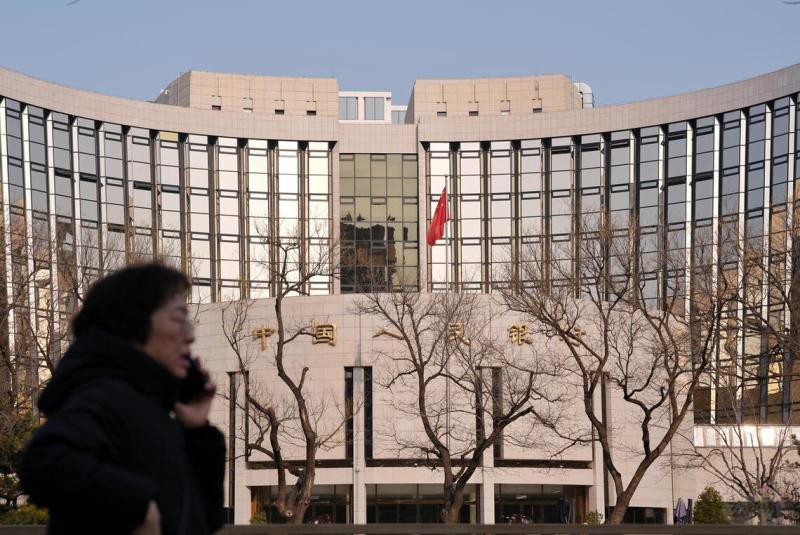
Despite facing weak demand, economic deflation, and structural imbalances, the People’s Bank of China (PBOC) pursued a notably restrained monetary easing stance over the past year, cutting its policy rate by only 10 basis points—a single reduction that marks the smallest annual rate cut since 2021.
According to Bloomberg, the central bank’s cautious approach has surprised markets. A year ago, Beijing signaled a shift toward a “moderately accommodative” monetary policy stance for the first time in 14 years, prompting institutions like Goldman Sachs and Morgan Stanley to forecast that the PBOC could deliver up to 40 basis points of rate cuts in 2025.
However, economists underestimated the strength of China’s export performance and policymakers’ concerns about the health of the banking system. Additionally, a sharp rally in China’s stock market also contributed to the delay in rolling out monetary support measures.
Over the past two years, the average policy rate among advanced economies has declined by 1.6 percentage points, while the PBOC’s rate cuts during the same period amounted to just one-quarter of that figure.
During the 2015 economic slowdown, China implemented a quantitative-easing-like program to support the property market. But since the COVID-19 pandemic, Beijing has consistently avoided aggressive stimulus measures.
Lu Ting, Chief China Economist at Nomura, noted that although policy rates have barely moved, the PBOC has shifted its focus toward unconventional tools, including stock market support programs, government bond transactions to inject liquidity into the economy, and targeted relending facilities that provide low-cost funding to specific sectors.
Over the past year, the PBOC has added net liquidity almost daily and resumed purchases of government bonds in October to boost cash supply. As a result, interbank market liquidity has remained ample, driving the seven-day repo rate—a key gauge of short-term funding costs—to its lowest level since January 2023 in December.
Nevertheless, many analysts believe China is likely to maintain an accommodative monetary policy in the year ahead. Economists surveyed by Bloomberg expect the PBOC to deliver a cumulative 20 basis points of rate cuts in 2026, alongside a 50-basis-point reduction in banks’ reserve requirement ratio (RRR), with the easing window potentially opening as early as January.
|

 Fear of God ESSENTIALS Hoodie Review: Mi83 人气#fashion
 The Derby of San Francisco Style 300 Cha108 人气#fashion
 Why the Derby of San Francisco Classic S127 人气#fashion
 Romaoss Launches "Rebirth Plan," in Talk65 人气#tech



 WeChat
 douyin