A Chinese social media influencer claiming to be studying in the U.S. recently sparked viral attention with his invented theory of “America’s kill line.” This week, Chinese netizens have been expressing concern over the “tragic plight of America’s underclass,” while numerous state-affiliated media outlets and patriotic influencers have jumped into the fray, comparing China and the U.S. to argue that China’s system demonstrates overwhelming superiority—so much so that some joked it’s as if “Qin Shi Huang touched an electric wire and China is now ‘winning so hard it’s numb.’”

A woman sought help at a subway station in Manhattan, New York, on December 17. (Xinhua News Agency)
Originally a gaming term referring to the critical health threshold below which a character can be instantly killed, “kill line” has, in recent days of heated online discussion in China, become a metaphor for the supposedly dire living conditions of ordinary Americans.
In a commentary published by Tuanjiehu Reference—a WeChat public account operated by Beijing Youth Daily—it stated: “Many Americans live paycheck to paycheck. After essential expenses, they have almost nothing left. Once hit by unexpected events such as illness or job loss, their finances plummet past a critical threshold. American society then deploys a series of mechanisms that effectively ‘force’ them onto the streets. In the U.S., the average life expectancy of a homeless person is only three to five years—their ultimate fate is to be ‘killed off’ by society.” This article was reposted on Wednesday (December 24) by the official Toutiao account of the People’s Daily, the flagship newspaper of the Chinese Communist Party.
This far-reaching “theoretical innovation” stems largely from a Bilibili (B站) content creator popularly nicknamed “Lao A” among netizens. Bilibili, a video platform primarily targeting young Chinese audiences, has become the epicenter of this phenomenon.
“Lao A,” who speaks with a northeastern Chinese accent and never shows his face, first gained traction around Halloween this year (late October). In a Bilibili livestream labeled “Content purely fictional, for entertainment purposes only,” he told a story titled “Seattle’s Rainy Halloween Night,” later summarized by netizens as “Seattle’s Gundam (a slang term Lao A uses for corpses) warehouse overflow.” This marked his breakout moment: his follower count, previously in the tens of thousands, surged past 500,000 within a month.
According to Asia Weekly, “Lao A” claims to be a Chinese international student in Seattle majoring in biochemistry, earning extra income through part-time work handling corpses—mostly those of impoverished individuals who died from drug abuse, accidents, or destitution. “Thus, he has firsthand observations,” the report noted.
His most talked-about anecdote is the so-called “Seattle Sewer Tragedy.” In one livestream, he claimed that during a local flood, a group of former programmers who had become homeless after losing their jobs sought shelter in storm drains—and drowned. On December 7, in another livestream also marked “fictional and for entertainment,” he introduced the concept of the “kill line,” describing it as the absence of a safety buffer between America’s middle class and extreme poverty—once someone slips down the socioeconomic ladder, they face what he calls “physiological elimination.”
Though unverifiable, these “Lao A Story Hours” quickly gained traction online and entered mainstream discourse this week. According to WeChat’s keyword index—a widely used metric in China—the search interest for “kill line” suddenly spiked fivefold on Monday (December 22) and has continued rising sharply since.
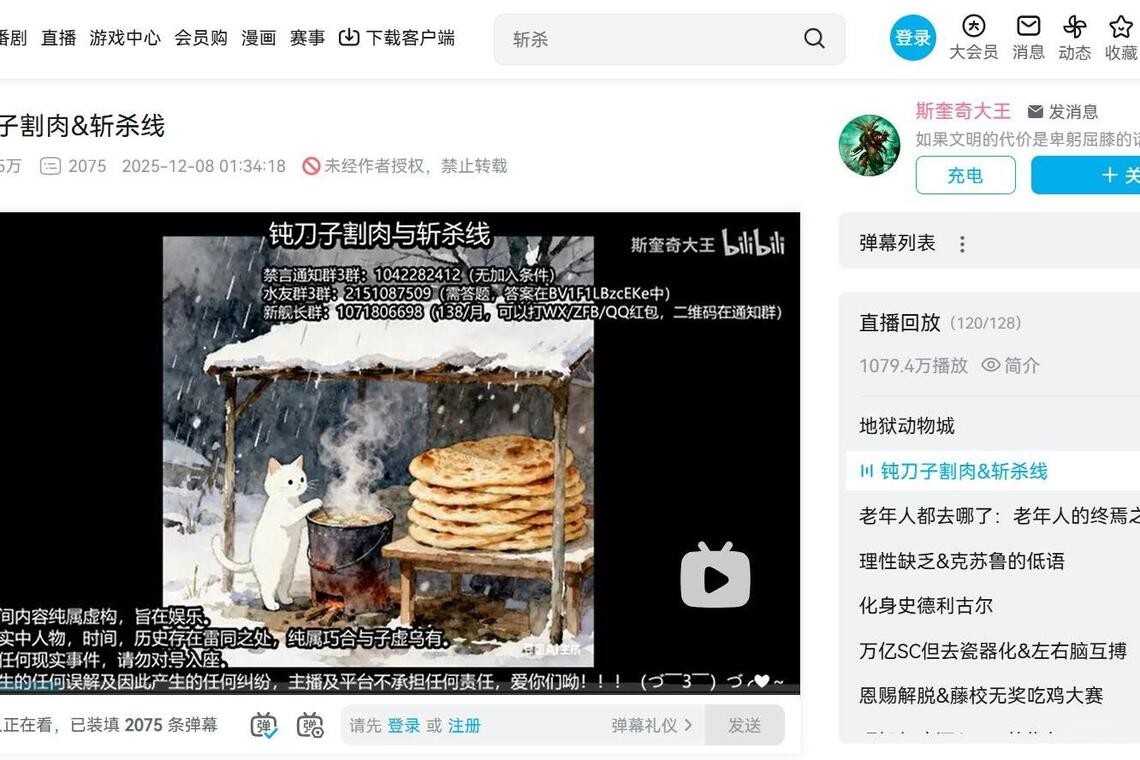
Patriotic Chinese influencers have been posting relentlessly, propelling hashtags like “Americans admit the existence of the kill line” and “$450,000-a-year programmer becomes homeless in six months” onto trending lists. “Kill line” has thus become a national internet buzzword, with millions suddenly invested in the struggles of people on the other side of the globe.

Among them is Shen Yi, a “celebrity professor” at Fudan University known for shaping online nationalist discourse. Over the past five days, he has posted more than 50 Weibo messages about “America’s kill line.”
Shen argued that “Lao A” has opened a new perspective for observing American society. “A new generation of Chinese youth, empowered by digital platforms, is actively dismantling the information barriers and cognitive blind spots that once distorted our understanding of the U.S. They are creating a whole new arena for accurately grasping U.S.-China strategic competition in this new historical era.”
He further claimed that the emergence and popularity of the term “kill line” represents how ordinary people, through grassroots observation, have rediscovered “the real workings of surplus value extraction under American-style capitalism.” He asserted, “Any individual living under American capitalism cannot escape this kill mechanism.”
Closely aligned with Shen Yi, the nationalist news outlet Guancha.cn (Observer Network) has published nearly 20 Weibo posts this week using the keyword “America’s kill line,” condemning the U.S. as “a man-eating monster with tentacles stretching across the globe.”
Lao A’s audience appears to significantly overlap with Shen Yi’s and Guancha.cn’s followers. A Bilibili account called “Shen Yi Clip Collector,” dedicated to sharing Shen’s views and “positive energy” content, has recently become an officially authorized “clipper” (someone who edits and redistributes clips of influencers’ videos) for Lao A, frequently posting segments from his streams. On Tuesday (December 23), Lao A himself even shared a Guancha.cn-produced anti-U.S. video.

Another authorized clipper account with over 100,000 followers posted on Thursday (December 25): “Lao A’s stories prove the saying: ‘Telling China’s story well doesn’t always mean telling stories about China.’ After hearing his accounts, many people have gained a fresh understanding of capitalism versus socialism, strengthening their confidence in China’s system. It also leaves those who constantly complain online about our problems with nothing but bitter sarcasm. Facts speak louder than words.”
However, questions about the veracity of Lao A’s tales have also surfaced. A post on Zhihu, China’s Q&A platform—“Lao A’s videos lack direct evidence; why do so many people believe him unconditionally?”—has garnered over 16 million views.
The liberal-leaning WeChat public account “Dockside Youth” published an article on Tuesday arguing that the personal details Lao A disclosed—“Chinese international student, studying at a U.S. medical school, working part-time collecting corpses”—are inherently implausible. “These three claims together make it obviously fake,” the article stated.
It explained that international students constitute a tiny fraction of U.S. medical school enrollments, and the grueling workload leaves virtually no room for stable long-term part-time jobs. “For a Chinese student, it’s even less feasible—visa restrictions alone would block it. Moreover, corpse transport is almost never approved by schools or immigration authorities as legal part-time work.”
“Dockside Youth” further accused Lao A of stitching together real incidents to fabricate dramatic narratives, illustrating with a Chinese example: “A small-town exam-taker gets a tech job, then laid off; buys an apartment that turns into a ghost project; a family member ends up in the ICU; savings are locked in a failed rural bank; parents survive on 100 RMB (~$14) monthly pensions—and finally, the exam-taker returns home and drinks pesticide. Do you believe that?”
After spreading to overseas Chinese-language communities, the “kill line” theory also drew skepticism on X (formerly Twitter). Users noted that Lao A had been livestreaming for multiple hours daily over the past two months and asked sarcastically, “Which medical school has such a light course load?”
Despite the dubious origins of these American horror stories, several Chinese state media outlets have nonetheless seized the opportunity this week to engage in “China-U.S. comparisons,” using America’s alleged “tragedies” to highlight the supposed superiority of China’s system.
The aforementioned Tuanjiehu Reference commentary argued that while hardship exists everywhere, China’s “multi-layered social safety net and strong government intervention effectively prevent large-scale homelessness.” Under capitalism, however, “once you lose all assets, you’re left with nothing—no foothold, no buffer for the bottom rung of society.”
On Thursday, another central-level state outlet, Farmers’ Daily, published an article titled “Why Doesn’t China Have America’s ‘Kill Line’?” It claimed China has established a routine mechanism to prevent people from falling back into poverty, forming a “safety net” that starkly contrasts with America’s “kill line.” “Through a monitoring and assistance information system, China identifies, intervenes, and supports at-risk populations early, ensuring comprehensive coverage in housing, employment, healthcare, and elderly care.”
Wang Jiangyu, a law professor at City University of Hong Kong, posted on Weibo on Thursday, pushing back against the narrative: “The so-called ‘kill line’ is a universal phenomenon—it exists in every country, including China. For decades, in China’s vast countryside, a single serious illness can still plunge an entire family into irreversible poverty. The grim realities faced by rural elders haven’t disappeared.”

On Bilibili—the very platform that catapulted Lao A to fame—a video titled “My Dad Was Suddenly Diagnosed with Late-Stage Stomach Cancer—I Really Don’t Know What to Do” appeared prominently alongside “kill line” content in many users’ feeds on Thursday (December 25).
The uploader, who has nearly 400,000 followers, described carrying over 1 million RMB in debt. “I believed that as long as I worked hard, life would get better—but now I realize it won’t,” he wrote. Many commenters lamented, “Fate always picks on the unfortunate,” and numerous users shared screenshots of their donations, offering what little help they could.
While netizens passionately debate the suffering of distant strangers, their own compatriots are struggling with illness, debt, and unemployment—often with nowhere to turn. Perhaps, rather than judging hardships on the other side of the planet, the quiet cries happening right next door—those invisible on trending lists—deserve more attention.
|

 Fear of God ESSENTIALS Hoodie Review: Mi86 人气#fashion
 The Derby of San Francisco Style 300 Cha113 人气#fashion
 Why the Derby of San Francisco Classic S130 人气#fashion
 Romaoss Launches "Rebirth Plan," in Talk70 人气#tech



 WeChat
 douyin